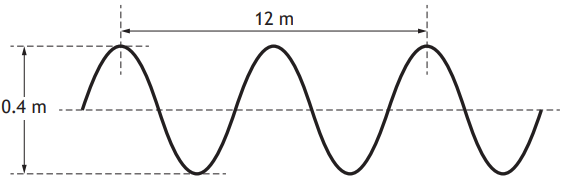
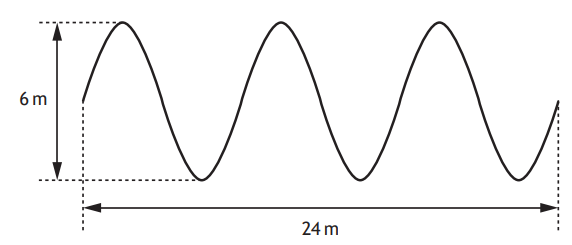
The diagram represents a wave.

The speed of the wave is 3.0 m s−1.
Which row in the table shows the amplitude and frequency of this wave?
Amplitude (m) | Frequency (Hz) | |
A | 0.2 | 0.25 |
B | 0.2 | 0.50 |
C | 0.2 | 2.0 |
D | 0.4 | 0.50 |
E | 0.4 | 2.0 |
Did this page help you?
Exam code: X857 75
The diagram represents a wave.

The speed of the wave is 3.0 m s−1.
Which row in the table shows the amplitude and frequency of this wave?
Amplitude (m) | Frequency (Hz) | |
A | 0.2 | 0.25 |
B | 0.2 | 0.50 |
C | 0.2 | 2.0 |
D | 0.4 | 0.50 |
E | 0.4 | 2.0 |
Choose your answer
Did this page help you?
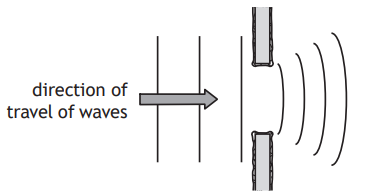
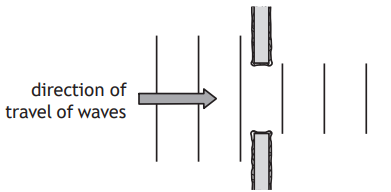
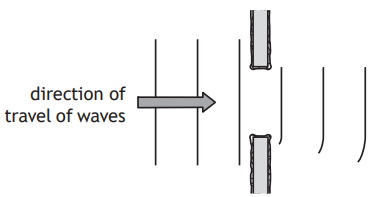
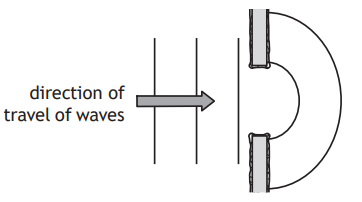
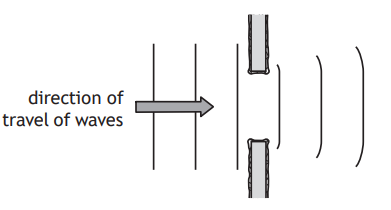
Which diagram shows the diffraction of water waves as they pass through a gap in a barrier?


Choose your answer
Did this page help you?
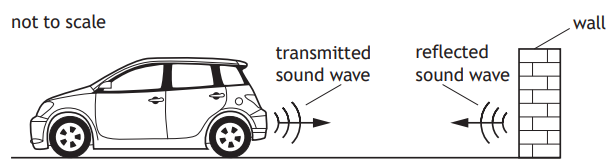
Some cars have parking sensors that emit pulses of ultrasound.
Ultrasound is high frequency sound waves. The emitted sound waves reflect from objects and are detected by sensors on the car.
During testing, a stationary car emits a sound wave with a frequency of 48 000 Hz.
The wave reflects from a wall and is detected by the sensors on the car.

The time taken between the sound wave being emitted and detected by the car is 0.015 s.
Determine the distance between the car and the wall.
How did you do?
The system in the car is now adjusted to emit sound waves with a different frequency.
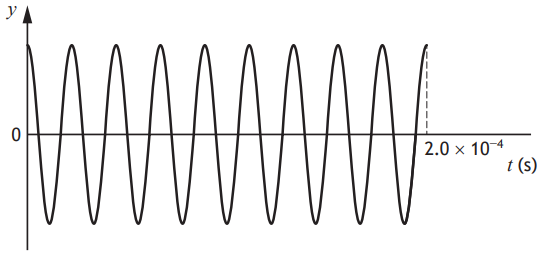
An oscilloscope connected to the system displays the following trace for the sound waves emitted by the car.

(i) Show that the frequency of this sound wave is 45 000 Hz.
[2]
(ii) Explain why the time taken between this sound wave being emitted and detected is also 0.015 s.
[1]
How did you do?
Did this page help you?
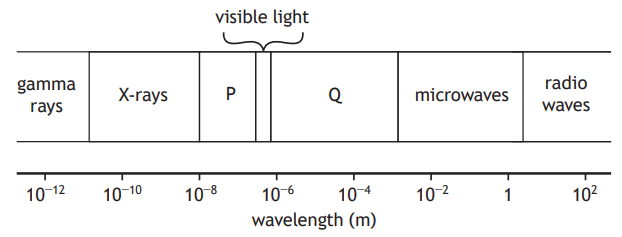
The diagram shows the electromagnetic spectrum in order of increasing wavelength.

State which part of the electromagnetic spectrum experiences the greatest amount of diffraction.
Justify your answer.
How did you do?
Electromagnetic radiation has many applications in everyday life.
Wireless headphones receive electromagnetic waves with a frequency of 2.42 GHz from an audio device.

(i) Show that the wavelength of these waves is 0.12 m.
[2]
(ii) Identify the part of the electromagnetic spectrum that these waves belong to.
[1]
How did you do?
Did this page help you?
Which of the following is a longitudinal wave?
sound
radio
ultraviolet
infrared
light
Choose your answer
Did this page help you?
A radio station transmits radio signals with a frequency range from 3.0 MHz to 6.0 MHz.
The maximum wavelength of the radio signal transmitted is:
0.01 m
0.02 m
50 m
100 m
113 m
Choose your answer
Did this page help you?
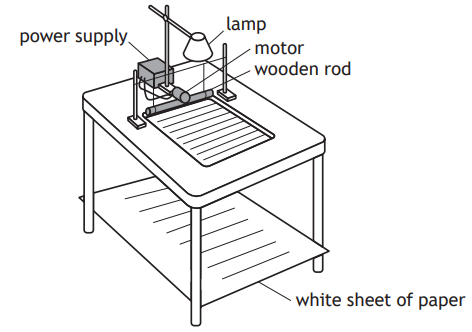
A student sets up a ripple tank. A ripple tank is a shallow tank of water used to demonstrate wave properties.

The wooden rod moves in and out of the water to generate water waves.
The pattern of the water waves is projected onto a white sheet of paper below the tank.
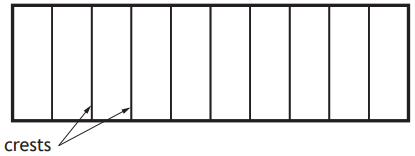
The wave pattern appears on the paper as a series of bright and dark lines. The dark lines correspond to the wave crests.

The student determines that there are six complete waves in 0.12 m.
(i) Determine the wavelength of the waves.
[1]
(ii) The six complete waves are produced in a time of 0.40 s.
Show that the frequency of the waves is 15 Hz.
[2]
(iii) Calculate the speed of the waves.
[3]
How did you do?
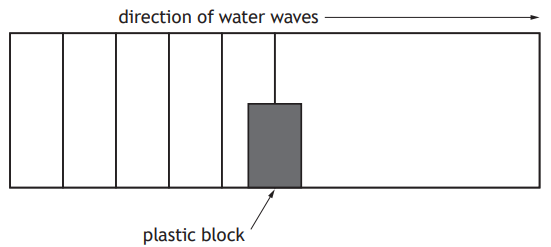
The student now places a plastic block in the ripple tank.

Complete the diagram to show the pattern of the water waves beyond the plastic block.
How did you do?
Did this page help you?
The following diagram gives information about a wave.

Which row in the table shows the amplitude and wavelength of the wave?
Wave | Amplitude (m) | Wavelength (m) |
A | 3 | 4 |
B | 3 | 8 |
C | 6 | 4 |
D | 6 | 8 |
E | 8 | 3 |
Choose your answer
Did this page help you?
A student is studying waves with a period of 80·0 ms and a wavelength of 4·00 m.
The frequency of these waves is
0·0125 Hz
0·320 Hz
12·5 Hz
80·0 Hz
320 Hz
Choose your answer
Did this page help you?
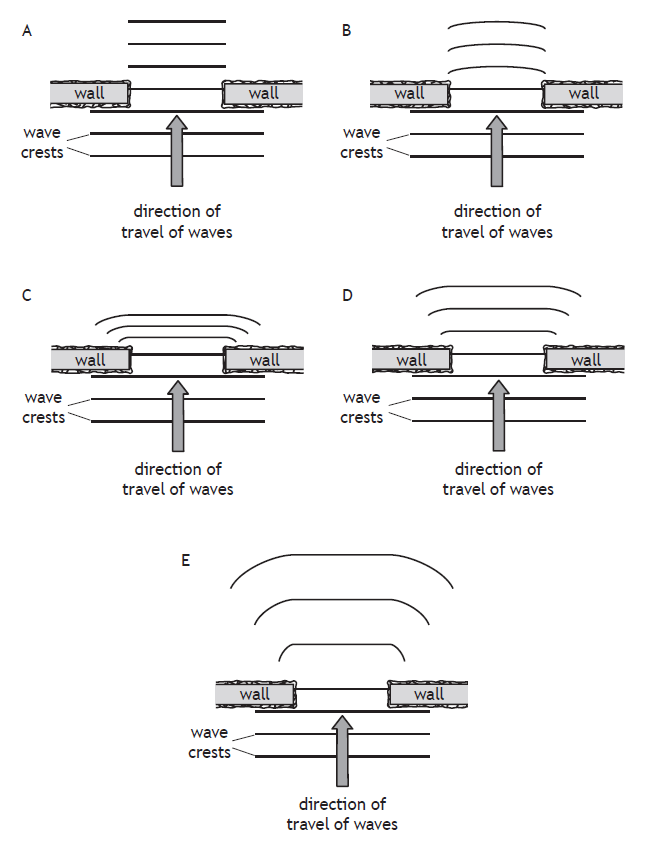
Which of the following diagrams shows the diffraction of water waves as they pass between two walls?

Choose your answer
Did this page help you?
A lifeboat crew is made up of local volunteers. When there is an emergency they have to get to the lifeboat quickly.
The lifeboat crew members are alerted to an emergency using a pager.
Text messages are sent to the pager using radio waves.

The radio waves have a frequency of 153 MHz.
Calculate the wavelength of the radio waves.
How did you do?
Did this page help you?
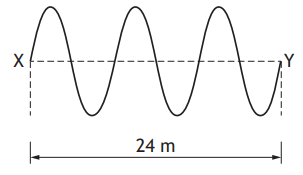
The diagram represents a wave travelling from X to Y.

The speed of the wave is 48 m s−1.
The frequency of the wave is
0.50 Hz
2.0 Hz
6.0 Hz
144 Hz
384 Hz
Choose your answer
Did this page help you?
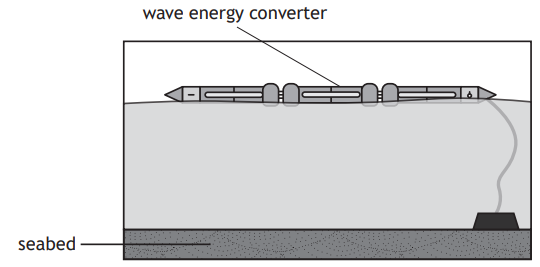
A wave energy converter is a machine anchored to the seabed that changes the kinetic energy of water waves into electrical energy.

Water waves are transverse waves.
State what is meant by the term transverse wave.
How did you do?
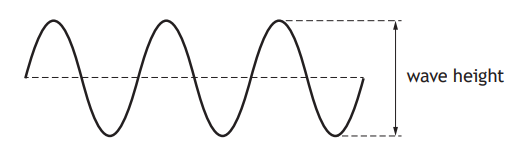
An engineer uses a stopwatch to measure the time taken for one complete wave to pass the end of the converter.
The stopwatch is started when a crest passes the end of the converter and stopped when the next crest passes.
The time measured by the engineer is 7.4 s.
(i) Calculate the frequency of the waves.
[3]
(ii) Suggest how the accuracy of the frequency of the waves determined by the engineer could be improved.
[1]
How did you do?
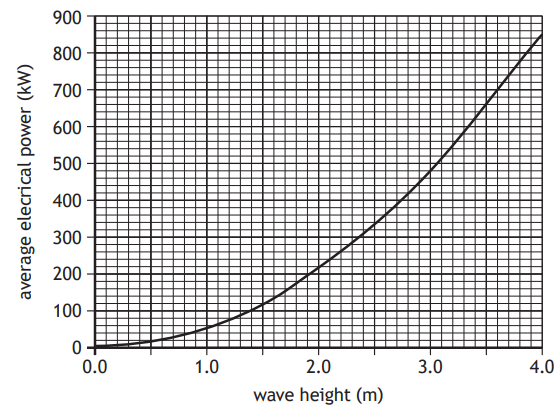
The average electrical power produced by the converter depends on the wave height.

The graph shows how the average electrical power produced by the convertor varies with wave height.

Use the graph to determine the average electrical power produced by the converter when the amplitude of the waves is 1.5 m.
How did you do?
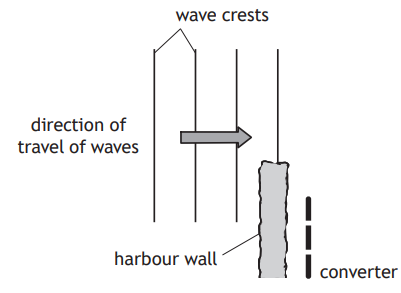
The wave energy converter is now moved to a position behind a harbour wall, so it can be serviced.
Waves travel towards the harbour wall, as shown.

Complete the diagram to show the pattern of the wave crests beyond the harbour wall.
How did you do?
Did this page help you?
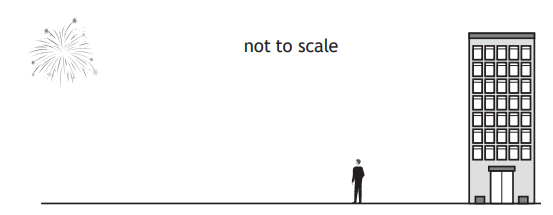
While at a firework display, a student sees a flash and hears a bang from each firework explosion.

The student states:
‘Measuring the time between seeing a flash and hearing a bang will allow me to calculate the distance to the firework when it explodes.’
State what additional information is required to calculate the distance between the student and the firework when it explodes.
How did you do?
At one point during the display the student moves to a position near a tall building and, as a result, now hears two bangs from each firework explosion.

State how the amplitude of the second bang from each explosion heard by the student compares to the amplitude of the first bang from each explosion heard by the student.
You must justify your answer.
How did you do?
Did this page help you?
A student makes the following statements about diffraction.
I Diffraction occurs when waves pass from one medium into another.
II Waves with a longer wavelength diffract more than waves with a shorter wavelength.
III Microwaves diffract more than radio waves.
Which of these statements is/are correct?
I only
II only
I and II only
II and III only
I, II and III
Choose your answer
Did this page help you?
The energy of a water wave can be calculated using
where: E is the energy of the wave in J
ρ is the density of the water in kg m−3
g is the gravitational field strength in N kg−1
A is the amplitude of the wave in m.
A wave out at sea has an amplitude of 3·5 m.
The density of the sea water is 1·02 103 kg m−3.
The energy of the wave is
6·2 103 J
1·7 104 J
6·1 104 J
1·2 105 J
6·1 108 J
Choose your answer
Did this page help you?
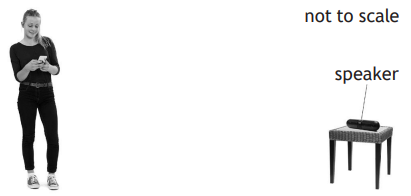
A student connects a mobile phone to a speaker wirelessly using a microwave signal.

The time taken for the microwave signal to travel from the mobile phone to the speaker is 2·1 10−8 s.
Calculate the distance between the mobile phone and the speaker.
How did you do?
Sound is a longitudinal wave.
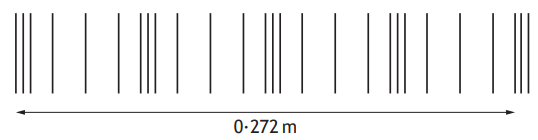
The sound produced by the speaker is represented by the following diagram.

(i) State what is meant by the term longitudinal wave.
[1]
(ii) Determine the wavelength of the sound wave.
[1]
(iii) Calculate the frequency of the sound wave in air.
[3]
How did you do?
Did this page help you?
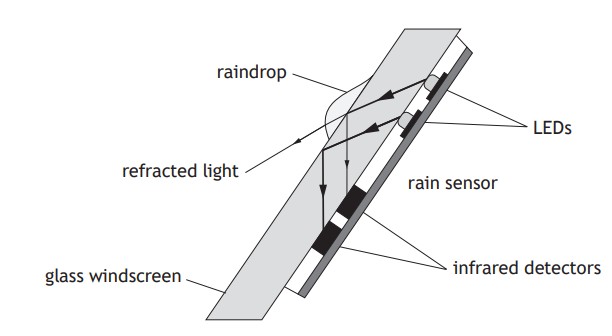
A rain sensor is attached to the glass windscreen of a vehicle to automatically control the windscreen wipers.

Infrared light is emitted from LEDs and is received by infrared detectors.
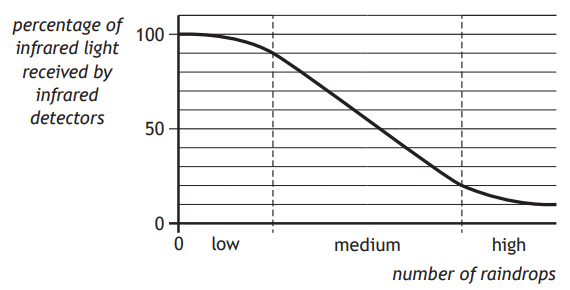
The graph shows how the number of raindrops affects the percentage of infrared light received by the infrared detectors.

The percentage of infrared light received by the infrared detectors from the LEDs controls the frequency with which the windscreen wipers move back and forth.
The table shows how the number of times the windscreen wipers move back and forth per minute relates to the number of raindrops.
Number of raindrops | Number of times the windscreen wipers move back and forth per minute |
low | 18 |
medium | 54 |
high | 78 |
At one point in time the infrared detectors receive 70% of the infrared light emitted from the LEDs.
Show that the frequency of the windscreen wipers at this time is 0·90 Hz.
How did you do?
Did this page help you?