Economic Resources (Cambridge (CIE) A Level Economics): Revision Note
Exam code: 9708

The factors of production
Factors of production are the resources used to produce goods and services
Land, labour, capital and enterprise
The production of any good/service requires the use of a combination of all four factors of production
Goods are physical objects that can be touched (tangible) e.g. mobile phone
Services are actions or activities that one person performs for another (intangible) e.g. manicure, car wash
The four factors of production
1. Land
Non man-made natural resources available for production
Some countries have a vast amount of a particular natural resource and so are able to specialise in its production
E.g., oil, wood, fish, corn, iron ore
2. Labour
The human input into the production process
Labour involves mental or physical effort
Not all labour is of the same quality
It can be skilled or unskilled
Some workers are more productive than others because of their education, training and experience
3. Capital
Capital is any man-made resource that is used to produce goods and services
E.g., tools, buildings, machines and computers
4. Enterprise
Enterprise involves taking risks in setting up or running a firm
An entrepreneur decides on the combination of the factors of production necessary to produce good and services with the aim of generating profit
Some of the factors of production required to produce a motor car
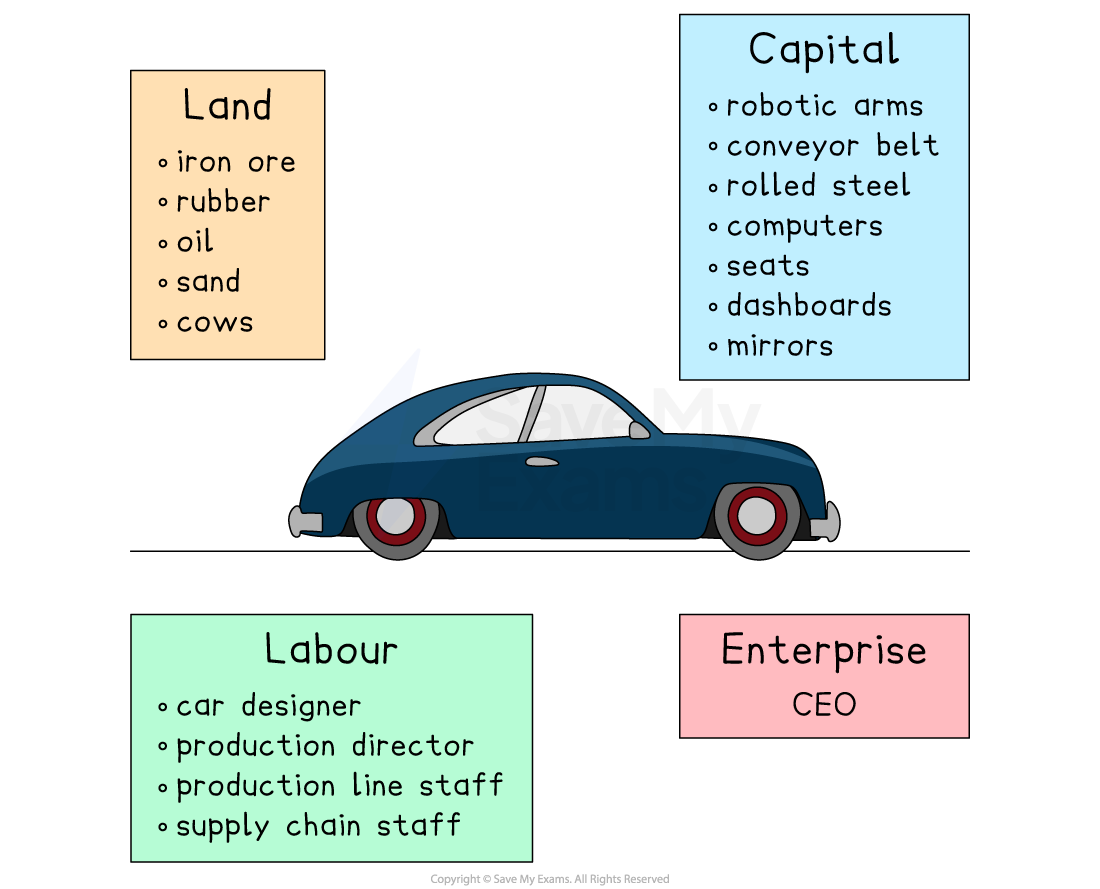
The difference between human capital and physical capital
Physical capital
Refers to tangible assets like factories, machinery, and infrastructure
Created through investments by businesses and governments
Especially crucial for economic growth in low-income and lower-middle-income countries
Both quality and quantity of physical capital matter
Human capital
Represents the value of labour in driving productivity and future economic growth
Includes skills, knowledge, and experience of individuals and the workforce
Seen as an investment by individuals, employers, and governments
Influences future earnings and national economic performance
Rewards for the factors of production
In a free market economic system, the factors of production are privately owned by households or firms
Households make these resources available to firms that use them to produce goods/services
Firms purchase land, labour, and capital from households in factor markets
Households receive the following financial rewards (factor income) for selling their factors of production
The factor income for land → rent
The factor income for labour → wages
The factor income for capital → interest
The factor income for entrepreneurship → profit
Specialisation and the division of labour
The division of labour is when a task is broken up into several component tasks
This allows workers to specialise by focusing on one (or a few) of the components that make up the production process and thereby gain significant skill in doing it
This results in higher output per worker and so increases productivity
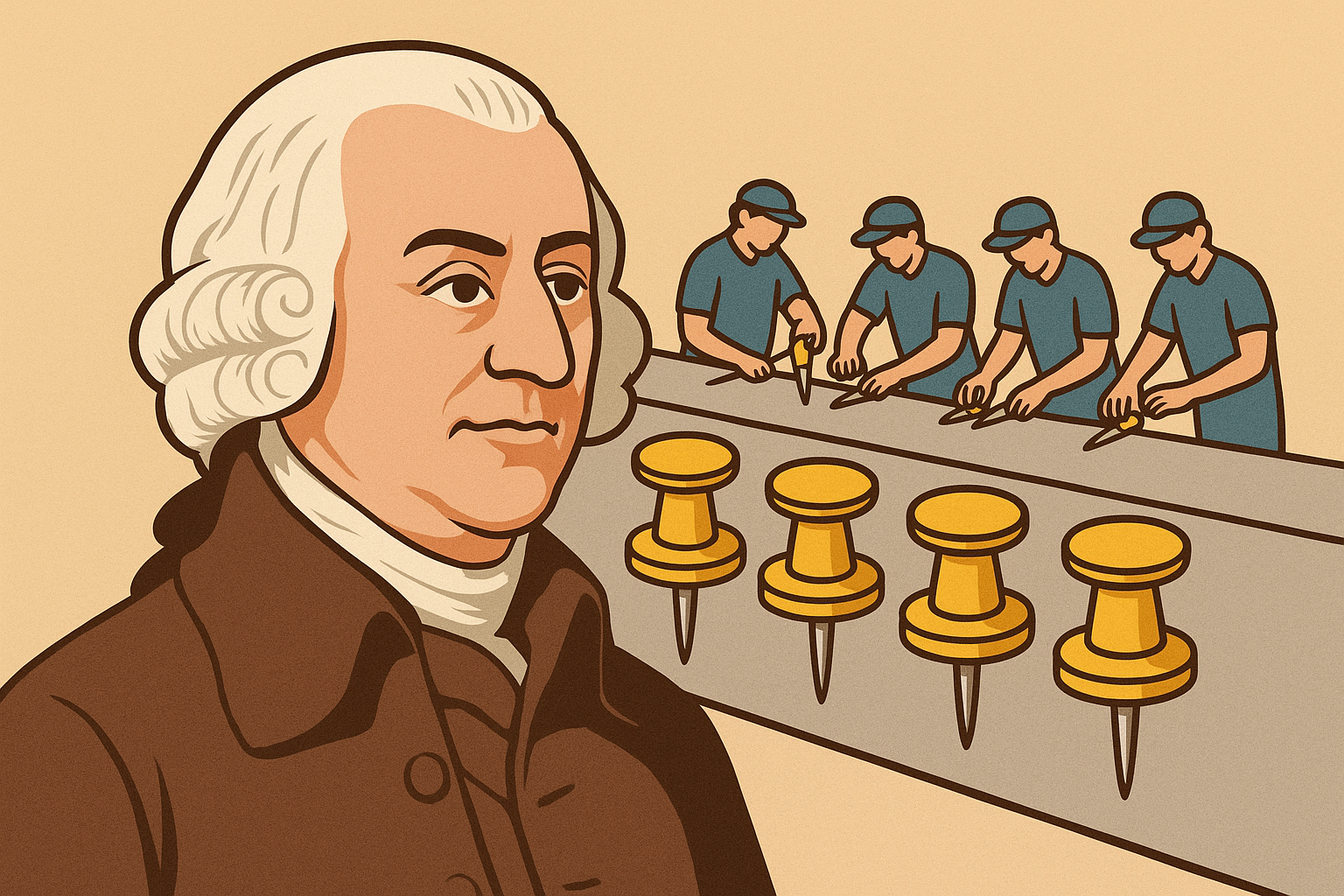
Based on observations made during a visit to a pin factory, famous economist Adam Smith developed the ideas of specialisation and the division of labour
He noted that a single worker could not make more than 20 pins a day as it involved around 18 different processes, such as cutting the wire, sharpening the end, stamping the head etc.
However, if the labour was divided up into different tasks and workers specialised in just that one task, Adam Smith estimated that just 10 workers could produce 48,000 pins per day
Specialisation occurs on several different levels
On an individual level
On a business level, for example, one firm may only specialise in manufacturing drill bits for concrete work
On a regional level, for example, Silicon Valley has specialised in the tech industry
On a global level, as countries seek to trade, for example Bangladesh specialises in textiles and exports them to the world
Advantages and disadvantages of the division of labour and specialisation
Pros | Cons |
|---|---|
|
|
|
|
|
|
|
|
|
|
Pros and cons of the division of labour and specialisation in international trade
Pros | Cons |
|---|---|
|
|
|
|
|
|
|
|
The role of entrepreneurs
Entrepreneurs play a vital role in organising production by bringing the factors of production together to create business ventures
They often take financial risks, using either their own funds or borrowed capital, in pursuit of new opportunities
Success in entrepreneurship typically depends on a mix of personal traits and strategic thinking
An entrepreneur is a person who is willing and able to create a new business idea or invention and takes risks in pursuing success
Successful entrepreneurs can identify and pursue opportunities, create value for customers and build thriving businesses
Entrepreneurs display three main characteristics
1. They organise resources
An entrepreneur must be able to gather and coordinate the resources necessary to start and operate a business
E.g., when Michael Dell started his computer company from his garage, he had to organise resources such as space, computers, software tools, and employees, and manage the finances
2. They take risks
Entrepreneurship involves taking risks – financial, personal, or professional
E.g., an entrepreneur may invest their life savings into a new venture or quit a secure job to start their own business
They may also take risks by introducing new products or entering new markets
These risks can pay off with great rewards, but they can also lead to failure and financial loss
As a business grows an entrepreneur may make the decision to employ staff to help with its day-to-day operations
The entrepreneur may take on the role of mentor, supporting new staff members to carry out their tasks in a particular way

Unlock more, it's free!
Join the 100,000+ Students that ❤️ Save My Exams
the (exam) results speak for themselves:

Was this revision note helpful?