Types of Economic Systems (Cambridge (CIE) A Level Economics): Revision Note
Exam code: 9708

An introduction to economic systems
In order to solve the basic economic problem of scarcity, economic systems emerge or are created by different economic agents within the economy
These agents include consumers, producers, the government, and special interest groups (e.g. environmental or trade unions)
The economic system aims to allocate the scarce factors of production
Any economic system needs to decide how to answer the three fundamental economic questions
What to produce? More weapons for the military, or more schools to educate the children?
Who to produce for? Only those who can afford to pay for it? Or for everyone in society?
How to produce it? Should more labour be used, or should the economy focus on using technology instead?
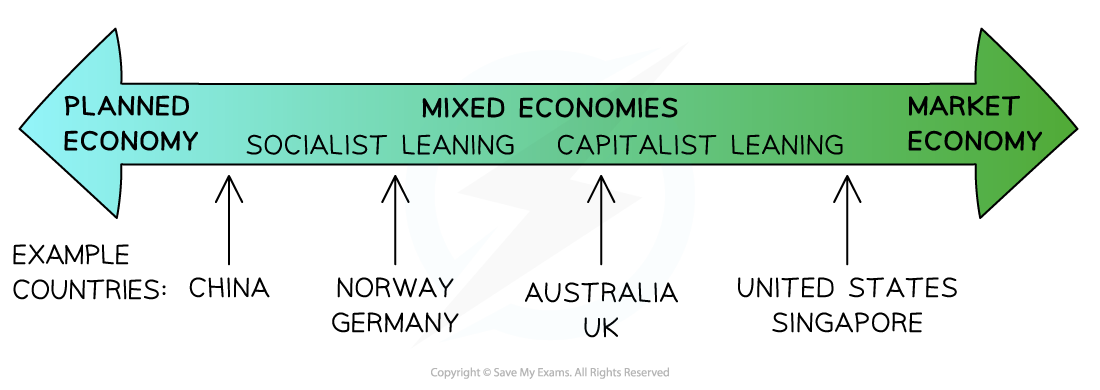
An economy can be considered to be a free market, mixed or planned economy
The type of economy is determined by how the three economic questions are answered
This ultimately determines the amount of government intervention in an economy
North Korea is a planned economy
The United States, Japan and Singapore are mixed economies but have less government intervention than Norway, Germany or China
Free-market economies
A market economy is an economy that has no government intervention in the allocation of resources and distribution of goods or services
This is also called a free market economy
There is no purely free market economy in the world but some countries have less government intervention than others
Characteristics of a market system
Characteristic | Explanation |
|---|---|
Property ownership |
|
Freedom of choice |
|
Self-interest is maximised |
|
Limited government intervention |
|
Price mechanism allocates resources |
|
The price mechanism plays a central role in resource allocation
When firms produce more than consumers demand, a surplus occurs
This surplus leads to falling prices, encouraging more purchases
Lower prices may cause firms to reduce production
As supply drops, prices begin to rise again
Higher prices attract firms back into the market, increasing supply
This cycle continues, helping balance supply and demand
The government’s role is limited to monitoring the system and stepping in only when the market fails to allocate resources efficiently
Planned economies
A planned economy is an economy in which all of the resources are owned by the state and the government controls the distribution of goods and services
Karl Marx believed that free markets lead to capitalism, in which the owners of the factors of production (Capitalists) exploited the workers
This creates inequality, which will lead to a breakdown between the classes
The role of the State is therefore to share the means of production and ownership with all of the workers in society
This required the abolition of private property
This required the State to become the central planner, deciding how each of the three economic questions would be answered
Characteristics of a planned economy
Characteristic | Explanation |
|---|---|
State ownership | • Most land and capital are owned by the government |
Central planning | • The government sets production targets and allocates resources |
Price and wage controls | • Prices and wages are fixed by the state |
Limited market forces | • Supply and demand play little or no role |
Subsidies for essentials | • Essential goods are kept cheap through subsidies |
Risk of shortages | • Fixed prices can cause excess demand and long queues |
Small private sector | • Private ownership limited to small businesses |
Decisions about the allocation of resources
In such economies, choices about what goods and services to produce, how to produce them, and who receives them are made by central authorities
Planning boards and government agencies oversee production, and consumer preferences are managed centrally rather than by market forces
Governments in planned economies often pursue rapid development to match the progress of more advanced market economies
Today, few countries operate under this model, with Cuba and North Korea being notable examples
Socialist-leaning nations like Albania and Vietnam share some features but are not fully planned economies
Mixed economies
A mixed economic system is a blend of a market and planned economy
Individuals, firms and the government own factors of production and distribute goods or services
In reality, almost every country in the world operates as a mixed economic system
Some countries have more government intervention than others
e.g. China has more intervention than the USA
The higher the level of government intervention, the more the economy will lean towards operating like a planned economy
Key thinker |
|---|
|
Decisions about the allocation of resources
A mixed economy combines elements of both private enterprise and government involvement in managing resources
Decisions about production and distribution are shaped by interactions among businesses, workers, and the state, with the market mechanism playing a central role
Examples
Over the past few decades, many countries, especially those in Central and Eastern Europe have shifted toward privatisation
This transition has significantly impacted industries such as manufacturing, particularly in the UK and similar regions
The restructuring of the Soviet Union’s economy, known as perestroika, marked a major shift toward market-oriented reforms
Countries known as the Asian Tigers including Singapore, Malaysia, the Philippines, Indonesia, and China have pursued rapid economic development by combining state planning with market-driven strategies
Evaluating mixed economies
Advantages | Disadvantages |
|---|---|
|
|
Examiner Tips and Tricks
Make sure you can provide examples for different economic systems
Mixed economies can be placed along a wide spectrum from strong government control to greater market reliance
At one end are countries like Albania, which lean heavily on centralised planning. Toward the middle are nations such as Hungary which balance both approaches. On the market-driven side are the UK and Singapore, with the USA representing the most market-oriented model

Unlock more, it's free!
Join the 100,000+ Students that ❤️ Save My Exams
the (exam) results speak for themselves:

Was this revision note helpful?