Policies To Redistribute Income & Wealth (Cambridge (CIE) A Level Economics): Revision Note
Exam code: 9708

The impact of a national minimum wage (NMW)
Government's often intervene in the labour market by setting a minimum wage
They do this in order to improve equity and avoid the exploitation of workers
A minimum wage is a legally imposed wage level that employers must pay their workers
It is set above the market rate
The minimum wage per hour often varies based on age
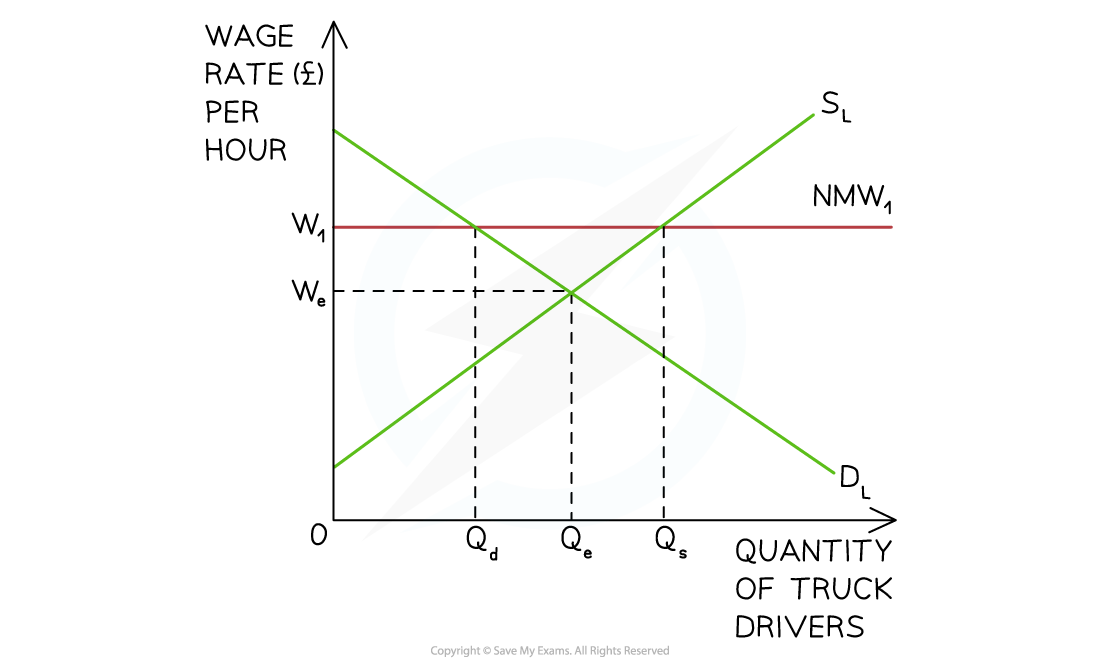
Diagram analysis
The market equilibrium wage and quantity for truck drivers in the the labour market is seen at WeQe
The government imposes a national minimum wage (NMW) at W1
Incentivised by higher wages, the supply of labour extends from Qe to Qs, leading to higher incomes for more workers
Facing higher production costs, the demand for labour by firms contracts from Qe to Qd
This means that at a wage rate of W1 there is excess supply of labour and the potential for unemployment equal to QdQs
Evaluating the use of minimum wages
Advantages | Disadvantages |
|---|---|
|
|
Transfer payments
Transfer payments are payments made by the government from tax revenue, where no good or service is exchanged
Redistributes income from higher-income taxpayers to lower-income households → reduces income inequality
They mainly support groups who may struggle to earn sufficient income through work. These are people who are unable to work or cannot participate fully in the labour market
Transfer payments typically involve a redistribution from taxpayers to recipients who require financial support
Examples include:
state retirement pensions
unemployment support payments
rent or housing support
income support for low-income households
family or child support payments
disability support
Tax credits
Effectiveness of transfer payments
The scale and effectiveness of transfer payment systems depend on the size of the government’s tax revenue and the proportion of the population contributing tax
In many lower-income economies, there is narrow tax base and a large informal sector
Only workers in the formal sector contribute regularly to income tax, meaning social protection schemes cover only a small share of the population
Where populations are ageing or unemployment is high, governments may struggle to fund pensions and welfare payments
Higher-income economies with broader tax bases are generally better able to finance extensive welfare systems
Advantages | Disadvantages |
|---|---|
|
|
Examiner Tips and Tricks
Transfer payments improve equity, but may create efficiency trade-offs if work incentives are weakened
Progressive taxation
Progressive tax system: as income rises, a larger percentage of income is paid in tax (e.g. UK Income Tax; UK Corporation Tax)
This system is built around the idea of marginal tax rates
Case Study
UK progressive tax rates : June 2022
Tax Band | Taxable Income | Tax Rate |
|---|---|---|
Personal Allowance | Up to £12,500 | 0% |
Basic Rate | £12,501 to £50,000 | 20% |
Higher Rate | £50,001 to £150,000 | 40% |
Additional Rate | Over £150,000 | 45% |
Using this system, a salary of £60,000 would attract a tax bill of £11,499.80, calculated as follows:
First £12,500 - no tax
Next £37,499 at 20% = £7499.80
Final £10,001 at 40% = £4,000
Advantages | Disadvantages |
|---|---|
|
|
Inheritance and capital gains tax to reduce wealth inequality
1. Inheritance tax (IHT)
Inheritance tax is a tax charged on the transfer of wealth when an individual dies. It is typically paid on estates above a certain threshold
How it reduces wealth inequality
Limits the intergenerational transfer of wealth, preventing large fortunes from being passed on unchanged
Reduces wealth inequality that arises from inheritance rather than earned income
Tax revenue can be used to fund public services or transfer payments that benefit lower-income households
Advantages | Disadvantages |
|---|---|
|
|
2. Capital gains tax (CGT)
Capital gains tax is charged on the profit made from selling assets such as shares, property or businesses
How it reduces wealth inequality
Ensures that income earned from assets and investments is taxed, not just wages
Reduces the gap between those who earn mainly from labour and those who earn from wealth
Slows the accumulation of wealth among high-asset individuals
Advantages | Disadvantages |
|---|---|
|
|
State provision of education and healthcare
Education and healthcare are often provided or funded by the state because they are essential services that generate significant social benefits beyond the individual consumer
How state provision reduces inequality
Improves equality of opportunity
Free or subsidised education allows individuals from low-income households to develop skills and qualifications. This increases their chances of higher-paid employment
Reduces income-related barriers to access
Without state provision, only higher-income households may be able to afford quality schooling or medical treatment, widening inequality
Raises long-term earning potential
Improves human capital → increases earning potential → reduces inequality
Improves health outcomes
Access to healthcare reduces illness and absenteeism, allowing people to work more consistently and productively
Supports social mobility
When access to education and healthcare is based on need rather than ability to pay, individuals are more able to move up the income distribution
Advantages | Disadvantages |
|---|---|
|
|
Worked Example
Question
Which policy is most likely to reduce wealth inequality rather than income inequality?
A. Increasing the national minimum wage
B. Increasing transfer payments to unemployed workers
C. Increasing inheritance tax
D. Increasing government spending on educatio
Answer
C. Increasing inheritance tax [1]
Explanation
A. Minimum wage
Raises earnings for low-paid workers → reduces income inequality, not wealthB. Transfer payments
Redistribute income from taxpayers to recipients → reduces income inequalityC. Inheritance tax
Taxes the transfer of assets → reduces the accumulation of wealth across generations → reduces wealth inequalityD. Government spending on education
Improves skills and earning potential → reduces income inequality over time (equality of opportunity)
State provision mainly improves equality of opportunity, but it does not guarantee equal outcomes
Policies such as education improve equality of opportunity
Taxes and transfers improve equality of outcome

Unlock more, it's free!
Join the 100,000+ Students that ❤️ Save My Exams
the (exam) results speak for themselves:

Was this revision note helpful?