Buffer Stocks & Information Provision (Cambridge (CIE) A Level Economics): Revision Note
Exam code: 9708

Buffer stock schemes
Buffer stocks occur when the government buys excess supply when prices are low and sells stocks when prices are high to stabilise prices

Diagram explanation
The government sets a price floor (P2) and price ceiling (P3) to stabilise prices within a target range
When price falls:
Price falls below P2 → government buys excess supply → market supply decreases → price rises back towards P2
When price rises:
Price rises above P3 → government sells stocks → market supply increases → price falls back towards P3
Case Study
Rice buffer stock scheme in India (food corporation of India)
Context
India has experienced significant volatility in rice prices due to changing harvest conditions and global supply shocks. This creates uncertainty for both farmers and consumers. Without intervention, prices can fall sharply in years of excess supply, reducing farmer income
Action taken
The government, through the Food Corporation of India (FCI), buys rice at a minimum support price (MSP)
Rice is stored as part of a buffer stock
Stocks are released when prices rise or during shortages
In 2023–2024, India held over 50 million tonnes of rice reserves
Outcome
The scheme helps stabilise prices and protect farmer incomes by preventing prices from falling below the MSP. It also improves food security, with rice released during periods of shortage
However, maintaining large buffer stocks is costly, with high storage and wastage risks. There are also concerns about government failure, as excessive stockpiling can distort market signals and lead to inefficient allocation of resources
The effectiveness of buffer stock schemes
Advantages
Price stability
Helps reduce large fluctuations in prices, making prices more predictable for both producers and consumers
Income stability for producers
Farmers and other producers are protected from sudden falls in prices caused by oversupply or poor market conditions
Food security
Maintaining reserves can help ensure supplies are available during shortages caused by bad harvests or supply shocks
Encourages investment
More stable prices and incomes may encourage producers to invest in improving productivity
Disadvantages
High storage costs
Buying, storing and maintaining stocks can be expensive, especially for perishable goods
Difficulty in setting the correct price range
If the intervention price is set incorrectly, the scheme may fail or require excessive government spending
Risk of waste
Stored goods may spoil or become outdated, leading to losses
Government failure
Poor management, forecasting errors or political pressure can make schemes inefficient
Distorts market signals
Artificially stabilised prices may reduce incentives for producers to respond to changes in demand and supply
Provision of information
Information asymmetry leads to market failure
Governments provide information to reduce information asymmetry
Examples
Health information
Governments provide information on the risks of smoking, alcohol misuse and poor diets through public health campaigns and warning labels.
Energy efficiency labels
Appliances and vehicles are labelled with energy efficiency ratings to help consumers compare long-term costs and environmental impact.
Education and careers guidance
Information on exam results, training options and employment prospects helps students and workers make better education and career choices.
Food labelling
Nutritional information and allergy warnings allow consumers to make safer and healthier consumption decisions. E.g. traffic light system (opens in a new tab)
Environmental information
Governments publish data on air quality, pollution levels and recycling to raise awareness of negative externalities.
The effectiveness of providing information
Advantages
Addresses information failure directly
Helps consumers and producers make decisions based on accurate information rather than assumptions
Preserves consumer choice
Individuals remain free to decide, unlike with bans or regulations
Low cost compared to other policies
Often cheaper than subsidies, taxes or direct regulation
Encourages socially desirable behaviour
Can reduce demerit good consumption and promote positive externalities
Avoids market distortion
Does not interfere directly with prices or output
Disadvantages
Limited effectiveness
Information does not guarantee behaviour will change, especially for addictive goods
Time lag
Public attitudes and habits may take a long time to adjust
Unequal impact
More educated or higher-income groups may benefit more from the information provided
Risk of misinformation or bias
Information may be unclear, outdated or influenced by political interests
Requires consumer engagement
Assumes individuals will understand and act upon the information given
Case Study
Context
The USA has high obesity rates, with around 42% of adults classified as obese (CDC). Consumers often lacked clear information about calorie content when purchasing fast food, leading to over-consumption of demerit goods
Action taken
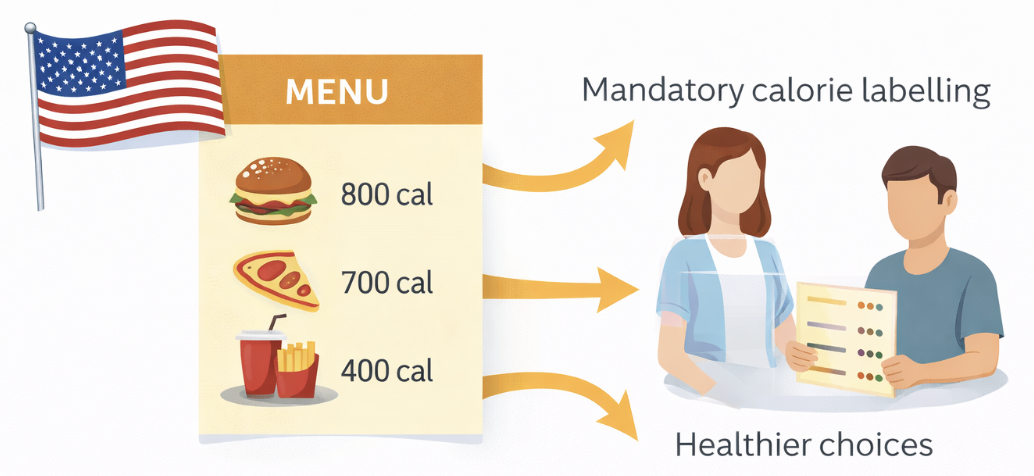
In 2018, the US government required large restaurant chains (20+ outlets) to display calorie information on menus
The policy aimed to reduce information asymmetry at the point of purchase
Outcome
Studies found that calorie labelling reduced average calories purchased by around 20–60 calories per transaction (FDA studies), suggesting some improvement in consumer decision-making
However, the overall impact on obesity has been limited, as many consumers do not significantly change behaviour, particularly where demand is habit-driven or price inelastic

Unlock more, it's free!
Join the 100,000+ Students that ❤️ Save My Exams
the (exam) results speak for themselves:

Was this revision note helpful?
