Price Controls & Direct Provision (Cambridge (CIE) A Level Economics): Revision Note
Exam code: 9708

State provision
Merit goods and public goods are under-provided in a free market, causing a market failure
Public goods are beneficial for society and are not provided by private firms due to the free rider problem
They are usually provided free at the point of consumption, but are paid for through general taxation
Examples include roads, parks, lighthouses, national defence
Merit goods are beneficial to society but consumers cannot always access them as they are priced out of the market (e.g. private education or healthcare)
To solve the market failure, governments can provide these goods and services
The advantages and disadvantages of state provision
Advantages | Disadvantages |
|---|---|
|
|
Case Study
Context
Access to healthcare in Indonesia has been uneven, with many low-income and rural populations unable to afford private services. Healthcare generates positive externalities, but the market under-provided it as firms focused on private benefits, leading to under-provision (Qe < Qopt)
Action taken
Expansion of the Jaminan Kesehatan Nasional (JKN) scheme
Government-funded universal health insurance
Subsidised or free access for low-income households
Increased state support for healthcare provision
Outcome
Coverage has expanded to over 80% of the population, improving access and moving provision closer to the socially optimal level. Preventative care and affordability have improved.
However, the scheme faces funding pressures and capacity issues, raising concerns about long-term sustainability and potential government failure
Price ceilings (maximum prices)
A price ceiling is a maximum price set by the government. Sellers cannot legally sell the good or service at a higher price
The price ceiling is set below the existing equilibrium market price
Governments will often use price ceilings to help consumers if the market price is too high, especially for essential goods and services
This may increase consumption of merit goods, helping to generate positive externalities (external benefits)
It may also improve equity by making essential goods more affordable for low-income consumers
Sometimes they are used for long periods of time, e.g., rent controls to keep rents lower in housing rental markets
Other times, they are short-term solutions aimed at limiting unusual price increases, e.g., petrol
Impact of a price ceiling

Diagram analysis
The initial market equilibrium is at PeQe
A price ceiling is imposed at Pmax below the equilibrium level
The lower price reduces the incentive to supply and there is a contraction in quantity supplied (QS) from Qe → Qs
The lower price increases the incentive to consume and there is an extension in quantity demanded (QD) from Qe → Qd
This creates a condition of excess demand (shortage) equal to QsQd
The shortage may lead to non-price rationing, such as queues, waiting lists or favouritism
It may also encourage the development of black markets
The aim of this policy is to promote equity in the market for essential goods and services and it attempts to solve market failure caused by income inequality
Evaluating the use of price ceilings
Advantages | Disadvantages |
|---|---|
|
|
Price floors (minimum prices)
A price floor (minimum price) is set by the government above the existing free market equilibrium price and sellers cannot legally sell the good/service at a lower price
Governments will often use price floors to help producers or to decrease consumption of a demerit good
By reducing consumption of demerit goods, price floors can help to reduce negative externalities (external costs) and move output closer to the socially optimal level
In Wales and Scotland, governments have introduced a minimum price of alcohol at 50 pence per unit
Minimum prices are also used in the labour market to protect workers from wage exploitation. These are called minimum wages
Impact of a price floor

Diagram analysis
The initial market equilibrium is at PeQe
A price floor is imposed at Pmin above the equilibrium level
The higher price increases the incentive to supply and there is an extension in supply from Qe → Qs
The higher price decreases the incentive to consume and there is a contraction in demand from Qe → Qd
This creates an excess supply equal to QdQs
In the case of demerit goods, this discourages consumption, reducing output to a level that may be closer to the socially optimal level if the price floor is set appropriately
Consumers lose from higher prices, while producers gain
There is likely to be a deadweight loss, indicating a loss of allocative efficiency
Examiner Tips and Tricks
The effectiveness of a price floor depends on the price elasticity of demand. If demand is price inelastic, the higher price leads to only a small fall in quantity demanded, so the policy may have limited impact on reducing consumption
Evaluating the use of price floors
Advantages | Disadvantages |
|---|---|
|
|
Case Study
Context
Alcohol consumption in Scotland was high, creating significant negative externalities, including increased healthcare costs, crime and lower productivity. Cheap, high-strength alcohol was widely available, encouraging excessive consumption, particularly among heavy drinkers
The market price did not reflect the full social costs of consumption, leading to over-consumption (Qe > Qopt) and market failure
Action taken
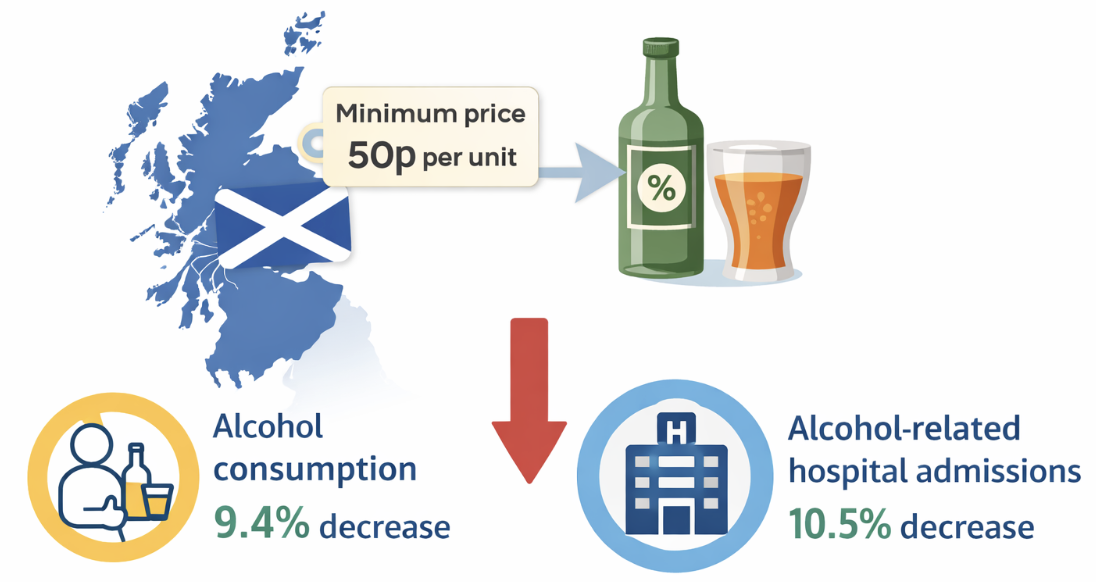
The government introduced a minimum price of 50p per unit of alcohol in 2018
This set a price floor above equilibrium for low-cost alcohol
Retailers were legally prohibited from selling alcohol below this price
The policy specifically targeted cheap, high-strength products
Outcome
The policy led to a reduction in alcohol consumption, particularly among heavy drinkers, helping to move consumption closer to the socially optimal level. There is evidence of falling alcohol-related hospital admissions and deaths
However, the effectiveness depends on the price elasticity of demand, with some consumers relatively unresponsive to higher prices
The policy may also be considered regressive, although it has reduced the negative externalities associated with alcohol misuse

Unlock more, it's free!
Join the 100,000+ Students that ❤️ Save My Exams
the (exam) results speak for themselves:

Was this revision note helpful?
