Subsidies (Cambridge (CIE) A Level Economics): Revision Note
Exam code: 9708

Subsidies
A subsidy is a payment made by the government to producers to reduce the cost of production
Governments frequently use subsidies to encourage production or consumption of merit goods such as energy-efficient products, electric vehicles, healthcare, and education
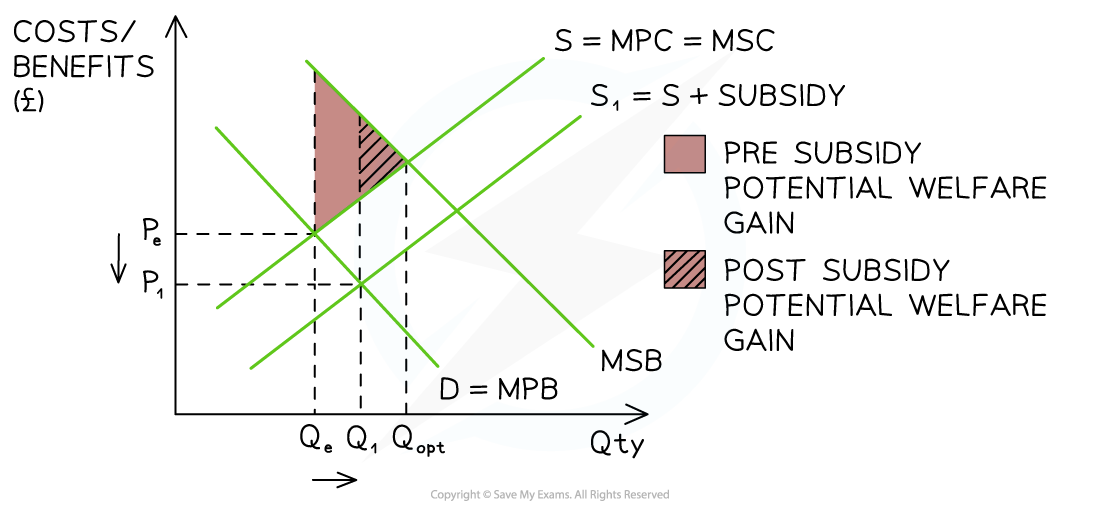
Diagram analysis
The free-market equilibrium is at PeQe - where MPB = MSC
Market failure exists as MSB > MSC at the free market equilibrium, meaning the good is under-consumed
Optimum level of output is at Qopt
A subsidy shifts the supply curve right from S → S1
It does not completely eradicate the potential welfare gain but moves the market closer to the optimum level of output (Qopt)
The potential welfare gain has been reduced as shown in the diagram
This represents a reduction in deadweight loss and an improvement in allocative efficiency
The new market equilibrium is at P1Q1
This is a lower price and higher output
There is less under-consumption and so less market failure
Some of the external benefits available have been realised
Subsidy incidence
The incidence (share) of the subsidy is determined by the PED of the product
If governments subsidise goods or services with high PED, the increase in QD will be more than proportional to the decrease in price
Producers keep some of the subsidy and pass the rest on to the consumers

Diagram analysis
The original equilibrium is at P1Q1
The subsidy shifts the supply curve from S → S + subsidy:
This increases the QD in the market from Q1→Q2
The new market equilibrium is P2Q2
This is a lower price and higher QD in the market
Producers receive P2 from the consumer PLUS the subsidy per unit from the government
Producer revenue is therefore P3 x Q2
Producer incidence of the subsidy is marked B in the diagram
The subsidy decreases the price that consumers pay from P1 → P2
Consumer incidence of the subsidy is marked A in the diagram
The total cost to the government of the subsidy is (P3 - P2) x Q2 represented by area A+B
This creates an opportunity cost, as government funds could be used for alternative purposes
Examiner Tips and Tricks
When dealing with a subsidy, the producer benefit is now the top portion of the incidence area, and consumer incidence is below
The effectiveness of subsidies
Estimating the appropriate size of a subsidy can be difficult
Many subsidies are applied uniformly, meaning they are not linked to consumers’ income levels or ability to pay. Unlike income-based taxes or benefits, subsidies usually reduce the price by the same amount for all users
As a result, both higher-income and lower-income consumers benefit equally per unit consumed, even though the policy may be intended to support those on lower incomes
This makes it important to consider who actually gains from a subsidy
Examples
1. Domestic energy subsidies
In some countries, governments subsidise electricity or gas to keep household energy bills affordable
While this can help low-income households cope with rising living costs, wealthier households also benefit, often to a greater extent because they consume more energy
In addition, lower prices may increase demand, leading to supply pressures or higher government spending.
If subsidies are paid directly to energy suppliers, there is no guarantee that firms will become more efficient or invest in cleaner technologies
2. Subsidies for education and training
Governments often subsidise further education or vocational training to improve workforce skills and productivity
These subsidies can increase access to education and benefit society through higher employment and economic growth
However, some of the financial benefits may go to individuals who could afford training without support, raising questions about whether the subsidy is well targeted
Examiner Tips and Tricks
A great evaluation point is that:
There is no guarantee that subsidies will fully correct market failure, as firms may not pass on the full benefit to consumers
Taxes vs Subsidies (Comparison)
Taxes discourage consumption and production, while subsidies encourage them
Feature | Indirect tax | Subsidy |
|---|---|---|
Effect on supply |
|
|
Effect on price |
|
|
Effect on output |
|
|
Market failure targeted |
|
|
Welfare effect |
|
|
Government finances |
|
|
Incidence |
|
|

Unlock more, it's free!
Join the 100,000+ Students that ❤️ Save My Exams
the (exam) results speak for themselves:

Was this revision note helpful?