Short-Run Production (Cambridge (CIE) A Level Economics): Revision Note
Exam code: 9708

Short-run production function
The production function shows the relationship between inputs used in production and the level of output produced
In the short run, at least one factor of production is fixed, meaning it cannot be changed quickly
Firms increase output mainly by adjusting variable factors
When additional variable factors are added to fixed factors, output changes according to the production function
Fixed factors of production
Inputs that cannot be changed in the short run
Their quantity remains constant as output changes
Examples include:
Machinery
Buildings
Land
Large equipment
Variable factors of production
Inputs that can be changed in the short run
Firms adjust these to increase or decrease production
Examples include:
Labour
Raw materials
Energy inputs
Types of product
1. Total product (TP)
Total product (TP) is the total quantity of output produced using a given amount of labour and other inputs
For example:
A bakery produces 100 loaves of bread with one baker
With two bakers, output increases to 180 loaves
As more workers are added, total output increases, although the rate of increase may change
2. Marginal product (MP)
Marginal product (MP) is the additional output produced by employing one more unit of labour
Formula:
format('truetype')%3Bfont-weight%3Anormal%3Bfont-style%3Anormal%3B%7D%3C%2Fstyle%3E%3C%2Fdefs%3E%3Ctext%20font-family%3D%22Times%20New%20Roman%22%20font-size%3D%2218%22%20text-anchor%3D%22middle%22%20x%3D%2213.5%22%20y%3D%2230%22%3EMP%3C%2Ftext%3E%3Ctext%20font-family%3D%22math17f39f8317fbdb1988ef4c628eb%22%20font-size%3D%2216%22%20text-anchor%3D%22middle%22%20x%3D%2238.5%22%20y%3D%2230%22%3E%3D%3C%2Ftext%3E%3Cline%20stroke%3D%22%23000000%22%20stroke-linecap%3D%22square%22%20stroke-width%3D%221%22%20x1%3D%2253.5%22%20x2%3D%2292.5%22%20y1%3D%2223.5%22%20y2%3D%2223.5%22%2F%3E%3Ctext%20font-family%3D%22Times%20New%20Roman%22%20font-size%3D%2218%22%20text-anchor%3D%22middle%22%20x%3D%2273.5%22%20y%3D%2216%22%3E%26%23x394%3BTP%3C%2Ftext%3E%3Ctext%20font-family%3D%22Times%20New%20Roman%22%20font-size%3D%2218%22%20text-anchor%3D%22middle%22%20x%3D%2273.5%22%20y%3D%2241%22%3E%26%23x394%3BQL%3C%2Ftext%3E%3C%2Fsvg%3E)
Where:
ΔTP = change in total product
ΔQL = change in quantity of labour
For example:
Output increases from 100 loaves to 180 loaves when a second worker is hired
The marginal product of the second worker is 80 loaves
Marginal product shows how much extra output each additional worker produces
3. Average product (AP)
Average product (AP) measures the output produced per worker
Formula:
format('truetype')%3Bfont-weight%3Anormal%3Bfont-style%3Anormal%3B%7D%3C%2Fstyle%3E%3C%2Fdefs%3E%3Ctext%20font-family%3D%22Times%20New%20Roman%22%20font-size%3D%2218%22%20text-anchor%3D%22middle%22%20x%3D%2211.5%22%20y%3D%2230%22%3EAP%3C%2Ftext%3E%3Ctext%20font-family%3D%22math17f39f8317fbdb1988ef4c628eb%22%20font-size%3D%2216%22%20text-anchor%3D%22middle%22%20x%3D%2235.5%22%20y%3D%2230%22%3E%3D%3C%2Ftext%3E%3Cline%20stroke%3D%22%23000000%22%20stroke-linecap%3D%22square%22%20stroke-width%3D%221%22%20x1%3D%2250.5%22%20x2%3D%2277.5%22%20y1%3D%2223.5%22%20y2%3D%2223.5%22%2F%3E%3Ctext%20font-family%3D%22Times%20New%20Roman%22%20font-size%3D%2218%22%20text-anchor%3D%22middle%22%20x%3D%2264.5%22%20y%3D%2216%22%3ETP%3C%2Ftext%3E%3Ctext%20font-family%3D%22Times%20New%20Roman%22%20font-size%3D%2218%22%20text-anchor%3D%22middle%22%20x%3D%2264.5%22%20y%3D%2241%22%3EQL%3C%2Ftext%3E%3C%2Fsvg%3E)
Where:
TP = total product
QL = quantity of labour
For example:
If three bakers produce 240 loaves, then
format('truetype')%3Bfont-weight%3Anormal%3Bfont-style%3Anormal%3B%7D%3C%2Fstyle%3E%3C%2Fdefs%3E%3Ctext%20font-family%3D%22Times%20New%20Roman%22%20font-size%3D%2218%22%20text-anchor%3D%22middle%22%20x%3D%2211.5%22%20y%3D%2230%22%3EAP%3C%2Ftext%3E%3Ctext%20font-family%3D%22math17f39f8317fbdb1988ef4c628eb%22%20font-size%3D%2216%22%20text-anchor%3D%22middle%22%20x%3D%2235.5%22%20y%3D%2230%22%3E%3D%3C%2Ftext%3E%3Cline%20stroke%3D%22%23000000%22%20stroke-linecap%3D%22square%22%20stroke-width%3D%221%22%20x1%3D%2250.5%22%20x2%3D%2277.5%22%20y1%3D%2223.5%22%20y2%3D%2223.5%22%2F%3E%3Ctext%20font-family%3D%22Times%20New%20Roman%22%20font-size%3D%2218%22%20text-anchor%3D%22middle%22%20x%3D%2264.5%22%20y%3D%2216%22%3ETP%3C%2Ftext%3E%3Ctext%20font-family%3D%22Times%20New%20Roman%22%20font-size%3D%2218%22%20text-anchor%3D%22middle%22%20x%3D%2264.5%22%20y%3D%2241%22%3EQL%3C%2Ftext%3E%3Ctext%20font-family%3D%22Times%20New%20Roman%22%20font-size%3D%2218%22%20text-anchor%3D%22middle%22%20x%3D%2211.5%22%20y%3D%2281%22%3EAP%3C%2Ftext%3E%3Ctext%20font-family%3D%22math17f39f8317fbdb1988ef4c628eb%22%20font-size%3D%2216%22%20text-anchor%3D%22middle%22%20x%3D%2235.5%22%20y%3D%2281%22%3E%3D%3C%2Ftext%3E%3Cline%20stroke%3D%22%23000000%22%20stroke-linecap%3D%22square%22%20stroke-width%3D%221%22%20x1%3D%2250.5%22%20x2%3D%2280.5%22%20y1%3D%2274.5%22%20y2%3D%2274.5%22%2F%3E%3Ctext%20font-family%3D%22Times%20New%20Roman%22%20font-size%3D%2218%22%20text-anchor%3D%22middle%22%20x%3D%2265.5%22%20y%3D%2267%22%3E240%3C%2Ftext%3E%3Ctext%20font-family%3D%22Times%20New%20Roman%22%20font-size%3D%2218%22%20text-anchor%3D%22middle%22%20x%3D%2265.5%22%20y%3D%2292%22%3E3%3C%2Ftext%3E%3Ctext%20font-family%3D%22Times%20New%20Roman%22%20font-size%3D%2218%22%20text-anchor%3D%22middle%22%20x%3D%2211.5%22%20y%3D%22118%22%3EAP%3C%2Ftext%3E%3Ctext%20font-family%3D%22math17f39f8317fbdb1988ef4c628eb%22%20font-size%3D%2216%22%20text-anchor%3D%22middle%22%20x%3D%2235.5%22%20y%3D%22118%22%3E%3D%3C%2Ftext%3E%3Ctext%20font-family%3D%22Times%20New%20Roman%22%20font-size%3D%2218%22%20text-anchor%3D%22middle%22%20x%3D%2257.5%22%20y%3D%22118%22%3E80%3C%2Ftext%3E%3C%2Fsvg%3E)
So the average product is 80 loaves per worker
The law of diminishing returns
The law of diminishing returns (also called the law of variable proportions) states that:
When increasing amounts of a variable factor are added to a fixed factor, the marginal product of the variable factor will eventually fall
This occurs because the fixed factor becomes a constraint on production.
For instance, in a small coffee shop:
The first barista works efficiently alone
A second barista improves output, but not as dramatically
By the time a sixth barista is hired, they may be crowding each other, leading to minimal gains in output
Eventually, adding more workers does not increase total output significantly and may even reduce efficiency
Short-run production in a coffee shop
Workers | Total Product | Marginal Product | Average Product |
|---|---|---|---|
1 | 100 | 100 | 100 |
2 | 180 | 80 | 90 |
3 | 240 | 60 | 80 |
4 | 280 | 40 | 70 |
5 | 300 | 20 | 60 |
This table shows how output increases with each additional worker, but at a decreasing rate
Eventually, output plateaus, illustrating diminishing returns
Stages of production
The law of diminishing returns leads to three stages of production
Firms usually operate in Stage 2, where production is still increasing but diminishing returns have begun
Stage 1: Increasing returns
Marginal product increases
Workers specialise and production becomes more efficient
Stage 2: Diminishing returns
The marginal product begins to fall
Additional workers still increase output but at a decreasing rate
Stage 3: Negative returns
The marginal product becomes negative
Too many workers cause crowding and inefficiency
Total output may begin to fall
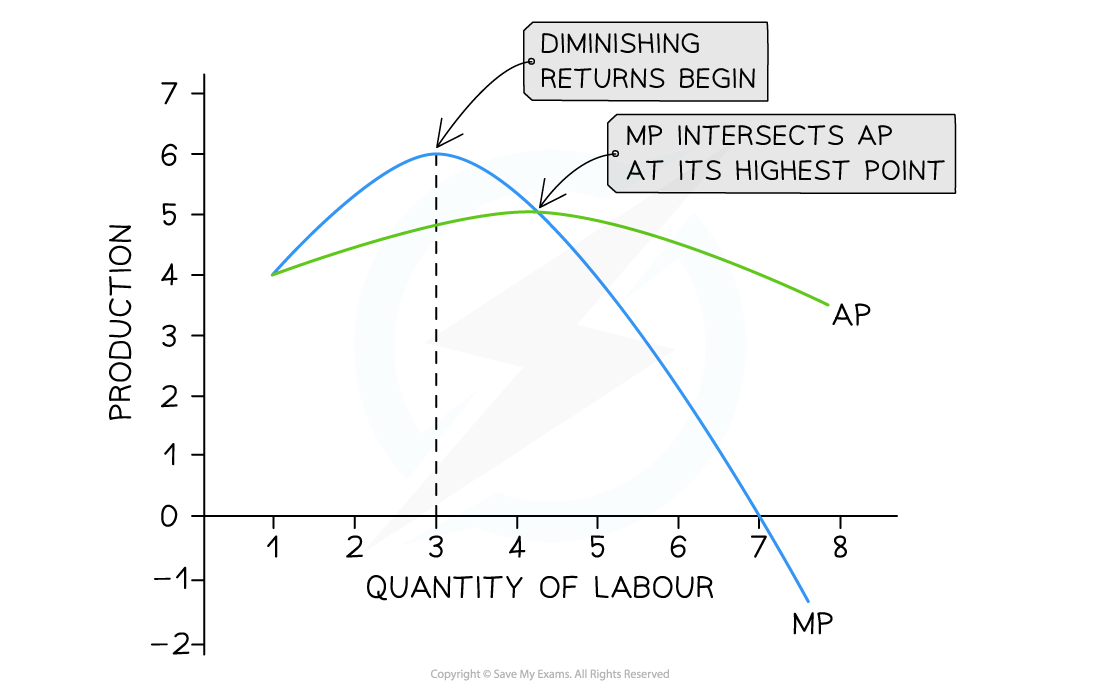
Diagram analysis
A small food van selling burgers at a music festival increases productivity up to the third worker as workers specialise and the grill is used more efficiently
After this point, workers begin to get in each other's way and there is limited grill space (capital), so the marginal product of labour begins to fall
Hiring additional workers still increases total product, but at a diminishing rate
When the 7th worker is hired, the marginal product becomes negative, causing total product to fall
Understanding the short-run production function helps firms
Decide how many workers to hire
Estimate the cost of increasing output
Identify the point at which adding more labour becomes inefficient
It also supports broader economic analysis of resource allocation, productivity, and cost structures in different industries

Unlock more, it's free!
Join the 100,000+ Students that ❤️ Save My Exams
the (exam) results speak for themselves:

Was this revision note helpful?
