Demand Curves (Cambridge (CIE) A Level Economics): Revision Note
Exam code: 9708

An introduction to demand
Demand is the amount of a good or service that a consumer is willing and able to purchase at a given price in a given time period
Effective demand is demand supported by the necessary purchasing power (the ability to pay)
If a consumer is willing to purchase a good, but cannot afford to, it is not effective demand
A demand curve is a graphical representation of the price and quantity demanded (QD) by consumers
If the data were plotted, it would be an actual curve. Economists, however, use straight lines so as to make analysis easier
The law of demand states that there is an inverse relationship between price and quantity demanded (QD), ceteris paribus
When the price rises, the QD falls
When the price falls, the QD rises
Individual and market demand
Market demand is the combination of all the individual demand for a good or service
It is calculated by adding up the individual demand at each price level
The Monthly Market Demand for Newspapers in a Small Village
Customer 1 | Customer 2 | Market Demand |
|---|---|---|
8 | 12 | 20 |
Individual and market demand can also be represented graphically
Market demand for children's swimwear

Diagram analysis
A shop sells both boys' and girls' swimwear.
In July, at a price of $10, the demand for boys' swimwear is 500 units and girls' is 400 units
At a price of $10, the shop's market demand during July is 900 units
Movements along the demand curve
If price is the only factor that changes (ceteris paribus), there will be a change in the quantity demanded (QD)
This change is shown by a movement along the demand curve
Movement along the demand curve

Diagram analysis
An increase in price from £10 to £15 leads to a movement up the demand curve from point A to B
Due to the increase in price, the QD has fallen from 10 to 7 units
This movement is called a contraction in QD
A decrease in price from £10 to £5 leads to a movement down the demand curve from point A to point C
Due to the decrease in price, the QD has increased from 10 to 15 units
This movement is called an extension in QD
The determinants of demand
There are numerous factors that will change the demand for a good or service, irrespective of the price level
Collectively, these factors are called the determinants of demand and include
Changes in real income
Changes in tastes/preferences/fashion/trends
Advertising and branding
Changes in the price of related goods (substitutes and complements)
Changes in the population size and structure
Future price expectations
Shifts of the entire demand curve
Changes to each of the determinants of demand shift the entire demand curve (as opposed to a movement along the demand curve)

For example, if a firm increases their Instagram advertising, there will be an increase in demand as more consumers become aware of the product
This is a shift in demand from D to D1. The price remains unchanged at £7 but the demand has increased from 15 to 25 units
Illustrating changes to the determinants of demand
1. A change in real income
Real Income determines how many goods/services can be enjoyed by consumers
In most cases, there is a direct relationship between income and demand for goods and services
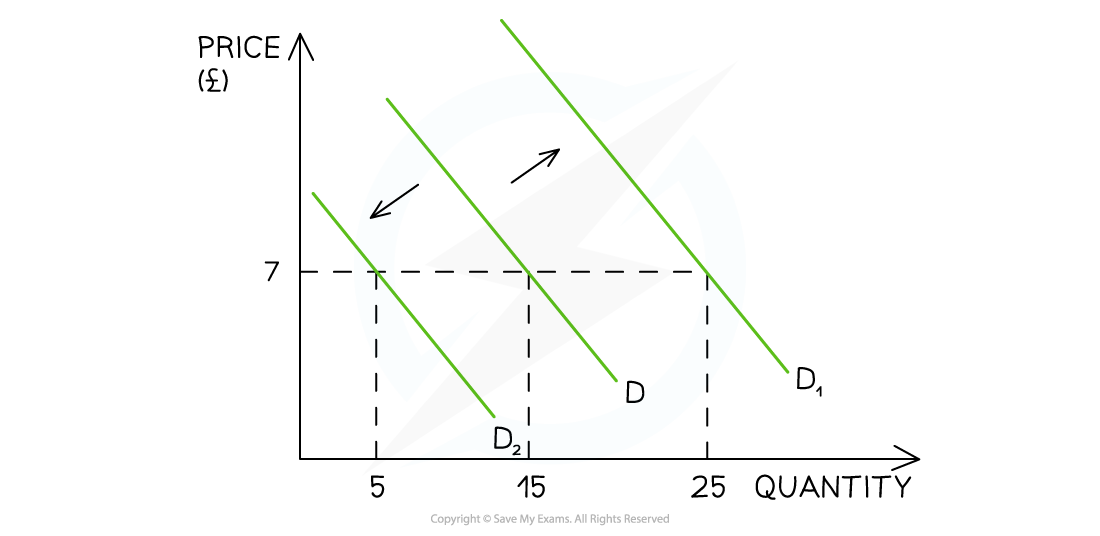
If income increases
Demand increases and shifts right (D→D1)
If income decreases
Demand decreases and shifts left (D→D2)
2. Change in consumer tastes and preferences
If goods and services become more fashionable, then demand for them increases
There is a direct relationship between changes in consumer preferences and demand
If preference for a product increase
Demand increases and shifts right (D→D1)
If preference for a product decrease
Demand decreases and shifts left (D→D2)
3. Improved advertising and branding
If more money is spent on advertising or branding, then demand for goods and services will increase as more consumers become aware of the product
There is a direct relationship between branding or advertising and demand
If advertising or brand awareness of a product increases
Demand increases and shifts right (D→D1)
If advertising or brand awareness of a product decreases
Demand decreases and shifts left (D→D2)
4. Changes in the prices of substitute goods
Changes in the price of substitute goods will influence the demand for a product/service
There is a direct relationship between the price of good A and demand for good B
For example, the price of a Sony 60" TV increases so the demand for LG 60" TV increases
If the price of good A increases
Demand for good B increases and shifts right (D→D1)
If the price of good A decreases
Demand for good B decreases and shifts left (D→D2)
5. Changes in the prices of complementary goods
Changes in the price of complementary goods will influence the demand for a product or service
There is an inverse relationship between the price of good A and demand for good B
For example, the price of printer ink increases so the demand for ink printers decreases
If the price of good A increases
Demand for good B decreases and shifts left (D→D2)
If the price of good A decreases
Demand for good B increases and shifts right (D→D1)
6. Changes in population size or distribution
If the population size of a country changes over time, then demand for goods and services will also change
There is a direct relationship between the changes in population size and demand
Demand will also change if there is a change to the age distribution in a country, as different ages demand different goods and services
For example, an ageing population will buy more hearing aids
If the population increases
Demand increases and shifts right (D→D1)
If the population decreases
Demand decreases and shifts left (D→D2)
Examiner Tips and Tricks
The difference between a movement along the demand curve and a shift in demand is essential to understand
When price changes (ceteris paribus), there is a movement along the demand curve resulting in a change to quantity demanded, which is a contraction or extension
When a condition of demand changes, there is a shift of the entire demand curve, resulting in a change to demand, which is an increase or a decrease in demand

Unlock more, it's free!
Join the 100,000+ Students that ❤️ Save My Exams
the (exam) results speak for themselves:

Was this revision note helpful?
