Price Discrimination (Cambridge (CIE) A Level Economics): Revision Note
Exam code: 9708

Conditions for effective price discrimination
Price discrimination occurs when a firm charges a different price for the same good or service in order to maximise its revenue
There are different types (degrees) of price discrimination
1. First-degree price discrimination
Occurs when a firm separates consumers based on their ability to pay
E.g market traders can often easily identify high-worth customer and double the price of the product offered – especially in situations where the product prices are not displayed
2. Second-degree price discrimination
Occurs when a firm gives discounts for bulk buying, e.g., 3 for 2 offers
3. Third-degree price discrimination
Occurs when a firm charges different prices to different consumers for the same good or service, e.g., rail fares are priced differently depending on the time of travel
Third-degree markets are often sub-divided based on time, age, income and geographic location
Some airline ticket portals charge higher prices to customers using an Apple computer, as they are likely to have higher income
Conditions required for price discrimination to occur
Market power | Varying consumer price elasticity of demand (PED) | Ability to prevent resale of tickets |
|---|---|---|
|
|
|
Case Study
Context
In South Korea, train operators use third-degree price discrimination, charging different fares to different groups of passengers based on time of travel
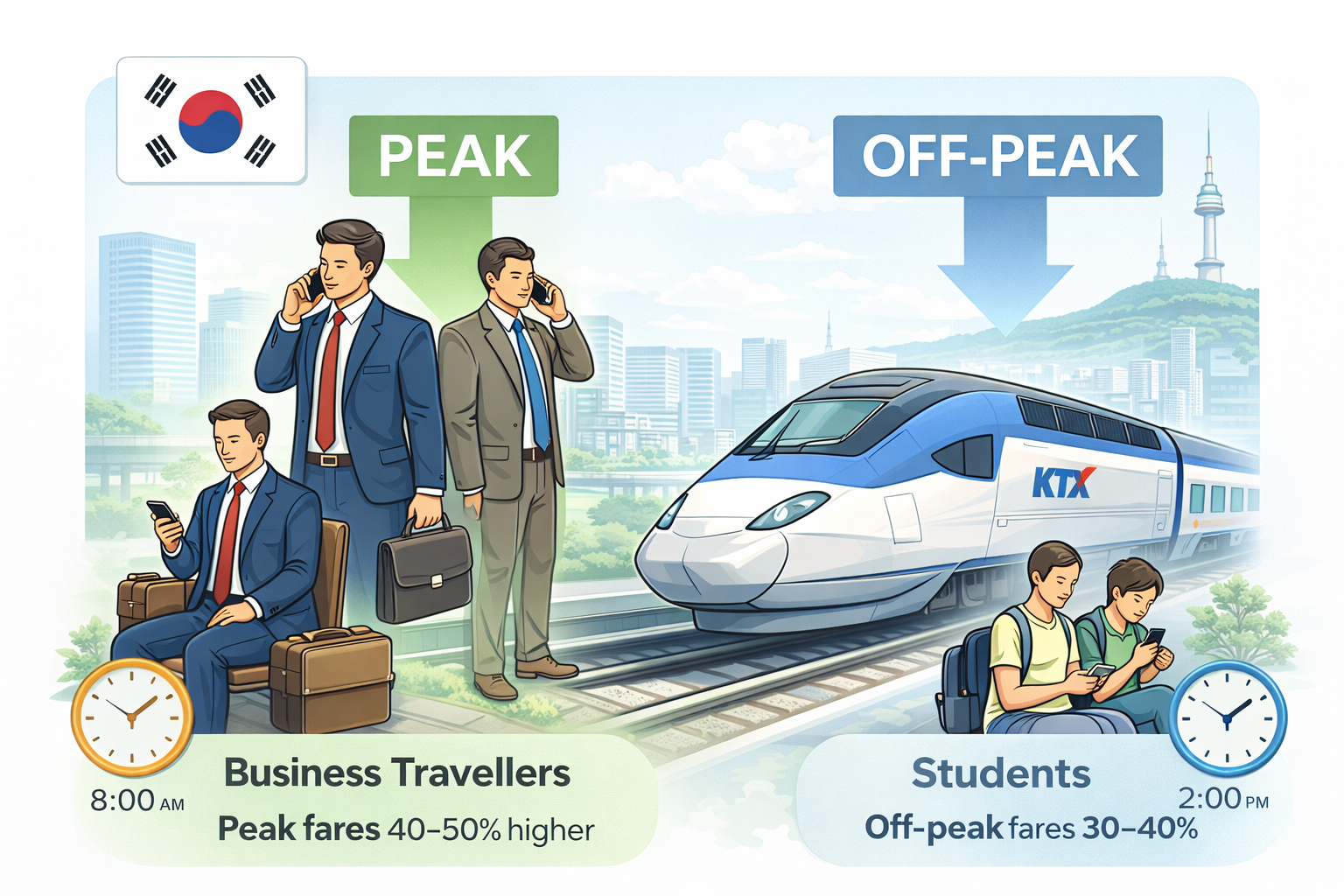
Price discrimination
Peak fares are charged during busy periods, while off-peak fares are offered during quieter times
Business travellers often pay 40–50% higher peak fares
Students and seniors may receive off-peak discounts of around 30–40%
Outcome
This pricing strategy allows operators to increase revenue from passengers with inelastic demand
It also helps fill spare capacity by offering lower fares to passengers with more elastic demand
Illustrating third-degree price discrimination
In order to illustrate third-degree price discrimination diagrammatically, the different sub-market diagrams are placed side by side
The total market diagram is a combination of the sub-market diagrams
The total profit is a combination of profits from the sub-markets
The diagram below illustrates the market for rail travel in the UK, where inelastic demand is 'peak' hour demand and elastic demand is any other time of the day, i.e., 'off-peak'.
Third-degree price discrimination

Diagram analysis
Each train route has an effective monopoly provider
The overall firm is producing at the profit-maximising level of output, where MC=MR
This point is extrapolated to both sub-markets on the left by using the lower dotted line
The average cost is extrapolated across both sub-markets using the upper dotted line (C1)
A higher price for peak travel has been set at Pa & a lower price for off-peak travel has been set at Pb
Following the revenue rule, total revenue increased in both markets
The profit for sub-market A = (Pa-C1) * Q1
The profit for sub-market B = (Pb-C1) * Q2
The firm's total profit is the average selling price minus the average costs
Total profit = (Pt-C1) * Q3
The firms' total profits are higher than if they had charged a single price to all customers
Consequences of price discrimination
Price discrimination redistributes consumer surplus and profit between consumers and firms
Consequence | Explanation | Example |
|---|---|---|
Higher profits for firms |
|
|
Different prices for different consumers |
|
|
Possible increase in output |
|
|
Redistribution of consumer surplus |
|
|
Potential efficiency gains |
|
|

Unlock more, it's free!
Join the 100,000+ Students that ❤️ Save My Exams
the (exam) results speak for themselves:

Was this revision note helpful?
