Other Pricing Policies (Cambridge (CIE) A Level Economics): Revision Note
Exam code: 9708

Limit pricing
Limit pricing occurs when a firm sets a price below the short-run profit-maximising level to deter new firms from entering the market
Common in monopolies and oligopolies
Why do firms use limit pricing?
Prevents entry by making the market appear unprofitable
Protects long-run supernormal profit
Acts as a barrier to entry
Key features
The price is set low enough to discourage entry, but high enough to still earn profit
Firms often:
Increase output
Exploit economies of scale
More effective when:
Barriers to entry are already high
Incumbent firms have cost advantages
Limitations
Firms sacrifice short-run profit
May not work if:
New firms have lower costs
Market demand is growing rapidly
Difficult to sustain in the long run
What is price leadership?
Price leadership occurs when one dominant firm (price leader) sets the price, and other firms (followers) adjust their prices accordingly
Common in oligopolistic markets
Types of price leadership
Dominant firm leadership → largest firm sets price
Barometric leadership → most informed firm sets the price
Collusive leadership → firms informally agree on a leader
Key characteristics
Firms avoid price wars
Prices are relatively stable
Competition shifts to:
Non-price factors (branding, quality, advertising)
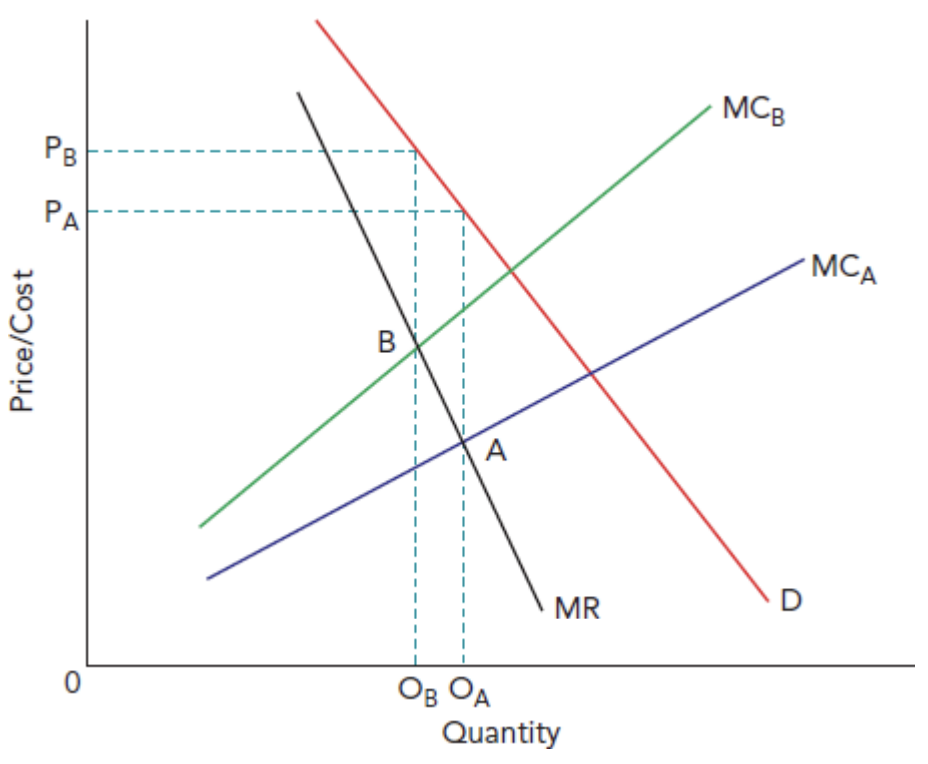
Diagram analysis
The price leader (Firm A):
Produces where MCₐ = MR
Sets price at Pₐ from the demand curve
The follower (Firm B):
Has higher costs → its profit-maximising price would be Pᵦ
But must match Pₐ to remain competitive
Therefore:
Firm B earns lower profit (or may make losses)
Firm A gains a cost advantage
Evaluation of price leadership
Advantages | Disadvantages |
|---|---|
|
|
Predatory pricing
Predatory pricing occurs when a firm deliberately sets a very low (often below cost) price to force competitors out of the market
Why do firms use predatory pricing?
Eliminate existing competitors
Deter potential entrants
Increase market power
Key features
Prices may fall below average cost (AC)
Firms make short-run losses
After rivals exit:
Firm raises prices
Earns supernormal profit
Limitations
Very expensive strategy (requires financial reserves)
Competitors may:
Survive (e.g. government support)
Retaliate with price cuts
Often illegal under competition law
Hard to prove in practice
Case Study
Context
In the 2010s, Uber expanded rapidly into global ride-hailing markets, including the US, India, and Southeast Asia. It faced strong local competitors such as Lyft (US) and Grab (SE Asia). Markets were highly competitive with low switching costs for consumers
Strategy
Uber used predatory pricing tactics by:
Offering heavily discounted fares
Providing driver incentives and bonuses
Prices were often set below cost, leading to large short-run losses
The aim was to:
Undercut rivals
Gain market share quickly
Force weaker competitors to exit
Outcome
Several competitors were driven out or acquired
Uber sold its Southeast Asia operations to Grab (2018) after intense losses
In markets where competition weakened:
Prices began to rise
Uber moved closer to profitability
However
Regulators have investigated Uber for anti-competitive behaviour
The strategy proved costly and risky, with sustained financial losses
Examiner Tips and Tricks
An excellent evaluation point in essays for questions that include predatory pricing is 'Predatory pricing may eliminate competition in the short run, but it involves significant losses and regulatory risk'

Unlock more, it's free!
Join the 100,000+ Students that ❤️ Save My Exams
the (exam) results speak for themselves:

Was this revision note helpful?