Consumer Response to Price Changes (Cambridge (CIE) A Level Economics): Revision Note
Exam code: 9708

Income and substitution effects
When the price of a product changes, two effects happen at the same time:
Substitution effect
The product becomes cheaper or more expensive relative to other goods, so the consumer may switch towards or away from it
Income effect
The price change makes the consumer feel effectively richer or poorer because their real purchasing power changes
This can be shown with indifference curves and budget lines and can be understood clearly with everyday examples
1. Price increase for a normal good
Consider a consumer choosing between:
Good X: cinema tickets
Good Y: takeaway pizza
Both are normal goods (demand increases when income rises)
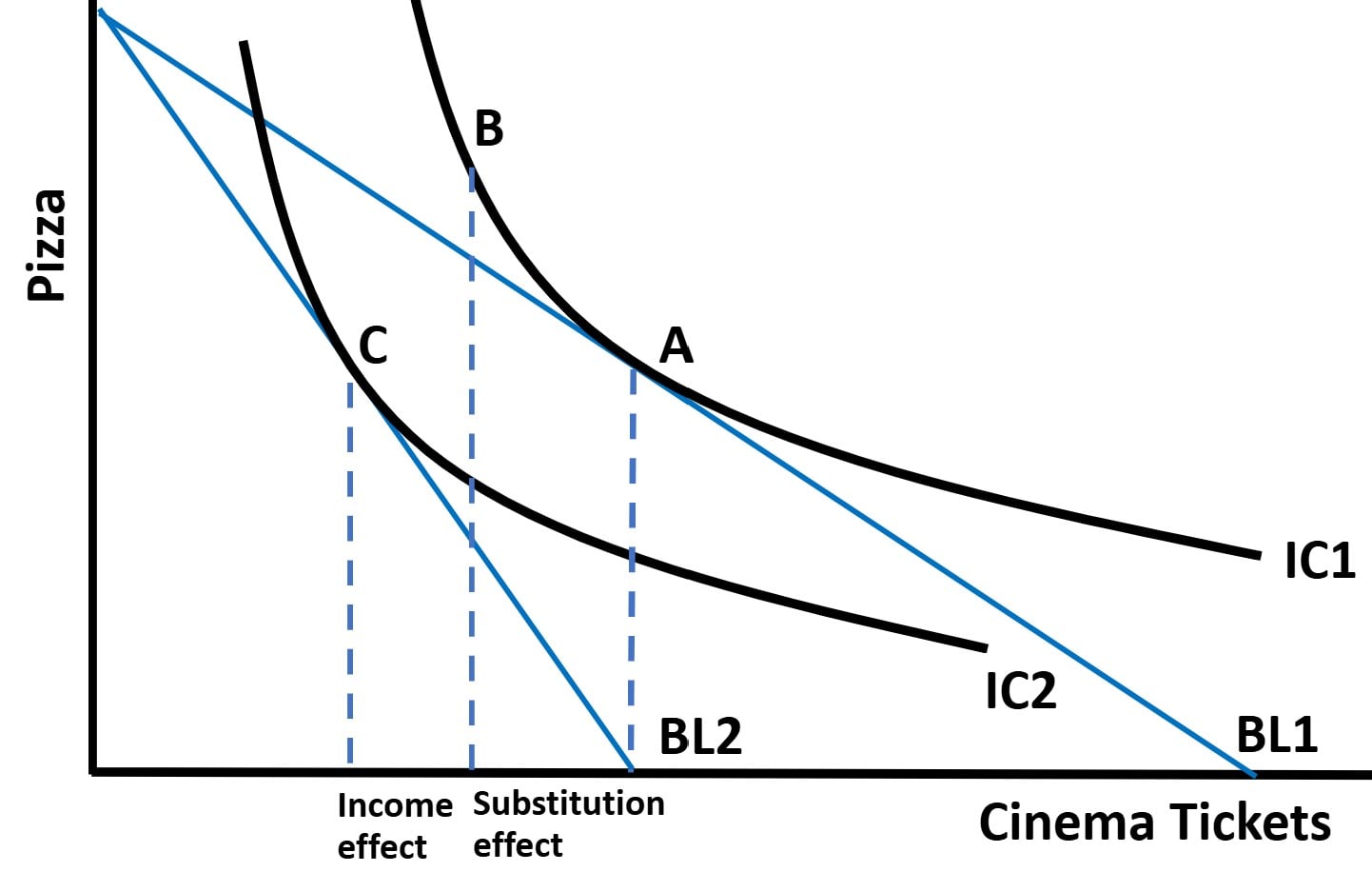
Substitution effect (moving along the same indifference curve)
If the price of cinema tickets rises:
Cinema becomes more expensive relative to pizza
Even if income has not changed, the cinema now gives less “value per pound” than before
This pivots the budget line from BL1 to BL2
The substitution effect means the consumer will cut back on cinema tickets and buy more pizza instead, holding their real level of satisfaction constant
This moves one combination of cinema-and-pizza on an indifference curve from Point A to another combination on the same curve at Point B, where they are still equally satisfied but have adjusted the mix
Income effect (moving to a lower indifference curve)
Now add the income effect:
As the cinema is more expensive, the consumer’s income doesn’t stretch as far
They feel poorer in real terms, even though their income is unchanged
For a normal good like the cinema, feeling poorer means they will usually want less of it, not more
The income effect also pushes them towards fewer cinema tickets and less pizza too at Point C
Summary
For a normal good, after a price increase:
Substitution effect: reduces quantity demanded of X
Income effect: also reduces quantity demanded of X
Together, these explain why the demand curve for normal goods slopes downward
2. Price decrease for a normal good
Now consider the price of cinema tickets. falling
Substitution effect (moving along the same indifference curve)
Cinema tickets are now cheaper compared to pizza
The consumer will tend to swap some pizza for more cinema because the cinema now gives more satisfaction per pound.
This is the substitution effect. There will be a movement along the same indifference curve to a point with more cinema and less pizza, keeping overall satisfaction constant
Income effect (moving to a higher indifference curve)
Because the cinema is cheaper, the consumer's real income has increased, so each £ now goes further
For a normal good, higher real income means they want more cinema, not less
They may also increase pizza consumption, because feeling richer often boosts demand for many normal goods
Summary
For a normal good after a price fall:
Substitution effect: increases quantity demanded of X
Income effect: also increases quantity demanded of X
Both work in the same direction, so demand clearly increases when the price falls
3. Price change for an inferior good
If we now consider:
Good X: supermarket-value noodles (cheap, basic meal)
Good Y: fresh pasta dishes (more expensive, higher quality)
Assume value noodles are an inferior good: when real income rises, the consumer prefers to buy fewer noodles and more of the nicer pasta meals
Price decrease for an inferior good
If the price of value noodles (X) falls:
Substitution effect:
Noodles are cheaper relative to fresh pasta
The consumer is likely to buy more noodles and fewer pasta dishes, because noodles now look like better value
This effect always increases demand for the cheaper good, whether it is normal or inferior
Income effect:
The lower price means their real income rises
As noodles are inferior, feeling richer may make them want fewer noodles and more pasta
So the income effect for an inferior good goes in the opposite direction to the substitution effect
In most real‑world cases, the substitution effect is stronger. The total demand for noodles still rises when the price falls, but not as much as it would if noodles were a normal good
4. The special case of a giffen good
A giffen good is a very unusual type of inferior good where:
The negative income effect is so strong that it more than cancels out the substitution effect
As a result, when the price rises, demand also rises, and when price falls, demand falls
Example
Plain bread or basic rice
People are so poor that they spend most of their income on this cheaper staple item
When the price of the staple rises, they feel much poorer and cannot afford better quality foods
They may be forced to cut back on meat, fruit, or vegetables
They buy more of the cheaper staple item, even at a higher price, simply to avoid going hungry
Summary
Substitution effect: The higher price of bread should reduce quantity demanded
Income effect: The higher bread price makes them much poorer, so they cut back on higher‑quality foods and buy more bread
If the income effect is bigger than the substitution effect, the result is a giffen good, where the demand curve slopes upward

Unlock more, it's free!
Join the 100,000+ Students that ❤️ Save My Exams
the (exam) results speak for themselves:

Was this revision note helpful?