1
30 marks
Evaluate the view that the outcomes of general elections are mostly decided by election campaigns and manifestos.
You must consider this view and the alternative to this view in a balanced way
Was this exam question helpful?
Exam code: 9PL0
Evaluate the view that the outcomes of general elections are mostly decided by election campaigns and manifestos.
You must consider this view and the alternative to this view in a balanced way
Was this exam question helpful?
Look at Source
Source shows how in May 1997 the Labour Party, headed by Tony Blair, won the General Election after 18 years of Conservative rule. Different perspectives on the election are given by The Guardian and the President of the Liberal Democrats, Mark Pack.
The Guardian Electoral mistakes had been learned by Labour when in opposition, it was aware of faults in previous campaigns. Importantly, it had now got the media on side, producing a far less hostile press. The party was unified with no major issues splitting them to cause divisions. Labour ran a slick and well-managed campaign which appealed to many and was inclusive. The campaign focused on the core issues which mattered to the electorate, and which shaped party policy. The electorate trusted Labour and had economic faith in them. The country saw a need to head into new policy areas avoided for too long, such as constitutional reform and recognition of key human rights. The party had rebranded itself as New Labour, this was a transformational move which won widespread support. The electorate were looking forward and voted for Labour for radical change. Mark Pack The main reason for Labour success in 1997 was the Conservative Party’s failure in office. The electorate witnessed a governing party split and divided over the issue of Europe. It saw a government that seemed out of touch with ordinary people. A series of scandals rocked the party, and it was damaged by sleaze. There was a failure to see the economic insecurity felt by many and failure on economic issues. Furthermore, 1997 did not bring in a huge range of new policy. Labour accepted the Thatcherite legacy on free markets and continued with economic plans set by the Conservatives. Policy was not a vote winner for Labour rather it was the negative image of the Conservative Party. The Conservatives failed to inspire the electorate. Rather than looking forward, the electorate looked back and saw a series of mistakes and decided to punish the Conservatives. |
(Source: Mark Pack perspective: https://www.markpack.org.uk/4875/ (opens in a new tab) why-wasnt-it-the-economy-stupid-in-1997/)
Using the source, evaluate the view that in 1997 the election was lost by the governing party rather than it being won by the Labour opposition.
In your response you must:
compare and contrast different opinions in the sources
examine and debate these views in a balanced way
analyse and evaluate only the information presented in the sources.
Was this exam question helpful?
Source 1 concerns the use of opinion polls in UK politics. Part of the extract comes from a House of Lords report into the recent impact of the use of polls. The second part of the extract is a more positive view of polling from Peter Kellner in The Evening Standard.
Source 1 Opinion polls influence voters and parties. They can deflate turnout if they show one party way ahead. Opinion polls cause voters to vote tactically. Opinion polls can influence the demand to call a general election and for parties to abandon principles in order to gain popularity. In the Scottish independence referendum, a poll showing that ‘leave’ was in the lead made all the parties work harder to change the outcome. The core issue is that they mislead and do not give an accurate reflection of the voting preferences across the UK and as such they damage democracy. The 2017 polls were not all wrong. They successfully reflected changing opinions during the campaign. Theresa May’s rating tumbled, while Jeremy Corbyn’s rose. Social care was the issue that caused Conservative support to fall. They correctly showed the Liberal Democrats had stalled, with UKIP support collapsing, and a significant switch from the SNP to the Conservatives in Scotland. They showed how Labour’s manifesto gained them support while the Conservative manifesto put voters off. In a close contest, opinion polls can improve turnout. Opinion polls are part of a free media and integral to a healthy representative democracy. |
(Sources: adapted from https://publications.parliament.uk/pa/ld201719/ (opens in a new tab) ldselect/ldppdm/106/10605.htm#_idTextAnchor010, and https://www.standard.co.uk/news/politics/general-electionpolls-how-the-pollsters-got-it-wrong-a3560936.html (opens in a new tab))
Using the source, evaluate the view that opinion polls bring more advantages than disadvantages to elections and referendums.
In your response you must:
compare and contrast different opinions in the source
examine and debate these views in a balanced way
analyse and evaluate only the information presented in the source.
Was this exam question helpful?
Evaluate the view that the influence of the media in politics is exaggerated; it is not heavily biased and has little power of persuasion.
You must consider this view and the alternative to this view in a balanced way.
Was this exam question helpful?
This source is adapted from the YouGov website, which analysed the 2017 General Election: its findings covered a range of topics that influenced the electorate. It attempts to understand the reasons why people voted for a particular political party.
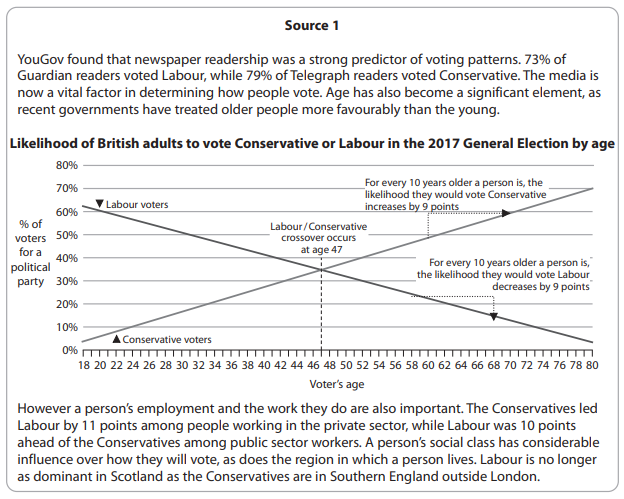
Using Source 1, evaluate the view that a person’s age and the media have now replaced social class and region as clear indicators of voting behaviour.
In your response you must:
compare and contrast different opinions in the source
examine and debate these views in a balanced way
analyse and evaluate only the information presented in the source.
Was this exam question helpful?
The source below considers the factors which deliver success for political parties in general elections. It reflects on whether the outcomes of general elections are predictable or whether the electorate can spring surprises, making the results more volatile.
Some people claim that success in a general election for a political party depends on stable and predictable forces. Few seats change hands in a general election and voting patterns are predictable and constant. In studies of voting behaviour factors such as an individual’s class and family background combined with the area in which they live all merge together to provide a clear indication of the way an individual will vote. On this basis, opinion polls accurately indicate the outcomes of a general election. When many people are asked, they readily identify with both a specific class and endorse the policies of a major political party. The dice is loaded from the start and outcomes of general elections are all too predictable and fixed. However, many now doubt the idea of predictability and the assumptions on which it is based. Instead of predictability they infer unpredictability and volatility with an inability to forecast accurately the outcome of how the public will vote. In fact in 2015, 111 seats changed hands and in 2017, 70. General elections and success in them is built around capturing ideas and having media support. What the political parties say in new policies and their manifestos matters greatly. Opinion polls, as the general election in 2017 showed, are no longer good indicators of the outcome. If anything, the 2017 general election illustrated the importance of age and education as indicators of how people vote. The media can make and break a political party. Riding the wave of media attacks, a political party must have a good leader who can weather any storm and connect with the masses. This is what Blair and Thatcher did and was the basis of their success. Policies and leaders are the crucial factors and, as such, they are the leading indicators for success at the polls. |
Using the source, evaluate the view that the outcomes of general elections are stable and predictable.
In your response you must:
compare and contrast different opinions in the source
examine and debate these views in a balanced way
analyse and evaluate only the information presented in the source.
Was this exam question helpful?