130 marks
Evaluate the view that the outcomes of general elections are mostly decided by election campaigns and manifestos.
You must consider this view and the alternative to this view in a balanced way.
Was this exam question helpful?
Exam code: 9PL0
Evaluate the view that the outcomes of general elections are mostly decided by election campaigns and manifestos.
You must consider this view and the alternative to this view in a balanced way.
Was this exam question helpful?
Source shows how in May 1997 the Labour Party, headed by Tony Blair, won the General Election after 18 years of Conservative rule. Different perspectives on the election are given by The Guardian and the President of the Liberal Democrats, Mark Pack.
The Guardian Electoral mistakes had been learned by Labour when in opposition, it was aware of faults in previous campaigns. Importantly, it had now got the media on side, producing a far less hostile press. The party was unified with no major issues splitting them to cause divisions. Labour ran a slick and well-managed campaign which appealed to many and was inclusive. The campaign focused on the core issues which mattered to the electorate, and which shaped party policy. The electorate trusted Labour and had economic faith in them. The country saw a need to head into new policy areas avoided for too long, such as constitutional reform and recognition of key human rights. The party had rebranded itself as New Labour, this was a transformational move which won widespread support. The electorate were looking forward and voted for Labour for radical change. Mark Pack The main reason for Labour success in 1997 was the Conservative Party’s failure in office. The electorate witnessed a governing party split and divided over the issue of Europe. It saw a government that seemed out of touch with ordinary people. A series of scandals rocked the party, and it was damaged by sleaze. There was a failure to see the economic insecurity felt by many and failure on economic issues. Furthermore, 1997 did not bring in a huge range of new policy. Labour accepted the Thatcherite legacy on free markets and continued with economic plans set by the Conservatives. Policy was not a vote winner for Labour rather it was the negative image of the Conservative Party. The Conservatives failed to inspire the electorate. Rather than looking forward, the electorate looked back and saw a series of mistakes and decided to punish the Conservatives. |
(Source: Mark Pack perspective: https://www.markpack.org.uk/4875/ (opens in a new tab) why-wasnt-it-the-economy-stupid-in-1997/)
Using the source, evaluate the view that in 1997 the election was lost by the governing party rather than it being won by the Labour opposition.
In your response you must:
compare and contrast the different opinions in the source
examine and debate these views in a balanced way
analyse and evaluate only the information presented in the source
Was this exam question helpful?
Source 1 concerns the use of opinion polls in UK politics. Part of the extract comes from a House of Lords report into the recent impact of the use of polls. The second part of the extract is a more positive view of polling from Peter Kellner in The Evening Standard.
Source 1 Opinion polls influence voters and parties. They can deflate turnout if they show one party way ahead. Opinion polls cause voters to vote tactically. Opinion polls can influence the demand to call a general election and for parties to abandon principles in order to gain popularity. In the Scottish independence referendum, a poll showing that ‘leave’ was in the lead made all the parties work harder to change the outcome. The core issue is that they mislead and do not give an accurate reflection of the voting preferences across the UK and as such they damage democracy. The 2017 polls were not all wrong. They successfully reflected changing opinions during the campaign. Theresa May’s rating tumbled, while Jeremy Corbyn’s rose. Social care was the issue that caused Conservative support to fall. They correctly showed the Liberal Democrats had stalled, with UKIP support collapsing, and a significant switch from the SNP to the Conservatives in Scotland. They showed how Labour’s manifesto gained them support while the Conservative manifesto put voters off. In a close contest, opinion polls can improve turnout. Opinion polls are part of a free media and integral to a healthy representative democracy. |
(Sources: adapted from https://publications.parliament.uk/pa/ld201719/ ldselect/ldppdm/106/10605.htm#_idTextAnchor010, and https://www.standard.co.uk/news/politics/general-electionpolls-how-the-pollsters-got-it-wrong-a3560936.html)
Using the source, evaluate the view that opinion polls bring more advantages than disadvantages to elections and referendums.
In your response you must:
compare and contrast the different opinions in the source
examine and debate these views in a balanced way
analyse and evaluate only the information presented in the source.
Was this exam question helpful?
Evaluate the view that the influence of the media in politics is exaggerated; it is not heavily biased and has little power of persuasion.
You must consider this view and the alternative to this view in a balanced way.
Was this exam question helpful?
This source is adapted from the YouGov website, which analysed the 2017 General Election: its findings covered a range of topics that influenced the electorate. It attempts to understand the reasons why people voted for a particular political party.
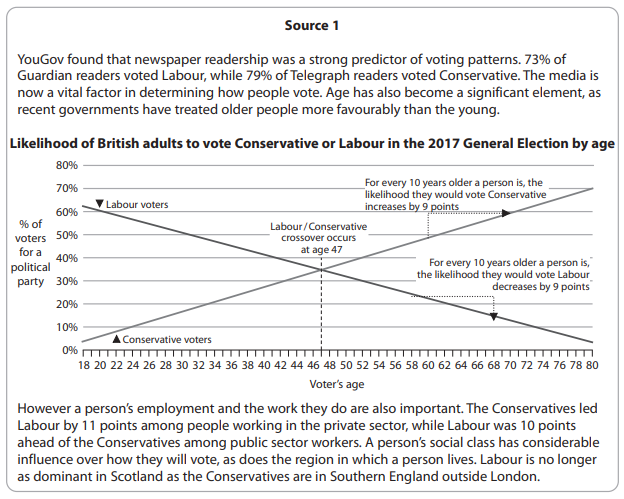
Using Source 1, evaluate the view that a person’s age and the media have now replaced social class and region as clear indicators of voting behaviour.
In your response you must:
compare and contrast different opinions in the source
examine and debate these views in a balanced way
analyse and evaluate only the information presented in the source.
Was this exam question helpful?
The source below considers the factors which deliver success for political parties in general elections. It reflects on whether the outcomes of general elections are predictable or whether the electorate can spring surprises, making the results more volatile.
Some people claim that success in a general election for a political party depends on stable and predictable forces. Few seats change hands in a general election and voting patterns are predictable and constant. In studies of voting behaviour factors such as an individual’s class and family background combined with the area in which they live all merge together to provide a clear indication of the way an individual will vote. On this basis, opinion polls accurately indicate the outcomes of a general election. When many people are asked, they readily identify with both a specific class and endorse the policies of a major political party. The dice is loaded from the start and outcomes of general elections are all too predictable and fixed. However, many now doubt the idea of predictability and the assumptions on which it is based. Instead of predictability they infer unpredictability and volatility with an inability to forecast accurately the outcome of how the public will vote. In fact in 2015, 111 seats changed hands and in 2017, 70. General elections and success in them is built around capturing ideas and having media support. What the political parties say in new policies and their manifestos matters greatly. Opinion polls, as the general election in 2017 showed, are no longer good indicators of the outcome. If anything, the 2017 general election illustrated the importance of age and education as indicators of how people vote. The media can make and break a political party. Riding the wave of media attacks, a political party must have a good leader who can weather any storm and connect with the masses. This is what Blair and Thatcher did and was the basis of their success. Policies and leaders are the crucial factors and, as such, they are the leading indicators for success at the polls. |
Using the source, evaluate the view that the outcomes of general elections are stable and predictable.
In your response you must:
compare and contrast the different opinions in the source
examine and debate these views in a balanced way
analyse and evaluate only the information presented in the source.
Was this exam question helpful?
Evaluate the view that the outcome of the 1979 general election was determined more by the Winter of Discontent than by Margaret Thatcher's personal appeal.
You must consider this view and the alternative to this view in a balanced way.
Was this exam question helpful?
Evaluate the view that the televised leaders' debates decided the outcome of the 2010 general election.
You must consider this view and the alternative to this view in a balanced way.
Was this exam question helpful?
Evaluate the view that the 2024 general election marked a fundamental realignment in UK voting behaviour.
You must consider this view and the alternative to this view in a balanced way.
Was this exam question helpful?
Evaluate the view that ethnicity remains a more reliable predictor of voting behaviour than gender.
You must consider this view and the alternative to this view in a balanced way.
Was this exam question helpful?
Evaluate the view that tactical voting now has a decisive impact on the outcome of UK general elections.
You must consider this view and the alternative to this view in a balanced way.
Was this exam question helpful?
The Labour government led by James Callaghan lost a motion of no confidence by a single vote on 28 March 1979, forcing the general election held that May, which the Conservatives won under Margaret Thatcher. The vote followed the Winter of Discontent, a wave of public sector strikes over pay.
Both extracts come from that confidence debate. Article 1 is from the Leader of the Opposition, who moved the motion. Article 2 is the Prime Minister's reply.
Article 1 I beg to move, That this House has no confidence in Her Majesty's Government. … The essence of the motion is that the Government have failed the nation, that they have lost credibility, and that it is time for them to go. … Let us take the Prime Minister's own objectives as the test by which he should be judged. … His first objective was to overcome inflation. … [T]he fact is that this Government have been responsible for doubling the prices in the housewife's shopping basket. Far from being overcome, inflation is rising again and will rise in the coming months. … The Prime Minister's second objective was to make inroads into the unacceptably high level of unemployment … and to reduce it by 1979 to 3 per cent. Today it is double that figure. On that, too, the Prime Minister has failed. The Prime Minister's third objective was to achieve "a high-output, high-productivity, and a high-wage economy based on full employment". But only a week or so ago we had news of the worst level of manufacturing output this decade. Source: extract taken from a House of Commons debate on a motion of no confidence (speech of the Leader of the Opposition), 28 March 1979, Hansard vol. 965. Contains Parliamentary information licensed under the Open Parliament Licence v3.0. Article 2 I reply to the right hon. Lady by advancing three propositions. First, this Government, who have been in a minority in this House for most of their life, have achieved an outstanding record of social progress and economic performance. Secondly … during the years that lie ahead there will be a great deal for the Government and for the country to do in such areas as improving our industrial efficiency, the return to full employment, controlling prices, better industrial relations, and overcoming poverty. There will be no sense of complacency by the Government about what needs still to be done, but neither should we overlook the achievements of the last five years. My third proposition is that we shall make most progress by adapting and broadening the policies that have served so far to protect the people of this country in the midst of world recession and not by sudden switches or reversals of policy. The right hon. Lady clearly believed this afternoon that she was putting forward some new policies. On the contrary, what we heard was a repetition of the same old policies that the Conservative Government tried between 1970 and 1974—policies that failed. Source: extract taken from a House of Commons debate on a motion of no confidence (reply of the Prime Minister), 28 March 1979, Hansard vol. 965. Contains Parliamentary information licensed under the Open Parliament Licence v3.0. |
Using the source, evaluate the view that the 1979 general election offered voters a genuine choice between two different directions for Britain.
In your response you must:
compare and contrast the different opinions in the source
examine and debate these views in a balanced way
analyse and evaluate only the information presented in the source.
Was this exam question helpful?
At the general election of July 2024 the Labour Party won 411 of the 650 seats in the House of Commons, a majority of 174, on 33.7 per cent of the votes cast and the lowest turnout since 2001. Both extracts come from a Westminster Hall debate of January 2026 on a public petition, signed by more than a million people, calling for another general election. Article 1 is from a Liberal Democrat member. Article 2 is from a Labour member.
Article 1 … [S]ome people said they signed the petition because they would like to see proportional representation, because they feel the current Government do not represent the views of the country. Of course, many people meant that critically, but it also reflects the simple numerical fact that we have a voting system that gave a majority to a party that won 33.7% of the vote on the lowest turnout in 24 years. It would of course be unrealistic to even hope that such a Government could represent the views of the country, because they are so far below representing what at least 50% of people think. … [P]roportional representation would enshrine the idea of more than one party having to co-operate, compromise, listen and engage in order to form a broad-based and more representative Government. … It is not right that a Prime Minister of whatever party affiliation should be able to treat the country like a political casino, choosing on a whim when to have a general election. Source: extract taken from a Westminster Hall debate, 'Call for General Election' (speech of Olly Glover), House of Commons, 12 January 2026, Hansard vol. 778. Contains Parliamentary information licensed under the Open Parliament Licence v3.0. Article 2 … I am proud that we are rolling out free breakfast clubs across the country, making sure children go to school nourished and ready to learn. The Government also announced funding for 300 new nurseries … Recently, we scrapped the two-child benefit cap. Although Opposition Members might disagree with lifting thousands of children in my towns and villages, and 550,000 children across the country, out of poverty, I think it solves another stain on our country and is an investment in the future long-term success of our country. … Positive change takes time. We know that from many decades of history in this House and in town halls up and down this country. Labour was elected with a resounding victory, a large majority and a mandate to make decisions that turn this country around. Anybody looking at our manifesto can see a vision of what Britain will look like by the time we get to the next general election. That is how our political system works. That is how British Governments have always been judged; they get four or five years and then the public have their say. Source: extract taken from a Westminster Hall debate, 'Call for General Election' (speech of Josh Newbury), House of Commons, 12 January 2026, Hansard vol. 778. Contains Parliamentary information licensed under the Open Parliament Licence v3.0. |
Using the source, evaluate the view that Labour's victory in 2024 gave it a strong mandate to govern.
In your response you must:
compare and contrast the different opinions in the source
examine and debate these views in a balanced way
analyse and evaluate only the information presented in the source.
Was this exam question helpful?
Both extracts concern who holds power over what voters see, but they are separated by fourteen years. Article 1 is from a House of Lords debate of April 2025 on the future of news. Article 2 is from a House of Commons debate of July 2011, held during the phone hacking scandal, and is from the then Leader of the Opposition. News International, the company he names, owned The Sun and The Times and had just closed the News of the World.
Article 1 A healthy democracy needs voters to be informed and engaged; instead, we are seeing a significant rise in news avoidance, significant disengagement with news among some demographics, and lowering levels of voter turnout. … The growth of local news deserts is alarming. … [I]n too many areas voters next week will be going to the ballots almost blindfold. The absence of local professional journalism means local politicians not being held to account, a lack of transparency and an absence of channels for candidates to promote their policies. Instead, voters are reliant on social media. We know that these are the platforms for echo chambers and pile-ons, not reasoned debate. Voters are vulnerable there to simplistic populist policies that do not bear scrutiny. … [Carole Cadwalladr's] previous talk blew the lid on Cambridge Analytica and the massive, widespread harvesting of Facebook data that then allowed social media to be used to influence voters in the Brexit referendum and other elections. Source: extract taken from a House of Lords debate, 'The Future of News' (speech of Lord Knight of Weymouth), 25 April 2025. Contains Parliamentary information licensed under the Open Parliament Licence v3.0. Article 2 … The issue … goes beyond press regulation. … Why did not more of us speak out earlier? The answer is what we all know and used to be afraid to say: News International was too powerful. It owned 40% of the newspaper market before the closure of the News of the World. It owns two thirds of the pay [television] market through 39% of the Sky platform and Sky News. The Communications Act 2003 rightly stops an organisation holding [a commercial television] licence and more than 20% of newspapers, but it does not apply to digital channels. One might say that it was an analogue Act in a digital age. The Act needs to be updated as such a concentration of power is unhealthy. If one thing comes out of what we have seen in the past two weeks and over many years, it must be that we understand the point about concentrations of power in our society because large concentrations of power are more likely to lead to abuses of power. Source: extract taken from a House of Commons debate, 'Public Confidence in the Media and Police' (speech of the Leader of the Opposition), 20 July 2011. Contains Parliamentary information licensed under the Open Parliament Licence v3.0. |
Using the source, evaluate the view that media power in elections has shifted from the press to social media.
In your response you must:
compare and contrast the different opinions in the source
examine and debate these views in a balanced way
analyse and evaluate only the information presented in the source.
Was this exam question helpful?