Brain Anatomy & Function (College Board AP® Psychology): Revision Note

The hindbrain
The brain is the body's central processing center, responsible for regulating behavior, thought, emotion, and all bodily functions
Understanding the functions of brain structures allows psychologists to explain how damage or disruption to specific regions affects behavior and mental processes
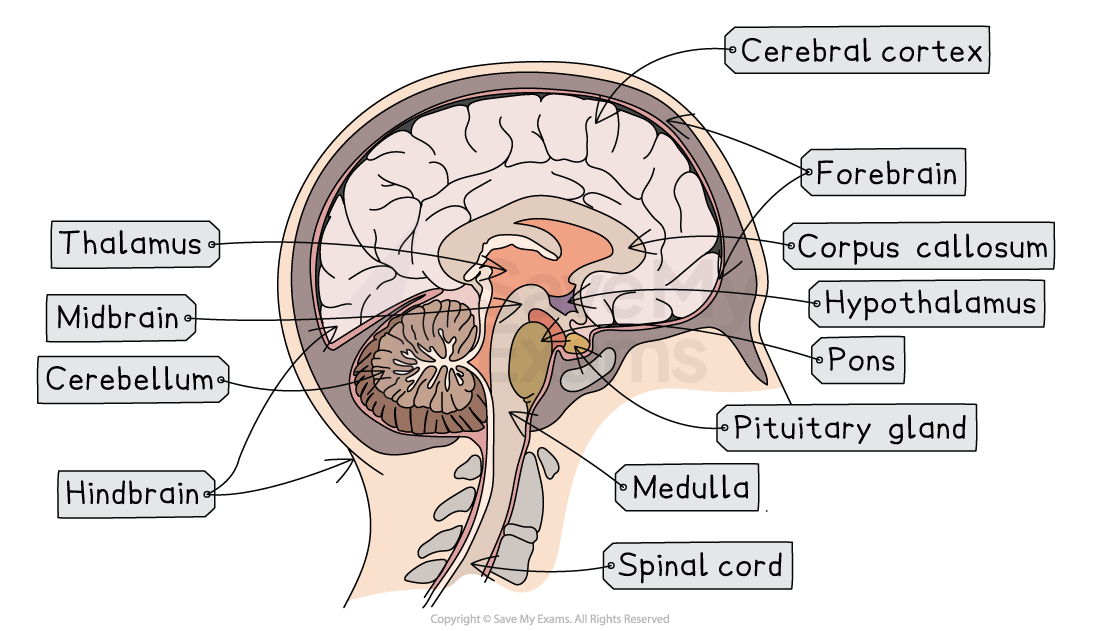
The brain is divided into three broad regions that reflect its evolutionary development:
The hindbrain is the oldest region and controls basic survival functions
The midbrain controls alertness and connects the hindbrain to the forebrain
The forebrain is the most recently evolved region, controlling complex thought, emotion, and behavior
The hindbrain is the most primitive part of the brain evolutionarily and is responsible for life-sustaining functions
It is composed of the brainstem (including the medulla), the cerebellum, and connects to the reticular activating system
The brainstem and medulla
The brainstem connects the brain to the spinal cord and serves as a relay station for signals traveling between the brain and the rest of the body
The medulla is located at the base of the brainstem and controls essential autonomic functions including:
breathing
heart rate
blood pressure
swallowing and digestion
Because the medulla controls these basic life-sustaining processes, damage to it can be life-threatening
The pons sits just above the medulla and acts as a bridge between the medulla and the rest of the brain. It plays a role in:
relaying sensory information to the brain
sleep and arousal
the control of REM sleep
The cerebellum
The cerebellum ("little brain") is located at the rear base of the brain and generally controls:
coordination of muscle movement
balance and posture
some forms of procedural learning (i.e. the automatic performance of well-practiced skills)
e.g. riding a bike or playing a musical instrument
The cerebellum does not initiate movement but fine-tunes and coordinates it
Without the cerebellum, movements become jerky and uncoordinated
Damage to the cerebellum can result in loss of balance, impaired coordination, and difficulty with motor tasks
The midbrain
The midbrain connects the hindbrain to the forebrain and plays a key role in alertness, arousal, and some aspects of movement
The reticular activating system (RAS)
The reticular activating system is a network of neurons running through the midbrain and into the brainstem
It generally controls:
alertness and wakefulness by:
filtering incoming sensory information
regulating transitions between sleep and waking
some voluntary movement
eye movement
some types of learning, cognition, and emotion
The RAS acts as the brain's "gatekeeper," determining which incoming stimuli receive conscious attention and which are filtered out
Damage to or disruption of the RAS can result in reduced consciousness, coma, or sleep disorders
The brain's reward center
The brain's reward center operates via dopaminergic pathways and generally controls:
the anticipation and experience of reward and pleasure
motivation and goal-directed behavior
some types of learning through reinforcement
The nucleus accumbens is a key structure within the reward center
It is heavily involved in pleasure, reward, and motivation
Many addictive drugs trigger dopamine release specifically here, creating intense feelings of reward that reinforce repeated drug use
The reward center is heavily implicated in addiction
Many psychoactive drugs produce their pleasurable effects by stimulating dopamine release in this pathway, reinforcing repeated drug use
The forebrain
The forebrain is the largest and most recently evolved part of the brain and it:
is responsible for the most complex aspects of human behavior, thought, and emotion
includes the limbic system and the cerebral cortex
The limbic system
The limbic system is a set of interconnected structures located beneath the cerebral cortex that plays a central role in:
emotion
memory
motivation
Key structures of the limbic system include:
Structure | Key functions |
|---|---|
Thalamus | Relay station for sensory information — receives input from all senses (except smell) and routes it to the appropriate cortical areas for processing. |
Hypothalamus | Regulates the body's internal environment (temperature, hunger, thirst, sexual arousal); controls the pituitary gland and links the nervous system to the endocrine system; also involved in the fight-or-flight response. |
Pituitary gland | The "master gland" of the endocrine system; releases hormones that regulate other glands throughout the body. |
Hippocampus | Critical for the formation of new memories and spatial navigation; damage to the hippocampus impairs the ability to form new long-term memories. |
Amygdala | Processes emotions, especially fear and aggression; plays a key role in the fear response and emotional memory. |
The cerebral cortex
The cerebral cortex is the outer layer of the brain
This is the deeply folded surface that gives the brain its wrinkled appearance
It is divided into two hemispheres (left and right), which are connected by the corpus callosum
The cerebral cortex is responsible for the most sophisticated human functions:
perception
language
higher-order thinking
decision-making
voluntary movement
The corpus callosum
The corpus callosum is a thick band of nerve fibers that connects the left and right hemispheres, allowing them to communicate and share information
When the corpus callosum is severed (a procedure sometimes performed to treat severe epilepsy)the two hemispheres can no longer communicate directly
Patients that have undergone this procedure are known as split-brain patients
Hemispheric specialization and split-brain research
Research on split-brain patients has revealed that the left and right hemispheres may specialize in different functions
This is known as lateralization
The left hemisphere is typically dominant for language processing, including:
Broca's area, which is responsible for speech production
Damage to this area causes Broca's aphasia, in which a person understands language but cannot produce fluent speech
Wernicke's area, which is responsible for speech comprehension
Damage to this area causes Wernicke's aphasia, in which a person produces fluent but meaningless speech
The right hemisphere is typically dominant for spatial processing, facial recognition, and holistic perception
Researchers test for hemispheric specialization in split-brain patients by presenting information to one visual field at a time
This takes advantage of the brain's contralateral organization
Contralateral organization refers to the principle that the left hemisphere processes information from the right visual field and vice versa
The four lobes of the cerebral cortex
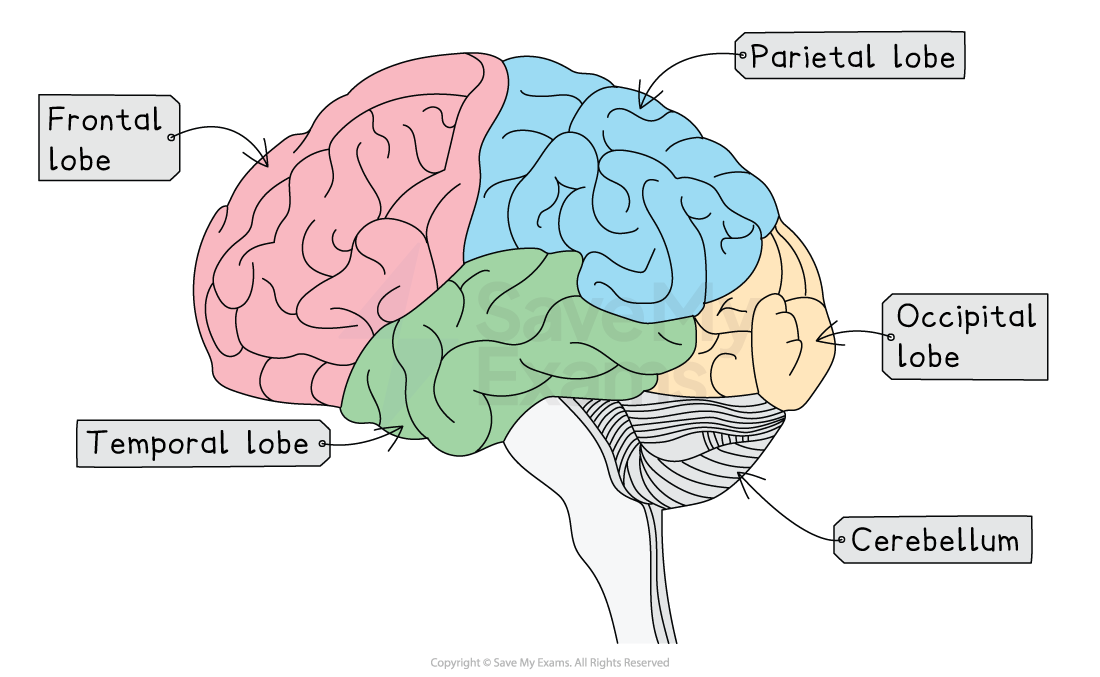
The cerebral cortex is further divided into four lobes, each with distinct functions:
Lobe | Location | Key functions |
|---|---|---|
Occipital lobes | Rear of the brain | Visual information processing |
Temporal lobes | Sides of the brain | Auditory and linguistic processing |
Parietal lobes | Back crown of the brain | Touch sensitivity (somatosensory cortex); processing and organizing sensory information (association areas) |
Frontal lobes | Behind the forehead | Higher-order thinking, executive functioning, linguistic processing (prefrontal cortex); skeletal movement (motor cortex, located at the rear of the frontal lobes) |
Brain plasticity
Brain plasticity, also called neuroplasticity, is the ability of the brain to rewire itself by modifying or creating new neural connections throughout development and in response to experience, injury, or disease
Plasticity allows the function of a damaged brain region to be assumed by a different region, enabling partial recovery from injury
E.g. a patient who suffers damage to Broca's area may partially recover speech production as other brain regions adapt and take over
Plasticity is greatest in childhood but continues throughout the lifespan
Younger brains are generally more plastic and better able to compensate for damage
Examiner Tips and Tricks
The AP exam focuses on the functions of brain structures and how damage to them affects behavior
Make sure you can explain what happens when each structure in the brain it is damaged (Skill 1.A)
E.g. hippocampus damage impairs new memory formation; amygdala damage reduces fear responses
For Skill 2.C, much of what we know about the brain comes from non-experimental research such as case studies of brain-damaged patients
Be ready to evaluate the limitations of this approach, e.g. case studies cannot establish causation and findings may not generalize
For Skill 2.D, lesioning studies and early split-brain research raise ethical questions
Consider whether participants gave informed consent and whether the procedures caused unnecessary harm
For Skill 3.A, you may be shown a diagram of the brain and asked to identify a structure or match a function to a region
Practice locating the four lobes, the key limbic system structures, and the brainstem/cerebellum on a diagram

Unlock more, it's free!
Join the 100,000+ Students that ❤️ Save My Exams
the (exam) results speak for themselves:

Was this revision note helpful?