The Divisions of the Nervous System (College Board AP® Psychology): Revision Note

The central nervous system (CNS)
The nervous system is the body's primary communication network, responsible for:
collecting information from the internal and external environment
processing this information
coordinating appropriate responses
The nervous system is divided into two major interconnected divisions that work together:
The central nervous system (CNS)
The peripheral nervous system (PNS)
These two systems are not independent as they communicate constantly
The PNS relays information to and from the CNS to enable behavior and mental processes
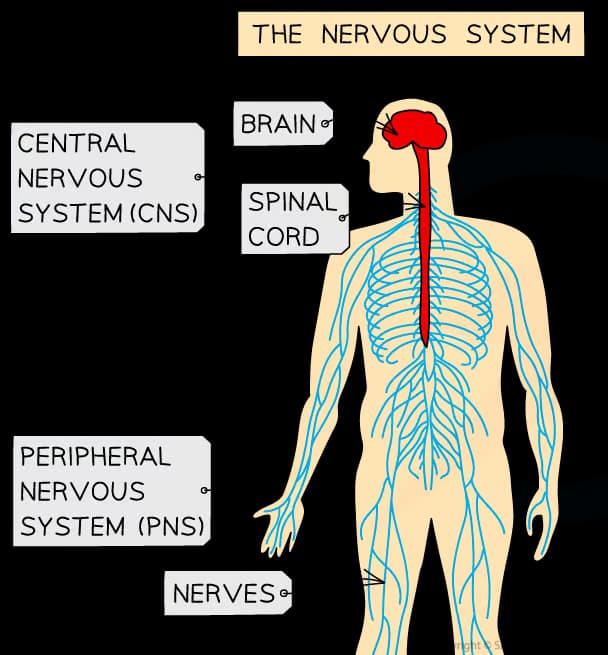
The CNS consists of the brain and the spinal cord, and interacts with all processes in the body
The brain is the body's central processing center for behavior, thoughts, motivations, and emotions
It regulates a wide range of functions including:
body temperature, heart rate, and breathing
language production and comprehension
coordinating movement
problem-solving and planning
processing sensory information from the environment
The spinal cord is a bundle of nerves housed within the protective bones of the spine (the vertebrae)
It transmits signals between the brain and the rest of the body via the PNS
It also plays a role in producing rapid, automatic responses to stimuli
Because the CNS is responsible for integrating and processing all incoming information and generating responses, damage to the CNS can have profound effects on behavior and mental processes
E.g. damage to spinal cord can disrupt the transmission of motor signals from the brain to the body, resulting in paralysis
The peripheral nervous system (PNS)
The PNS consists of all the nerves outside the brain and spinal cord
It relays messages between the CNS and the rest of the body
Sensory (afferent) neurons carry information from the body and environment toward the CNS
Motor (efferent) neurons carry instructions from the CNS out to muscles and organs
The PNS is divided into two subsystems:
The somatic nervous system
The autonomic nervous system
The somatic nervous system
The somatic nervous system governs voluntary processes
These are movements and actions that are under conscious control
E.g. choosing to pick up a pen, throw a ball, or stand up from a chair
It controls the movement of skeletal muscles in response to instructions from the motor cortex of the brain
The somatic nervous system also transmits sensory information from the body to the brain, such as touch, sound, smell, and taste
E.g. the sensation of texture when touching a surface, or the flavor of food on the tongue
The autonomic nervous system
The autonomic nervous system (ANS) governs involuntary processes
These are bodily functions that occur automatically without conscious control
E.g. heart rate, breathing, digestion, and the stress response
The ANS is further divided into two complementary subsystems:
The sympathetic nervous system
The parasympathetic nervous system
The sympathetic nervous system
The sympathetic nervous system prepares the body for physical activity in response to a perceived threat or stressor
The hypothalamus detects the stimulus and triggers the release of adrenaline from the adrenal glands
This produces rapid physiological changes that enable a fast, automatic response
E.g. accelerated heart rate, widened airways for increased breathing capacity, pupil dilation, and sweating
This response can also be triggered by excitement or intense positive arousal, not only by threat
The parasympathetic nervous system
The parasympathetic nervous system conserves the body's energy and returns it to a resting state after the sympathetic response has been activated
It slows heart and breathing rates, lowers blood pressure, and promotes digestion
The more time spent in a parasympathetic state, the more efficiently the body can recover and maintain health
The sympathetic and parasympathetic systems work in opposition to one another, but together they maintain the body's overall equilibrium
This is a state known as homeostasis
Sympathetic nervous system | Parasympathetic nervous system | |
|---|---|---|
Role | Activates the body for action | Returns the body to a state of rest |
Known as | "Fight or flight" system | "Rest and digest" system |
Triggered by | Perceived threat or high arousal | Safety, relaxation, recovery |
Effects on the body | Accelerated heart rate, dilated pupils, increased breathing rate, decreased digestion | Slowed heart rate, constricted pupils, decreased breathing rate, increased digestion |
Typical example | Preparing to run from a threat | Recovering after a stressful event |

Examiner Tips and Tricks
The AP exam may present a scenario describing a physiological response and ask you to identify which part of the nervous system is responsible (Skill 1.A), e.g.
a person's heart rate increasing when startled is the sympathetic nervous system
their heart rate slowing after the threat passes is the parasympathetic nervous system

Unlock more, it's free!
Join the 100,000+ Students that ❤️ Save My Exams
the (exam) results speak for themselves:

Was this revision note helpful?