Encoding & Storage (College Board AP® Psychology): Revision Note

Encoding strategies
Encoding is the process by which information is put into memory
How information is encoded determines how effectively it can be stored and later retrieved
Encoding can be:
automatic: unconscious and effortless, e.g. encoding the location of where you left your keys or the time you ate lunch
effortful: conscious and deliberate, e.g. studying for an exam or memorizing a speech
Several strategies can improve the effectiveness of encoding
Mnemonic devices
Mnemonic devices are strategies that aid encoding by linking new information to something already known, making it easier to store and retrieve
Method of loci: a mnemonic technique in which items to be remembered are mentally placed at specific locations along a familiar route or in a familiar place
To recall the items, you mentally "walk" the route and retrieve each item from its location
E.g. to remember a grocery list, you might imagine a carton of orange juice dripping off your front door, broccoli sitting on your sofa, and onions on your kitchen counter - each item is anchored to a specific location
Acronyms and acrostics: forming a word or sentence from the first letters of items to be remembered
E.g., ROYGBIV to remember the colors of the visible spectrum (red, orange, yellow, green, blue, indigo, violet)
Mnemonic devices are most effective when combined with the dual-coding hypothesis
Encoding information in both verbal and visual formats creates two memory traces, making recall more likely than if only one format is used
E.g. drawing a diagram alongside written notes encodes the same material in two ways, improving retention
Chunking
Chunking is the process of grouping individual pieces of information into larger, meaningful units to improve encoding
Chunking does not increase the number of slots in STM, rather it increases the amount of information held in each slot
E.g. the string F-B-I-C-I-A-N-B-A is nine individual letters, but grouped as FBI, CIA, NBA it becomes three meaningful chunks that are much easier to hold in memory
Information can also be grouped into categories or hierarchies to aid encoding
E.g. organizing a shopping list by category (dairy, vegetables, snacks) rather than as a random list makes it easier to encode and recall
The spacing effect
The spacing effect is the finding that encoding is significantly more effective when study sessions are distributed over time rather than concentrated in a single session
Distributed practice: spreading study sessions out over days or weeks, which is more effective for long-term retention
Massed practice: concentrating all studying into one session (also known as cramming) produces short-term retention but poor long-term recall
E.g. studying AP Psychology for one hour a day for seven days produces significantly better long-term retention than studying for seven hours the day before the exam
The spacing effect has direct implications for how students should structure their revision
The serial position effect
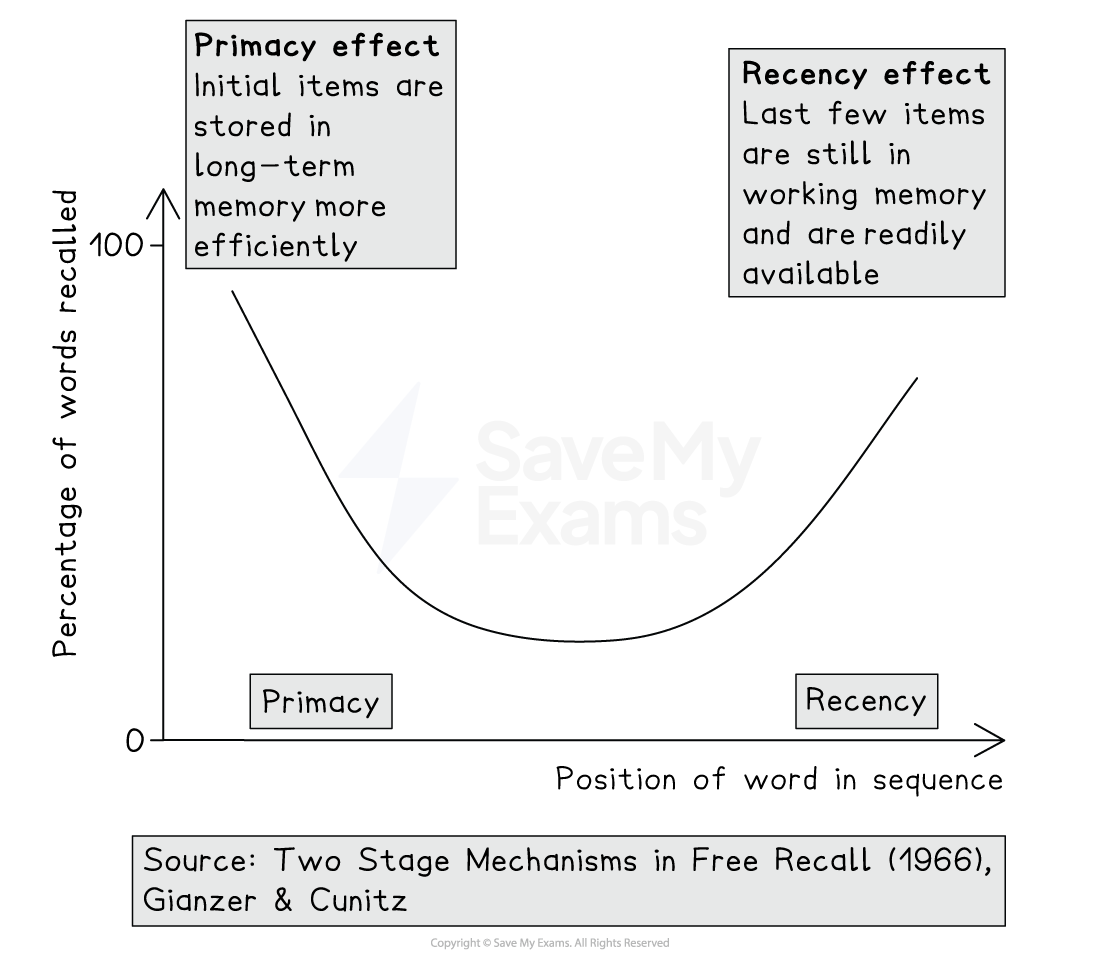
The serial position effect is the finding that recall is better for items at the beginning and end of a list than for those in the middle:
Primacy effect: items at the beginning are well remembered because they have been rehearsed and transferred to LTM
Recency effect: items at the end are well remembered because they are still held in STM at the time of recall
Items in the middle are poorly remembered because they have left STM but have not been sufficiently rehearsed to reach LTM
This pattern supports the multi-store model of memory because if memory were a single system, there would be no reason for recall to differ across serial positions
The serial position effect is demonstrated by the serial position curve
This is a U-shaped graph where the curve rises at the beginning (primacy), dips in the middle, and rises again at the end (recency)
Storage processes
Storage is the process by which encoded information is retained in memory over time
The four memory stores differ in their storage duration, capacity, and content
Store | Duration | Capacity | Coding |
|---|---|---|---|
Sensory memory | Fraction of a second (iconic ~0.5s; echoic ~3–4s) | Very large | Modality-specific (visual, auditory, etc.) |
Short-term memory | 18–30 seconds (without rehearsal) | 7 items (+/- 2) | Primarily acoustic |
Working memory | Active while in use | Limited (central executive has finite resources) | Verbal, visual, and spatial |
Long-term memory | Potentially a lifetime | Potentially unlimited | Primarily semantic |
Storage can be prolonged through rehearsal:
Maintenance rehearsal: is simple repetition to keep information in STM
E.g. repeating a phone number until you can write it down; effective for short-term retention only
Elaborative rehearsal: processing information in a way that promotes meaning and connects it to existing knowledge. This is more effective for transferring information to LTM
E.g. when learning that the amygdala is involved in fear responses, connecting it to a memory of feeling afraid makes it easier to recall than simply repeating the word "amygdala"
Autobiographical memory
Autobiographical memory is a person's memory for events and experiences from their own life, starting from around the age of four
Autobiographical memory is a form of episodic memory
Memories connected to our own lives and selves tend to be more memorable than unrelated information
This is known as the self-reference effect
Some individuals demonstrate highly superior autobiographical memory (HSAM)
This is the ability to recall virtually every day of their lives in vivid detail, suggesting there may be biological processes that support superior memory storage beyond what is typical
Storage impairment: amnesia and Alzheimer's disease
Storage processes can be severely disrupted by physical impairment or neurological disease:
Anterograde amnesia: the inability to form new long-term memories following a brain injury or illness, while memories from before the injury remain intact
E.g. patient HM could recall events from before his hippocampus was removed but could not form any new long-term memories after the surgery
This demonstrates that the hippocampus is critical for encoding new memories into LTM
Retrograde amnesia: the inability to recall memories from before a brain injury or trauma, while the ability to form new memories remains intact
E.g. a person who suffers a concussion may be unable to remember events immediately preceding the injury
Alzheimer's disease is a form of progressive dementia that impairs memory
it typically begins with difficulty forming new memories and gradually affects older memories and other cognitive functions
Alzheimer's disease progresses into other neurocognitive impairments beyond memory alone
Infantile amnesia refers to the inability of adults to recall memories from the first few years of life
This is thought to result from the incomplete development of the hippocampus and prefrontal cortex in early childhood
Examiner Tips and Tricks
Ensure that you understand these key points:
Cramming the night before an exam is an ineffective encoding strategy
Massed practice produces short-term retention but poor long-term recall. Distributed practice is significantly more effective for retention over time
Autobiographical memory is not perfectly accurate because personal experiences are vivid and meaningful.
Autobiographical memories, although vivid and meaningful, are reconstructive and subject to distortion. Even highly meaningful personal memories can change over time
Elaborative rehearsal and maintenance rehearsal are not equally effective for long-term retention
Maintenance rehearsal is effective for keeping information in STM but does not reliably transfer it to LTM. Elaborative rehearsal is significantly more effective for long-term storage
Examiner Tips and Tricks
For Skill 1.A, amnesia questions may describe a patient's memory profile and ask you to identify the type
always establish whether the deficit affects memories from before the injury (retrograde) or the ability to form new memories after the injury (anterograde)
For Skill 2.C, much of what we know about storage impairment comes from case studies such as HM
Be prepared to evaluate why case studies limit causal conclusions while providing unique evidence that could not be obtained experimentally

Unlock more, it's free!
Join the 100,000+ Students that ❤️ Save My Exams
the (exam) results speak for themselves:

Was this revision note helpful?