Classical Conditioning & Pavlov's Research (College Board AP® Psychology): Revision Note

Classical conditioning
Classical conditioning (CC) is a type of associative learning in which a neutral stimulus becomes associated with an unconditioned stimulus and eventually produces the same response on its own
Behaviorists argue that most behavior is learned from the environment through processes such as conditioning
Key terms and mechanisms
Term | Definition & Example |
|---|---|
Unconditioned Stimulus (UCS) | A stimulus that naturally and automatically triggers a response; no learning is required |
Unconditioned Response (UCR) | The natural, unlearned reaction to the UCS |
Neutral Stimulus (NS) | A stimulus that, before conditioning, does not produce a strong or relevant response |
Conditioned Stimulus (CS) | The previously neutral stimulus that, after repeated pairing with the UCS, now triggers the conditioned response |
Conditioned Response (CR) | The learned response to the CS; similar to the UCR but usually weaker |
The process of acquisition
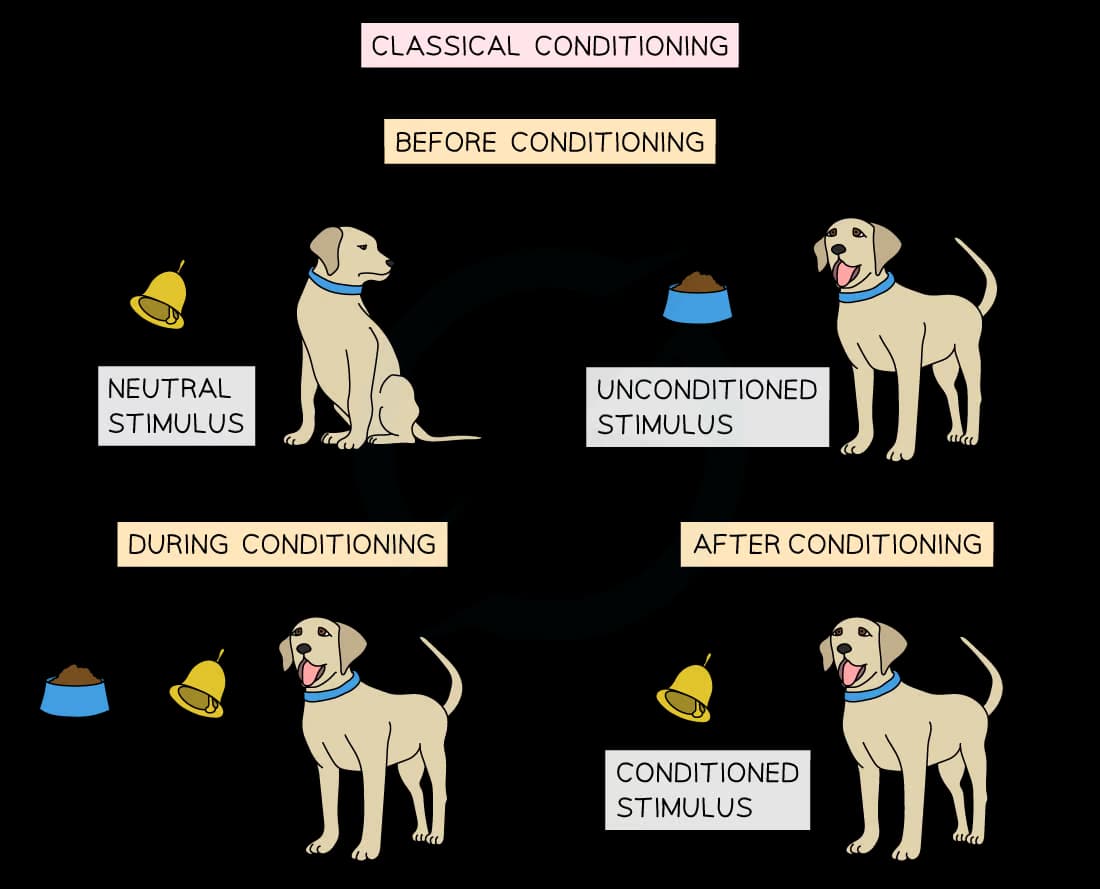
Acquisition refers to the initial learning phase in which the NS becomes associated with the UCS through repeated pairings, eventually becoming the CS
Before conditioning:
the UCS produces the UCR
the NS produces little or no relevant response
E.g. food (UCS) causes salivation (UCR), while a bell (NS) does not
During conditioning:
the NS is repeatedly paired with the UCS
The response continues to be driven by the UCS
E.g. the bell is sounded just before the food is presented
After conditioning:
the NS (now CS) is presented alone and produces the CR
E.g. the bell (CR) alone causes salivation (CR)
Order of presentation matters:
For conditioning to occur, the CS must typically be presented before the UCS
Reversing this order is largely ineffective
E.g. the bell must sound just before the food is delivered for the association to form effectively
Key phenomena in classical conditioning
Phenomenon | Definition | Example |
|---|---|---|
Extinction | The gradual weakening and disappearance of the CR when the CS is repeatedly presented without the UCS | The dog stops salivating to the bell when food is no longer paired with it |
Spontaneous recovery | The reappearance of the CR after extinction following a rest period, without further conditioning | After a break, the dog briefly salivates to the bell again |
Generalization | Producing the CR in response to stimuli similar to the CS | The dog salivates to similar tones |
Discrimination | Distinguishing between the CS and similar stimuli, responding only to the CS. | The dog salivates only to one specific tone |
Higher-order conditioning | Using an established CS to condition a new NS, which becomes a second-order CS | A light paired with the bell eventually produces salivation |
Pavlov's research
Ivan Pavlov (1897) discovered classical conditioning accidentally while measuring saliva production in dogs
He noticed that the dogs began salivating not only when food was presented, but also in response to stimuli that predicted food, such as the footsteps of lab assistants approaching
This anticipatory salivation demonstrated that a learned association had formed between a neutral stimulus (footsteps) and the biological response (salivation)
Procedure
Dogs were attached to an apparatus that held them in place and collected saliva
Phase 1 was the baseline trial:
Food (UCS) naturally produced salivation (UCR), while the bell (NS) alone produced no significant response
Phase 2 was the conditioning trial:
The bell (NS) was repeatedly presented just before the food (UCS), and salivation occurred in response to the food, while the association was gradually learned
Phase 3 was the test trial
The bell was presented alone and now produced salivation (CR), showing that the showing that the NS had become a CS
In the extinction trial, Pavlov repeatedly presented the bell without the food, and the conditioned response gradually weakened and eventually disappeared
Findings and conclusions
Pavlov demonstrated that a neutral stimulus can acquire the ability to elicit a biological response through repeated association with an unconditioned stimulus
He also demonstrated extinction, spontaneous recovery, generalization, and discrimination through systematic follow-up experiments
His work established associative learning as a scientific, measurable process
Thus forming the foundation of the behavioral perspective
Examiner Tips and Tricks
For Skill 1.A, always identify all four components (UCS, UCR, CS, CR)
The most common error is confusing the UCR and CR
Both may look the same (e.g., salivation), but the UCR is unlearned and triggered by the UCS; the CR is learned and triggered by the CS
For Skill 3.A, you may be given data showing the CR diminishing over extinction trials, or briefly returning after a rest period (spontaneous recovery)
Ensure you can identify which conditioning phenomenon the data represents
For Skill 2.D, Pavlov used non-human animals, so be able to evaluate the use of animals in research, particularly on ethical grounds
Restraint via the apparatus may have caused the dogs distress, however, the research produced valuable scientific knowledge and laid the groundwork for behavioral therapies

Unlock more, it's free!
Join the 100,000+ Students that ❤️ Save My Exams
the (exam) results speak for themselves:

Was this revision note helpful?