Operant Conditioning: Skinner's Research (College Board AP® Psychology): Revision Note

Skinner's research
B.F. Skinner (1938, 1953) built on Thorndike’s Law of Effect by developing operant conditioning and providing a systematic, experimental analysis of how consequences shape behavior
To study this, Skinner designed the Skinner box - a controlled environment containing a lever or key, a food dispenser, and sometimes an electrified floor
Consistent with the behaviorist approach, Skinner focused on observable, measurable behavior, allowing learning to be studied scientifically
Procedure and key findings
Skinner used the box to demonstrate how different consequences influence behavior
Positive reinforcement:
A rat received food after pressing a lever. Over time, lever-pressing increased and became the dominant behavior
Negative reinforcement:
Pressing the lever stopped an electric shock. Rats quickly learned to press the lever to escape or avoid the shock
Discrimination:
Rats reinforced only when a light was on learned to press the lever only in that condition, showing that behavior depends on specific cues
Shaping
Complex behaviors are not learned all at once
Instead, they are built gradually through shaping
Shaping involves reinforcing successive approximations
These are small steps that move closer to the desired behavior
E.g. to train a rat to press a lever:
reinforce moving toward the lever
then reinforce touching it
then reinforce pressing it
Each step must be closer to the target than the previous one
Reinforcement schedules
Once a behavior is learned, the schedule of reinforcement influences the rate, pattern, and persistence of responding
Continuous reinforcement: every response is rewarded
E.g. a parent praises a child every single time they tidy their toys
This leads to rapid learning, but rapid extinction
Partial (intermittent) reinforcement: only some responses are rewarded
E.g. a parent praises a child for tidying their toys only occasionally
This leads to slower learning, but much greater resistance to extinction
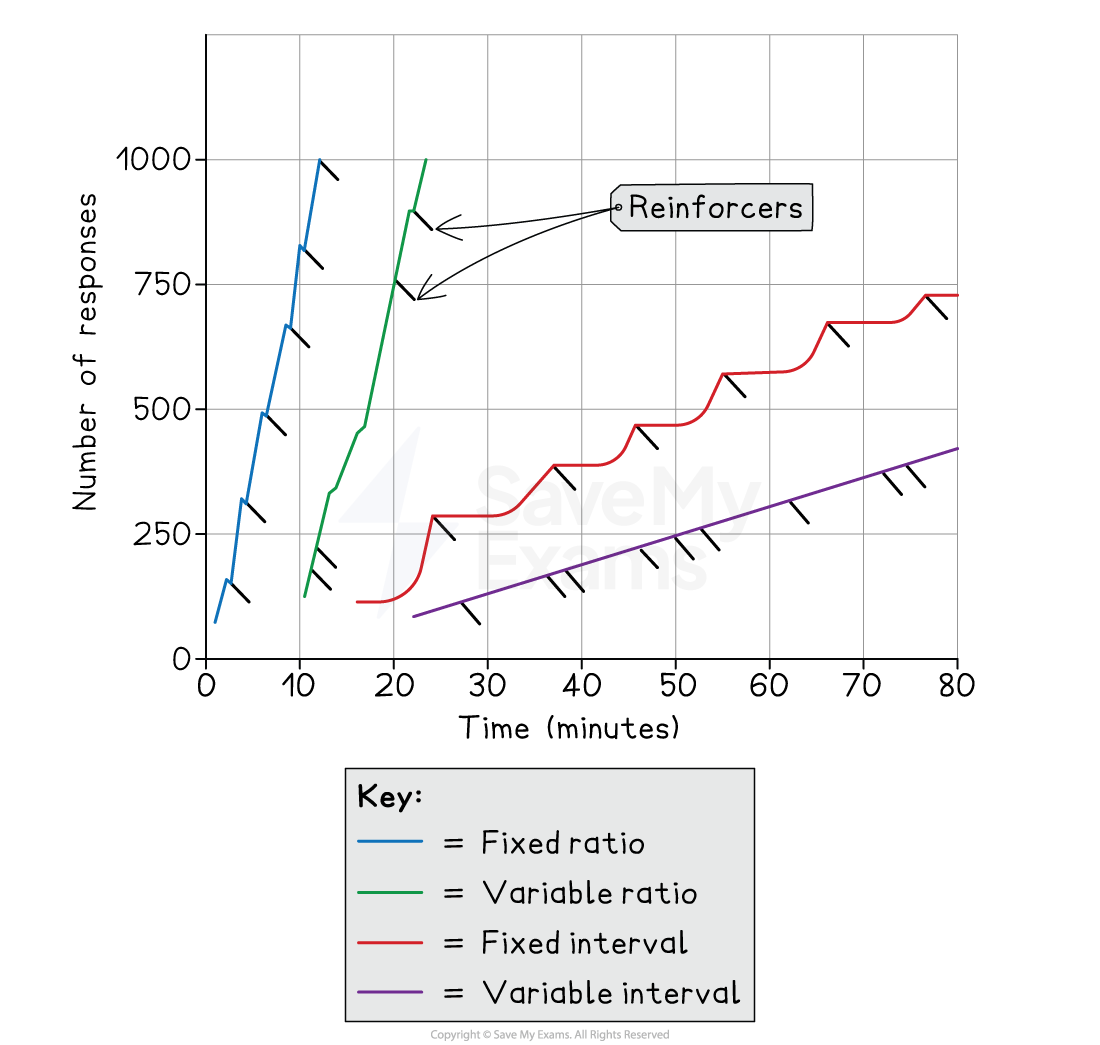
Different reinforcement schedules produce distinct patterns of behavior:
Schedule | Rule | Behaviour pattern | Example |
|---|---|---|---|
Fixed Ratio (FR) | Reward after a set number of responses | High rate with pauses | A parent praises a child after every 3 times they tidy their toys |
Variable Ratio (VR) | Reward after an unpredictable number of responses | Very high, steady rate; most resistant to extinction | A parent praises a child after a random number of times they tidy their toys |
Fixed Interval (FI) | Reward after a fixed time period | “Scalloped” pattern (increases near deadline) | A parent checks at the end of each day and praises the child if their room is tidy |
Variable Interval (VI) | Reward after varying time intervals | Slow, steady rate | A parent checks the child’s room at random times and praises tidy behavior |
These differences in response patterns are illustrated in graphs of responding over time:
ratio schedules produce higher response rates
interval schedules produce slower, more patterned responding
Instinctive drift
Although operant conditioning explains much behavior, biology can limit what can be learned
Instinctive drift is the tendency for conditioned behaviors to revert to innate, instinctive patterns
Breland and Breland (1961) demonstrated this:
A raccoon trained to deposit coins began rubbing them together, resembling natural food-washing behavior
A pig trained to deposit coins began rooting them along the ground, an instinctive foraging behavior
In both cases, instinctive behaviors interfered with the trained response
This shows that learning is constrained by biology, similar to biological preparedness in classical conditioning
Superstitious behavior
Sometimes behaviors are strengthened by coincidence rather than real cause-and-effect
Skinner (1948) showed this by giving pigeons food at fixed intervals regardless of their behavior
The pigeons developed repetitive actions (e.g. turning or head-bobbing) as if these behaviors caused the food
This occurred because whatever behavior happened just before reinforcement was strengthened
Human examples include:
athletes repeating rituals during winning streaks, such as wearing the same socks
gamblers using “lucky” behaviors, such as blowing on dice
These persist because they are reinforced unpredictably, making them resistant to extinction
Learned helplessness
Not all learning leads to increased responding
In some cases, organisms learn that their behavior has no effect
Learned helplessness occurs when an organism experiences uncontrollable negative events and stops trying to change the outcome
Seligman et al. (1967) found that:
dogs exposed to inescapable shocks later failed to escape, even when escape was possible
they had learned that their actions did not matter
this effect can transfer to new situations
Seligman argued that learned helplessness contributes to human depression
Repeated uncontrollable experiences may lead to a belief that effort is pointless
Learned helplessness can also apply to education
Students who have repeatedly failed despite effort stop trying even when success becomes possible
Examiner Tips and Tricks
For Skill 3.A, be able to identify which reinforcement schedule a graph represents by its distinctive shape
variable ratio = steepest, most consistent slope with no pauses
fixed interval = scalloped curve
fixed ratio = steep slope with brief post-reinforcement pauses
variable interval = slow, steady line
For Skill 1.A, when answering a question on learned helplessness, ensure you know both of the following components of this concept:
prior experience of uncontrollable aversive events
subsequent failure to act even when control becomes possible
Punishment vs. reinforcement
The four consequence types
To understand consequences, apply two key questions:
Is a stimulus added or removed?
Does the behavior increase or decrease?
Type | Mechanism | Effect on Behavior | Example |
|---|---|---|---|
Positive Reinforcement | Add a pleasant stimulus after behavior | Increases behavior | Praise for completing homework |
Negative Reinforcement | Remove an unpleasant stimulus after behavior | Increases behavior | Taking pain relief to remove a headache |
Positive Punishment | Add an unpleasant stimulus after behavior | Decreases behavior | Reprimand for running in the hall |
Negative Punishment | Remove a pleasant stimulus after behavior | Decreases behavior | Phone taken away after breaking curfew |
The key difference lies in their effect on behavior:
Reinforcement increases the likelihood of a behavior
Punishment decreases the likelihood of a behavior
Both can be positive (adding a stimulus) or negative (removing a stimulus)
Key differences
Feature | Reinforcement | Punishment |
|---|---|---|
Goal | Increase the frequency of a behavior | Decrease the frequency of a behavior |
Types | Positive (add pleasant) / Negative (remove unpleasant) | Positive (add unpleasant) / Negative (remove pleasant) |
Side effects | Generally minimal | May produce fear, aggression, avoidance, or anxiety |
Use in practice | Preferred approach | Should be used cautiously and alongside reinforcement |
When is punishment effective?
Punishment is only effective under specific conditions:
Timing: Must be immediate to create a clear link with the unwanted behavior
Delayed punishment loses its association with the behavior and becomes less effective
Consistency: Must be applied every time, as inconsistency can maintain behavior
Paired with reinforcement: Must be combined with reinforcing the desired behavior
Limitations of punishment
Punishment has several important limitations:
Side effects: Harsh punishment can produce fear, aggression, anxiety, and avoidance
Suppression, not elimination: Behavior may return when the punisher is absent
Does not teach alternatives: It shows what not to do, but not what to do
May reinforce avoidance: Unwanted behaviors can be strengthened if they help escape something unpleasant
E.g. a child throws a tantrum to avoid eating vegetables. If the parent removes the food, the tantrum is negatively reinforced
Examiner Tips and Tricks
Ensure that you understand these key points:
Negative reinforcement is not a type of punishment
Reinforcement always increases a desired behavior; punishment always decreases it
Negative reinforcement increases desired behavior by removing an unpleasant stimulus
'Negative' means subtraction, not something bad
Learned helplessness is not simply giving up
The person has learned from experience that their actions do not affect outcomes, so they stop trying, even when success is possible

Unlock more, it's free!
Join the 100,000+ Students that ❤️ Save My Exams
the (exam) results speak for themselves:

Was this revision note helpful?