Piaget's Stages of Cognitive Development (College Board AP® Psychology): Revision Note

The sensorimotor stage and object permanence
Piaget proposed that cognitive development occurs in four universal, sequential stages
Each stage is qualitatively different from the last, representing a fundamentally new way of thinking rather than simply more of the same
Each stage can be characterized by the presence or absence of:
schemas
mental operations
theoretical/abstract thinking
The sensorimotor stage
The sensorimotor stage spans the ages from birth to approximately 2 years old
In this stage, infants explore and understand the world entirely through their senses and physical actions
Behavior at this stage is governed by physical schemas
These are intentional actions, not reflexes, performed because the child derives pleasure from them
E.g. a baby repeatedly throwing their dish from a highchair is not misbehaving, rather they are intentionally exploring the trajectory schema, deriving pleasure from the action and its consequences
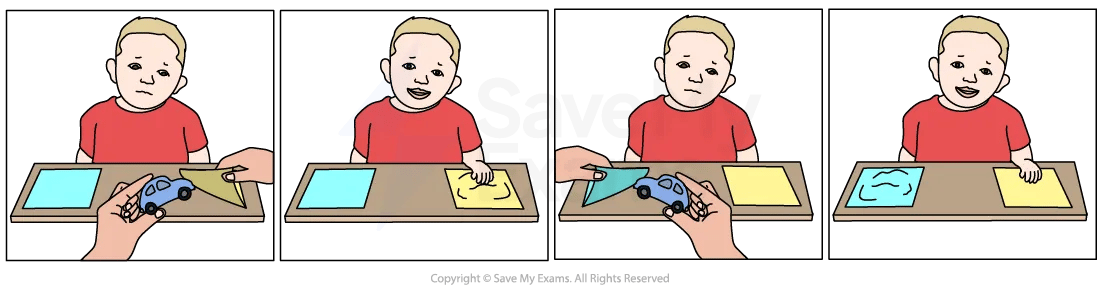
The key milestone of this stage is the development of object permanence
This is the understanding that objects continue to exist even when they are out of sight
Before object permanence develops (typically around 8 months), infants act as though an object ceases to exist when it is hidden
After object permanence develops, infants will actively search for hidden objects
Object permanence can be tested using the A-not-B task:
A toy is hidden under location A several times and the child retrieves it successfully
The toy is then hidden under location B in full view of the child
A child who has not yet developed object permanence continues to search under location A
Their behavior is governed by the previously reinforced action rather than their knowledge of where the toy now is
A child who passes the task searches under location B
This demonstrates that they understand the toy exists independently of their actions and can override a previously learned response
The preoperational stage and egocentrism
The preoperational stage spans approximately ages 2 to 7 years and is characterized by rapid development of language and the use of symbols to represent the world
Children begin to use symbolic thinking
They can use words and images to represent objects and events, enabling pretend play and language development
However, this stage is defined as much by what children cannot yet do as by what they can
Egocentrism
Egocentrism is the inability to see the world from another person's perspective
The child assumes that others see, think, and feel exactly as they do
E.g. a child playing hide-and-seek may cover their own eyes and assume that because they cannot see anyone, no one can see them
Piaget and Inhelder (1956) tested egocentrism using the Three Mountains Task:
A child is shown a 3D model of three mountains with different features (a cross, snow, a house)
A doll is placed on the opposite side of the model, facing the mountains from a different viewpoint
The child is asked to select from a set of pictures what the doll can see
Children around age 4 typically select the image that matches their own view, showing egocentrism
By age 7–8, children more consistently select the doll's viewpoint, showing reduced egocentrism and developing perspective-taking ability
Theory of mind (ToM) begins to develop during the preoperational stage
ToM is the growing ability to understand that others have mental states (beliefs, desires, intentions) that differ from one's own
Before ToM develops, children assume that other people know what they know
This is closely linked to egocentrism
A child who passes a false belief task demonstrates ToM
They understand that another person can hold a belief that the child knows to be incorrect
Baron-Cohen et al. (1985) tested ToM using the Sally-Anne task:
Sally places a marble in her basket, then leaves the room
While Sally is gone, Anne moves the marble into her own box
The child is asked: "Where will Sally look for her marble?"
A child without theory of mind says "the box", assuming Sally knows what they know
A child with theory of mind says "the basket", understanding that Sally holds a false belief about where the marble is
Other characteristics of the preoperational stage
Animism: the belief that inanimate objects are alive and have feelings
E.g. a child who trips over a chair may say "the chair is mean"
Artificialism: the belief that natural phenomena are made by people
E.g. believing that clouds were made by humans or that rivers were dug by workers
Centration: focusing on only one aspect of a situation at a time, which causes failures in conservation
E.g. a child watching liquid poured from a short, wide glass into a tall, thin glass centers on the height of the water and concludes there is now mor
They ignore the width of the container
Lack of conservation: the inability to understand that quantity remains the same when appearance changes
This is a direct result of centration
The concrete operational stage and conservation
The concrete operational stage spans approximately ages 7 to 11 and is marked by the development of logical thinking
This only applies to concrete, real-world objects and experiences
Children can now decenter
They can consider multiple aspects of a situation simultaneously rather than focusing on only one
Children can perform reversible mental operations
They can mentally undo a transformation to return to the original state
Children develop the ability to classify and categorize objects more accurately
Conservation
Conservation is the understanding that quantity remains the same even when the appearance of an object or material changes
This is a key milestone of the concrete operational stage
Piaget tested conservation using the following procedure:
Two equal quantities of material are presented side by side
E.g. equal amounts of liquid in identical glasses
The child is asked whether the quantities are the same
One quantity is then visibly transformed
E.g. the liquid is poured into a taller, thinner glass
The child is asked the same question againIs
A preoperational child says the quantities are now different
They center on the appearance (the height of the liquid) and cannot reverse the transformation mentally
A concrete operational child correctly states that the quantities are still the same
They can decenter and reverse the operation mentally
Conservation applies across multiple concepts:
Concept | What is conserved | Example transformation |
|---|---|---|
Volume | Amount of liquid stays the same | Poured from a wide glass into a tall, narrow one |
Mass | Amount of clay stays the same | A ball of clay flattened into a pancake |
Number | Number of objects stays the same | A row of coins spread further apart |
Area | Total area stays the same | Blocks rearranged within the same space |
The formal operational stage and hypothetical reasoning
The formal operational stage begins at approximately age 11 and continues into adulthood
It is characterized by abstract, systematic, and hypothetical thinking
Children can now manipulate ideas and principles mentally without needing concrete objects as reference points
Three key cognitive abilities define this stage:
Hypothetical reasoning: the ability to reason about situations that do not exist in reality and consider hypothetical possibilities
E.g. "How would you feel if you were born on a planet that had no light?"
A concrete operational child would struggle, but a formal operational thinker can engage with this hypothetically
Abstract thinking: the ability to think about concepts and ideas that have no physical form
E.g. understanding justice, freedom, love, or the concept of infinity
Metacognition: the ability to think about one's own thought processes
This includes evaluating how one is thinking and whether an approach to a problem is working
Piaget proposed that not all individuals reach formal operational thinking
Some people continue to reason primarily at the concrete operational level throughout adulthood
Criticisms of Piaget: the information processing model
Piaget's stage theory has been highly influential but faces significant criticisms, particularly from researchers who favor a more continuous view of cognitive development
Key criticism: Piaget underestimated children's abilities
Samuel and Bryant (1984) found that when children aged 4–8 years were asked only one question after a conservation transformation (rather than two, as in Piaget's original procedure), they made significantly fewer errors
This suggests that the two-question format in Piaget's original procedure may have confused children into thinking they were supposed to change their answer, making them appear less cognitively capable than they actually were
Hughes (1975) found that fewer children aged 3–5 failed an egocentrism task when the procedure was made more meaningful
When the abstract mountains were replaced with a boy doll hiding from two police officers, children found it easier to take another's perspective in a socially meaningful context
This suggests egocentrism may be less absolute than Piaget proposed
Children's ability to decenter depends on the context and familiarity of the task
Key criticism: development may be more continuous than stage-like
The information processing model proposes that cognitive abilities develop continuously and gradually rather than in discrete stages
E.g. research shows that attention span gradually increases as we age
This is a continuous change, not a step-change between stages
The inability to conserve number may have more to do with attention and memory capacity than with being in a fundamentally different cognitive stage
The information processing approach suggests that children's apparent cognitive limitations in Piaget's tasks may reflect processing constraints, e.g. limited attention and working memory, rather than a qualitatively different stage of thinking
Key criticism: cultural bias
Piaget based his theory primarily on observations of Swiss, middle-class children
Cross-cultural research suggests that the content and timing of cognitive development varies across cultures
Dasen (1994) researched children's cognitive development in Côte d'Ivoire, West Africa and found that children develop abstract reasoning in a different way from children in Western cultures
The children used symbols and worked from specific examples to general conclusions, instead of the logical, step-by-step analytical reasoning that Piaget described in the formal operational stage
This suggests that the way children develop cognitively is shaped by the culture they grow up in
This applies to not just what they learn, but how they learn to think
If Piaget's stages were truly universal and biologically fixed, we would expect the same pattern of reasoning to emerge across all cultures
Dasen's findings suggest this is not the case
This finding supports a more interactionist view of cognitive development
Biology sets a broad timetable, but culture and environment shape how and in what form cognitive milestones are reached
Examiner Tips and Tricks
For Skill 1.B, Piaget's stage questions may present a scenario describing a child's behavior and ask you to identify the stage or the cognitive limitation being demonstrated
Ensure you know the stages in order and the key characteristics and/or limitations that occur in each stage
The CED explicitly names animism and egocentrism as characteristics of the preoperational stage
Ensure that you know both terms and be able to give a concrete example of each (Skill 1.B)
For Skill 4.B, you may be asked to evaluate Piaget's theory
Use the information processing model as an alternative explanation and support it with Samuel and Bryant's (1984) evidence that children perform better when procedural confounds are removed
For Skill 2.C, Piaget's research is predominantly non-experimental
Be prepared to evaluate why this limits causal conclusions and generalizability, and consider how cultural bias in the tasks themselves may have led Piaget to underestimate children's cognitive abilities

Unlock more, it's free!
Join the 100,000+ Students that ❤️ Save My Exams
the (exam) results speak for themselves:

Was this revision note helpful?