Data-Based Questions (Paper 1B) (DP IB Chemistry: SL): Exam Questions

3 hours12 questions
1a
2 marks

A student investigated the enthalpy change of neutralisation by gradually adding aqueous potassium hydroxide (KOH) to a known volume of aqueous ethanoic acid (CH3COOH) in a polystyrene cup. A temperature probe recorded the temperature after each addition.

The following data were obtained:

Volume of KOH added (±0.1 cm3)

0.0

5.0

10.0

15.0

20.0

25.0

30.0

35.0

Temperature (±0.1 °C)

22.5

24.7

26.5

27.8

28.6

28.9

28.7

28.4

(i) Describe the overall trend in the temperature as the volume of KOH increases.

[1]

(ii) Suggest a reason for the slight decrease in temperature after 25.0 cm³ of KOH have been added.

[1]

1b
1 mark

A graph of temperature against volume of KOH added was plotted.

Graph showing temperature change from 22°C to 29°C as the volume of KOH increases from 0 to 35 cm³. Temperature initially rises, then stabilises.

Estimate the volume of KOH added at which neutralisation is complete, based on the data.

1c
1 mark

The concentration of the ethanoic acid was 1.00 mol dm-3, and the volume used was 25.0 cm3.

Determine the number of moles of ethanoic acid in the cup before titration began.

1d
3 marks

The student forgot to record the concentration of the KOH solution.

Describe how the temperature data and the enthalpy change of neutralisation (ΔHneut = –57.0 kJ mol-1) can be used to determine the concentration of the KOH solution.

1e
2 marks

Identify one assumption made in the method described in (d), and explain how it could affect the final value obtained.

1f
2 marks

Suggest two improvements to the experimental method to reduce heat loss to the surroundings.

2a
2 marks

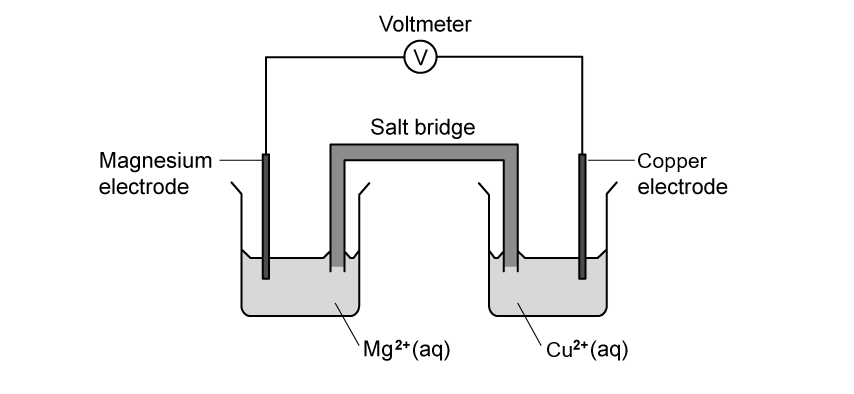
A student investigated how the distance between two electrodes affects the current in a voltaic cell. She used a magnesium electrode in a solution of magnesium nitrate and a copper electrode in a solution of copper(II) nitrate, connected by a salt bridge containing aqueous potassium nitrate (KNO3).

The experiment was repeated with two different concentrations of KNO3: 0.50 mol dm-3 and 1.00 mol dm-3. For each trial, the student increased the distance between the electrodes from 2.0 cm to 10.0 cm and recorded the current.

A diagram of the setup is shown below.

Diagram of an electrochemical cell with a magnesium electrode, copper electrode, voltmeter, and salt bridge, in Mg²⁺ and Cu²⁺ solutions respectively.

Identify the direction of electron flow in the external circuit and explain your answer.

2b
2 marks

(i) Write the half-equation for the reaction occurring at the magnesium electrode.

[1]

(ii) Explain whether the magnesium electrode acts as the anode or cathode.

[1]

2c
2 marks

Explain why the current is higher in the 1.00 mol dm-3 KNO3 solution than in the 0.50 mol dm-3 solution.

2d
3 marks

The student's results are shown in the graph below.

Graph showing current vs. distance between electrodes for 0.50 and 1.00 mol dm⁻³ KNO₃ solutions. Current decreases as distance increases.

(i) Use the graph to estimate the current for the 1.00 mol dm⁻³ solution when the electrodes are 6.0 cm apart.

[1]

(ii) Calculate the percentage increase in current at 4.0 cm when using the 1.00 mol dm⁻³ solution instead of the 0.50 mol dm⁻³ solution.

[2]

2e
2 marks

Explain the shape of the graph using ideas about ion movement and solution resistance.

2f
3 marks

The student considered replacing the Mg and Cu electrodes with platinum.

(i) Explain whether this change would improve the reliability of the results.

[2]

(ii) Suggest one controlled variable (other than distance, electrode material, and concentration) that should remain the same in each trial.

[1]

3a
1 mark

Every winter, road salt is spread on icy surfaces to lower the freezing point of water. A student investigates how the mass of calcium chloride (CaCl2) added to water affects the freezing point of the solution.

In each trial, a measured mass of solid CaCl2 is added to 100 g of distilled water. The solution is stirred and cooled, and the freezing point is recorded.

Write an ionic equation to show how CaCl2 dissociates in water.

3b
1 mark

Explain how the dissociation of CaCl2 helps to lower the freezing point of water.

3c
3 marks

The table below shows the freezing points recorded during the investigation.

Mass of CaCl2 added / g

Freezing point / oC

0.0

0.0

5.0

–2.6

10.0

–5.1

15.0

–7.5

20.0

–9.8

25.0

–11.6

(i) Describe the trend shown in the data.

[1]

(ii) Calculate the average decrease in freezing point per gram of CaCl2 added.

[2]

3d
1 mark

Estimate the freezing point if 30.0 g of CaCl2 were added.

3e
2 marks

Explain one reason why your estimate in (d) may not be completely accurate.

3f
2 marks

The student later discovers the CaCl2 used was slightly damp and not pure.

Explain how this would affect the results of the experiment.

3g
2 marks

A second student suggests:

“The bigger the molar mass of the salt, the more it lowers the freezing point.”

Evaluate this suggestion.

4a
2 marks

A student investigates the effectiveness of four commercial antacids in reducing stomach acidity. The active ingredients of the antacids are shown below:

Brand

Active ingredients

A

Mg(OH)2, Al(OH)3

B

NaHCO3, CaCO3

C

CaCO3

D

Mg(OH)2, Al2O3

Each tablet is crushed and added to 25.0 cm3 of 1.00 mol dm-3 hydrochloric acid (HCl). After 5 minutes, the final pH is recorded.

(i) Write a balanced chemical equation for the reaction between calcium carbonate and hydrochloric acid.

[1]

(ii) State the formula of one reactant ion in antacid tablets that causes the pH to increase..

[1]

4b
2 marks

Suggest two experimental variables, other than time, that should be controlled to ensure a fair comparison between the antacid tablets.

4c
2 marks

The results of the experiment are shown below.

Antacid

Dose used

Final pH

A

1 tablet (0.80 g)

3.42

B

1 tablet (1.25 g)

5.01

C

0.5 tablet (0.75 g)

3.48

D

1 tablet (0.95 g)

2.12

(i) Assuming that the initial pH of the acid was 1.00, calculate the change in pH for antacid A.

[1]

(ii) Calculate the uncertainty in the pH change for antacid A, using ±0.02 for each pH value.

[1]

4d
2 marks

Explain one reason why antacid B may appear more effective than C, even though both contain calcium carbonate.

4e
3 marks

The student concludes that “Antacid B is the most effective.”

Use the data to evaluate this conclusion.

4f
1 mark

The student later discovers the antacid B tablet was slightly damp.

Explain how this might affect the result.

4g
1 mark

Suggest one environmental concern with using excess antacid tablets that contain carbonate or hydroxide compounds.

5a
3 marks

A student investigated the effect of temperature on the rate of hydrogen peroxide (H2O2) decomposition using manganese(IV) oxide (MnO2) as a catalyst. The volume of oxygen gas produced in the first 20 seconds was measured at five different temperatures.

2H2O2 (aq) → 2H2O (l) + O2 (g)

Temperature / oC

Volume of O2 produced / cm3

20

6.2

30

10.7

40

15.6

50

22.3

60

23.1

70

23.3

80

23.2

(i) Describe the trend shown in the data.

[1]

(ii) Use particle theory to explain the effect of increasing temperature on the rate of reaction.

[2]

5b
3 marks

(i) Calculate the average rate of reaction at 50 oC in cm3 s-1.

[1]

(ii) Calculate the percentage increase in rate when the temperature is raised from 40 oC to 50 oC.

[2]

5c
2 marks

Explain why there is only a small increase in rate between 50 oC and 60 oC.

5d
3 marks

The student repeats the experiment without MnO2.

(i) Sketch a second curve on the grid below to show how the reaction rate would differ without a catalyst. Label the curve.

Graph showing oxygen volume versus temperature. Volume increases sharply from 20°C to 50°C, then levels off near 20 cm³ from 50°C to 80°C.

[1]

(ii) Explain why the catalyst affects the rate.

[2]

5e
1 mark

Suggest one procedural improvement the student could make to increase accuracy in measuring the volume of gas produced.

6a
2 marks

The graph below shows how the solubility of carbon dioxide (CO2) in water changes with pressure at a constant temperature of 25 oC.

Graph showing a linear increase in the solubility of CO2 in water with pressure, from 0.0 g/100g at 0 atm to 0.8 g/100g at 5 atm.

(i) Describe the trend shown by the graph.

[1]

(ii) State the type of relationship shown between pressure and solubility.

[1]

6b
2 marks

Explain the trend using ideas about particle behaviour.

6c
2 marks

(i) Use the graph to determine the solubility of CO2 at 2.5 atm.

[1]

(ii) Use the graph to determine the pressure needed for a solubility of 0.580 g per 100 g H2O.

[1]

6d
1 mark

Explain why the graph passes through the origin.

6e
3 marks

(i) Explain why increasing the temperature would reduce the solubility of CO2 in water.

[2]

(ii) Predict how the graph would look if temperature increased.

[1]

6f
1 mark

Suggest one real-world situation that relies on the solubility of gases in liquids.

6g
2 marks

Explain why the dissolution of CO2 in water is considered an exothermic process.