How to Refine Your RQ (DP IB Extended Essay): Revision Note

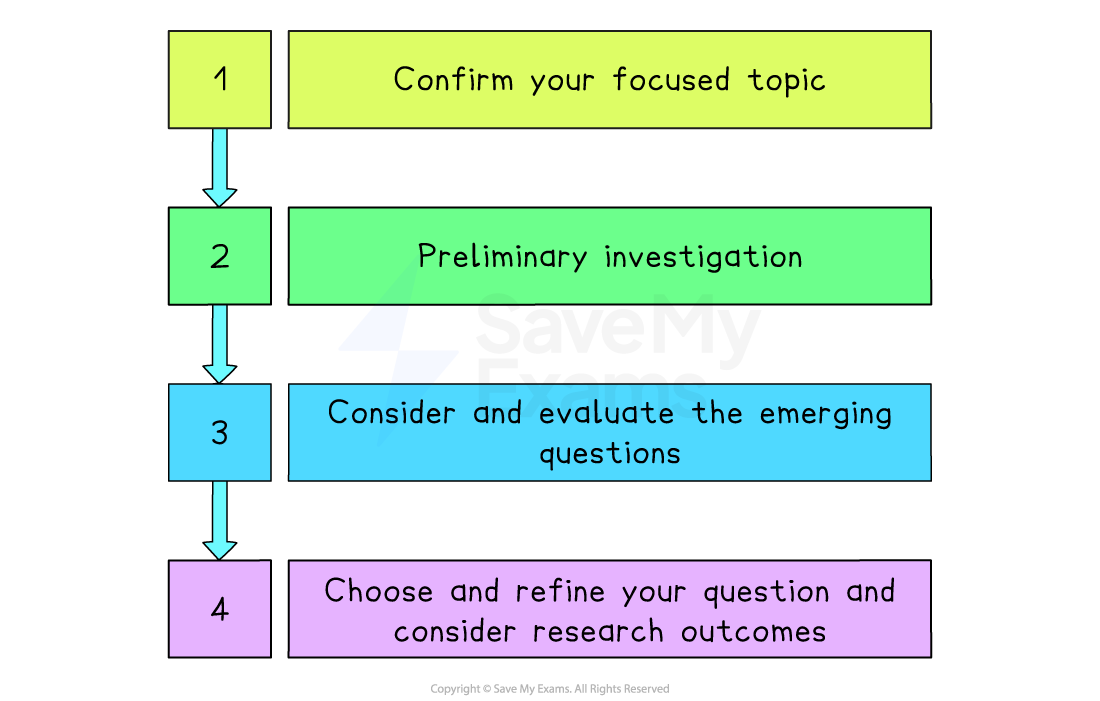
How do you refine an RQ for analysis and evaluation?
Connecting the question to the topics context
Preliminary research helps you connect your question to a specific context, which refers to the background circumstances, time period or specific case study being investigated
Refining the question within a clear context ensures the Research Question (RQ)—the central question that directs the investigation—is focused and manageable within the 4,000-word limit
You should skim secondary sources—materials like journals or books that interpret and analyse primary data—to see how your topic fits into existing academic knowledge
This contextual connection acts as a springboard, allowing you to move from a broad interest to a specific, professional inquiry
Encouraging analysis evaluation and synthesis
Your refined question must be designed to trigger analysis rather than description
Analysis is the process of breaking down a topic to explore "why", "how" and "so what"
Description focuses only on stating the facts of "who", "what", "where" and "when"
The RQ should invite evaluation, which involves critically appraising the strengths and limitations of the evidence and research methods used
A strong question leads to synthesis—the ability to combine different research findings and perspectives to form a new, coherent conclusion
To ensure the essay is analytical, you should use higher-order questions, which typically begin with phrases such as "to what extent", "how significant" or "how successful"
Finalising the research question
The Research Question (RQ) should be finalised before you begin the stage of major research and data gathering
Settling on a clear question early prevents issues later on, such as realising the topic is unviable due to a lack of available data
Refining the question is an iterative process—a cycle of asking questions, taking action and reflecting—which should be tracked in the Researcher's Reflection Space (RRS)
The RRS is a personal journal or digital space used to record your thinking, mind maps and research decisions
Once the RQ is stable, it provides the foundation for a strong line of argument, which is the logical thread of reasoning that connects your question to your final conclusion
Aim to settle a clear provisional RQ before major research, but expect refinement as you read more
Examiner Tips and Tricks
Don’t be afraid to refine the wording. The IB explicitly recognises that changing direction (including amending the research question) can be completely acceptable as you read more.

Unlock more, it's free!
Join the 100,000+ Students that ❤️ Save My Exams
the (exam) results speak for themselves:

Was this revision note helpful?