Supervisor Guidance & the One-Draft Rule (DP IB Extended Essay): Revision Note
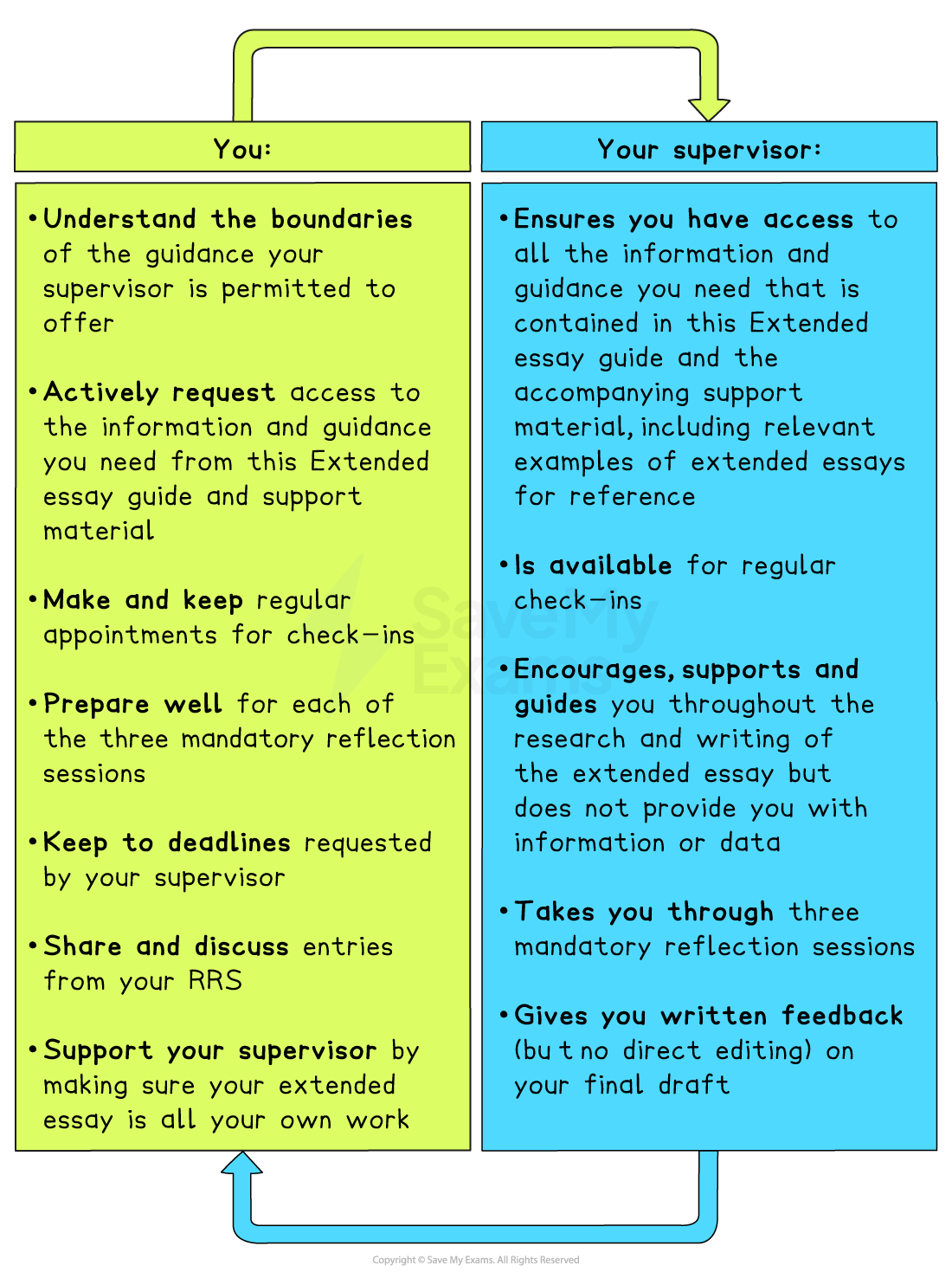
What feedback can your supervisor give you & what are the limits?
The one-draft rule
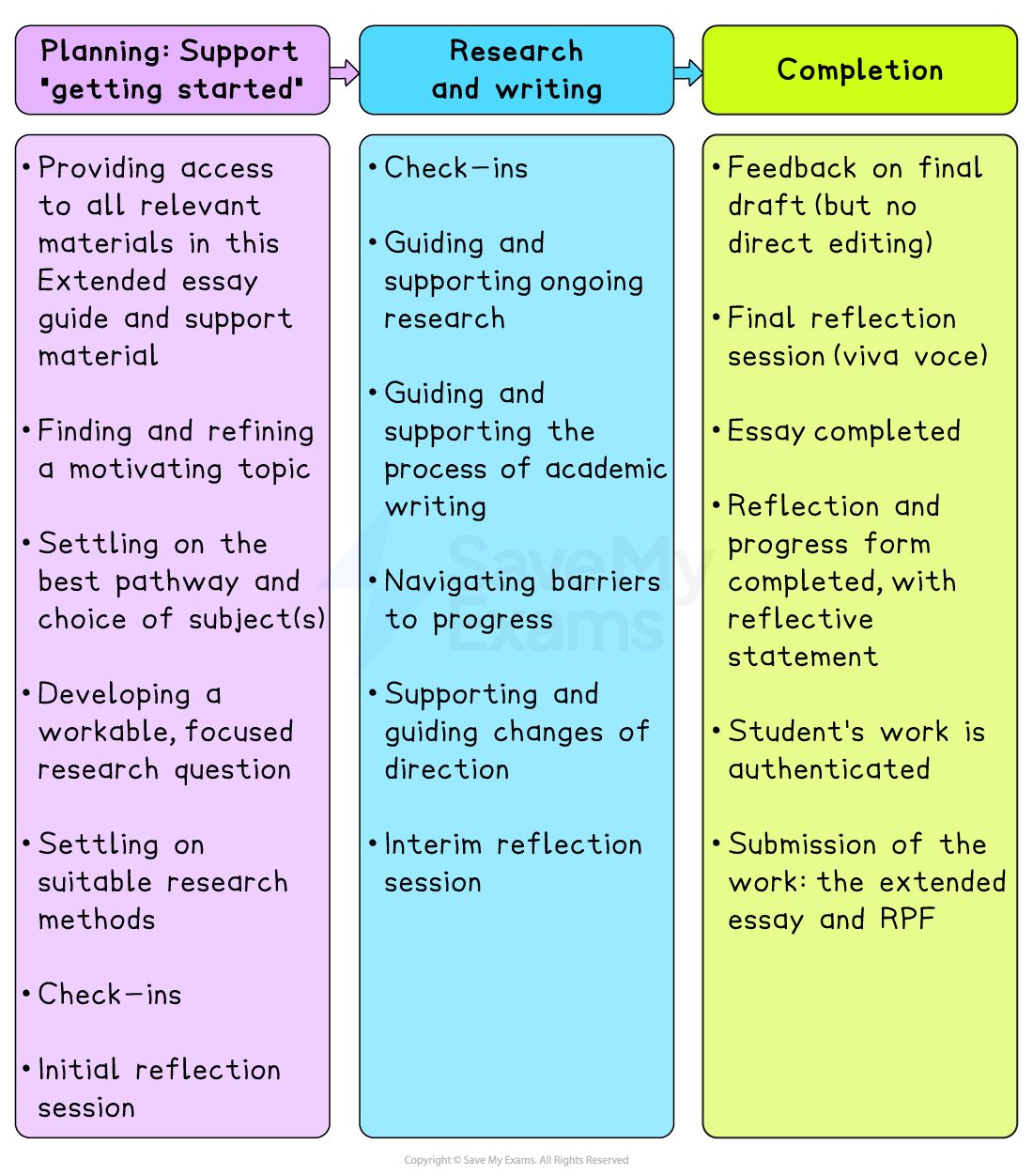
A supervisor is permitted to review and comment on only one full draft of the Extended Essay (EE)
This usually occurs during the latter stages of the process, after the interim reflection session
This draft should be a completed version of the essay so the supervisor can see the full development of the line of argument
Once this single review is complete, the next version the supervisor sees must be the final version submitted for assessment
Your supervisor should also read the final version before the viva voce to confirm authenticity, and your final submitted essay should not be changed after the viva voce
Permitted types of feedback
Supervisors provide general guidance and support throughout the research and writing process
The IB recommends around three to five hours of supervision in total, including the three mandatory reflection sessions and any check-in meetings, as well as time spent reading your draft
Feedback on the draft must be limited to general comments and pointed, open-ended questions designed to prompt student reflection
Supervisors might ask questions such as "I'm not sure I follow your argument here, because..." or "Could you express this point more clearly?"
They may also suggest that a student checks a specific page for accuracy of referencing or to improve a specific section
Feedback on the draft must be limited to general comments and pointed, open-ended questions (the draft must not be heavily annotated or edited)
Advice and mentorship are also provided during the three mandatory reflection sessions—initial, interim and the viva voce
Supervisors may also hold additional check-ins; only attendance at the three formal reflection sessions is recorded on the RPF
If you work with an external expert (an ‘external mentor’), you must still have a school-based supervisor who completes the reflection process and signs the RPF; the external mentor must follow IB limits and complete the required form (included in the appendix)
Explicit limits and prohibitions
A supervisor acts as a guide and mentor, not a shaper or co-author of the work
Supervisors are strictly prohibited from performing the following tasks:
Editing or rewriting any part of the essay text
Proofreading the essay for errors in spelling, punctuation or grammar
Correcting specific mathematical calculations or experimental work
Indicating exactly where whole sections of the essay should be moved or placed
It is a common misconception that supervisors should fix language expression or citations; they are not permitted to correct bibliographies or specific referencing errors
Student responsibility for independent improvement
The EE is a student-led, self-regulated learning experience where the student is responsible for the research and writing
Students must independently improve the structure, argument and expression of their work following the supervisor's general feedback
Proofreading is a task that must be done entirely by the student
Students are encouraged to use spelling and grammar checkers built into word-processing software to scaffold their communication
Other strategies include reading the essay aloud or changing the font colour and size to help spot errors independently
Examiner Tips and Tricks
Treat supervisor comments as prompts, not corrections. To make the one-draft review really count, send a genuinely complete draft (argument, citations, presentation) and bring 3–5 focused questions about your line of argument, methods and evidence—then use specific examples from your RRS/check-ins to write an evaluative reflective statement after the viva voce

Unlock more, it's free!
Join the 100,000+ Students that ❤️ Save My Exams
the (exam) results speak for themselves:

Was this revision note helpful?