What Makes a Strong RQ? (DP IB Extended Essay): Revision Note

What are the qualities of an effective RQ?
Qualities of an effective research question
An effective Research Question (RQ)—the specific, focused question that directs your entire investigation—must be clear, specific and focused
Define the key terms and set boundaries (time period, location, population/case, texts/artefacts). This prevents students writing RQs that are technically phrased well but impossible to scope.
The RQ should be academically appropriate, meaning it aligns with the disciplinary requirements and expectations of your chosen Diploma Programme (DP) subject or subjects
A strong question is worth investigating, meaning it enables a focused inquiry and a reasoned argument (even if it builds on existing scholarship), rather than new knowledge
The RQ must be manageable, ensuring it can be researched and answered fully within the 4,000-word limit and the suggested 40 hours of work
The EE must be driven by a clearly stated research question. In some subjects you may propose a hypothesis, but the essay is assessed on how effectively you answer the research question
You should avoid double-barrelled questions, which are two different questions combined into one, as these usually make the scope of your essay too broad to manage
The RQ must not lead to a self—evident or obvious answer, but instead should require a deep investigation to find a solution
Examiner Tips and Tricks
Write your research question at the top of your working document. If a paragraph doesn’t directly help answer it, cut it or rewrite it—this is the fastest way to avoid drifting into description.
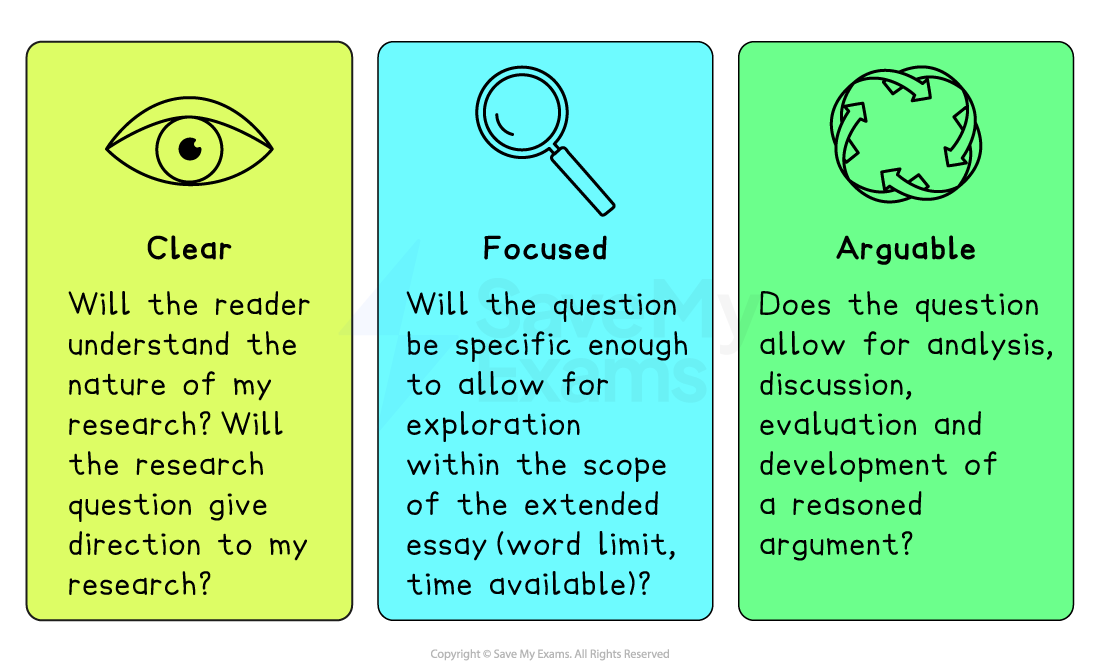
Supporting analysis and argument
The RQ must support analysis rather than description
Analysis is the process of exploring "why", "how" and "so what" by breaking a topic down into its essential parts
Description focuses only on "who", "what", "where" and "when", which does not allow for deep critical thinking
A strong question is arguable, which means it allows you to build a reasoned position where different interpretations or viewpoints are possible
To trigger deep thinking, you should use higher—order questions, which often begin with phrases such as "to what extent", "how significant" or "how successful"
The RQ must invite a clear line of argument—a logical thread of reasoning that connects your question, your research findings and your conclusion
Significance of Findings and Evidence
Criterion D isn’t simply “balanced discussion”; it’s a balanced discussion of the significance of findings supported by evidence, plus evaluation of the effectiveness of the essay (strengths/limitations).
Balanced discussion refers to an investigation that considers a range of different factors or perspectives rather than focusing on only one side
Criterion A isn’t just “effectiveness of your research framework” in general; it is explicitly about whether the research question, research methods, and structural conventions provide an effective framework
By framing a question that invites evaluation, you can better assess the strengths and limitations—the pros and cons—of your research materials and methods

Unlock more, it's free!
Join the 100,000+ Students that ❤️ Save My Exams
the (exam) results speak for themselves:

Was this revision note helpful?