What Makes a Successful EE? (DP IB Extended Essay): Revision Note

What makes an EE academically strong?
Clear academic focus
A successful extended essay maintains a sharp focus on the Research Question (RQ) throughout the entire document
It demonstrates a command of the specific subject by using correct terminology and concepts
Terminology refers to the specific vocabulary and technical words used by experts in that subject area
The essay must go beyond simply describing facts or telling a story
Descriptive writing focuses on answering "what", "where" and "when" to give background information
Analytical writing focuses on answering "how", "why" and "so what" to explore relationships and significance
Strong essays explore patterns, causes and effects rather than just listing information
Developing a strong argument
The essay must present a clear line of argument
A line of argument is a logical "thread" that connects your research question, your evidence and your conclusion
Every point made in the essay should contribute directly to answering the research question
Arguments must be supported by sufficient and relevant evidence
Evidence includes data, quotations, citations or examples drawn from your research
The conclusion should be a logical synthesis of the findings rather than just a summary of what was written
Why is consistent evaluation important in the EE?
The role of evaluation
Evaluation involves critically appraising the value, reliability and validity of your research materials and methods
It demonstrates critical thinking—the ability to assess the value of information—by weighing up the strengths and limitations of the evidence you have found
Evaluation helps you to identify potential bias in your sources
Bias is an inclination or prejudice for or against something that might affect the neutrality of a source
It allows you to explain why certain results occurred or why some sources might contradict others
Integrating evaluation
Evaluation should not be saved for a separate section at the end of the essay
It must be integrated into the main body of the text alongside your analysis
You should evaluate your sources and methods at the specific moment you use them to support an argument
This approach shows the examiner that you are acting as a discerning researcher throughout the whole process
Consistent evaluation is the primary focus of Criterion D: Discussion and evaluation, which is worth 8 marks—the highest individual mark for any of the five criteria
This criterion assesses your ability to provide a balanced discussion of your findings
A balanced discussion is a review that considers a range of different factors or perspectives rather than just one side of an argument
Because examiners look for evidence of assessment criteria throughout the entire essay, rather than in just one section, you must demonstrate these evaluative skills consistently to reach the higher markbands
Examiner Tips and Tricks
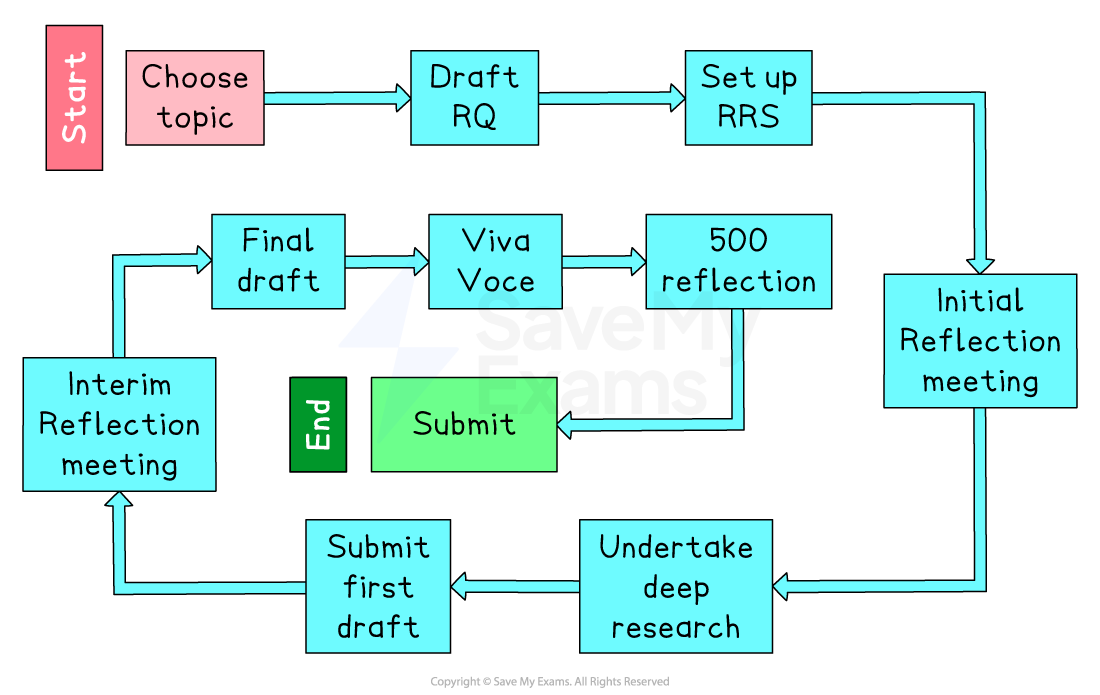
Treat the 500-word reflection statement as assessed writing. If the RPF is missing/blank or in a different language, Criterion E is automatically zero—so it is not an optional “nice reflection”, it is worth valuable marks.

Unlock more, it's free!
Join the 100,000+ Students that ❤️ Save My Exams
the (exam) results speak for themselves:

Was this revision note helpful?