Government Actions Influencing Legitimacy (DP IB Global Politics: HL): Revision Note

How states and governments gain legitimacy
Legitimacy refers to the extent to which a state or government is accepted as rightful and deserving of authority by its population and the international community
States and governments gain legitimacy in a number of ways, and the extent of their legitimacy often depends on how successfully they meet these criteria:
Maintaining order and stability – governments are expected to provide security and prevent conflict or disorder
Economic, political and social development – improving living standards, rights and opportunities for citizens
Sustained development – ensuring long-term growth and stability rather than short-term success
Free and fair elections – allowing citizens to choose their leaders through transparent and competitive processes
Representation and consent – ensuring that governments reflect the will of the people and act with their approval
Quality of governance – providing effective public services, upholding the rule of law and protecting rights
International recognition – being accepted as a legitimate state by other states and global organisations
The relative importance of these factors varies between states. In some systems, legitimacy is primarily based on democratic participation, while in others it may rely more on economic performance or stability.
Quality of governance and development
Citizens expect their governments to provide and maintain services that provide them with a good quality of life
'Good' can mean different things to different people but generally it includes
Effective and accessible educational institutions
Low crime
Economic development
Access to health care
Decent housing
Clean water
Fair police and judicial systems
Reliable public transportation
Safe and well-maintained public spaces such as parks, library and museums
The legitimacy of a government that is unable or unwilling to provide or maintain a good quality of life for citizens usually lacks legitimacy
In democracies people can protest, and their governments can be voted out
In single-party states, citizens can rarely openly voice their views on the legitimacy of the government
Citizen participation and consent
Within democracies, citizens are supposed to be involved in decisions made by governments
Citizen participation in government differs between states and in different situations
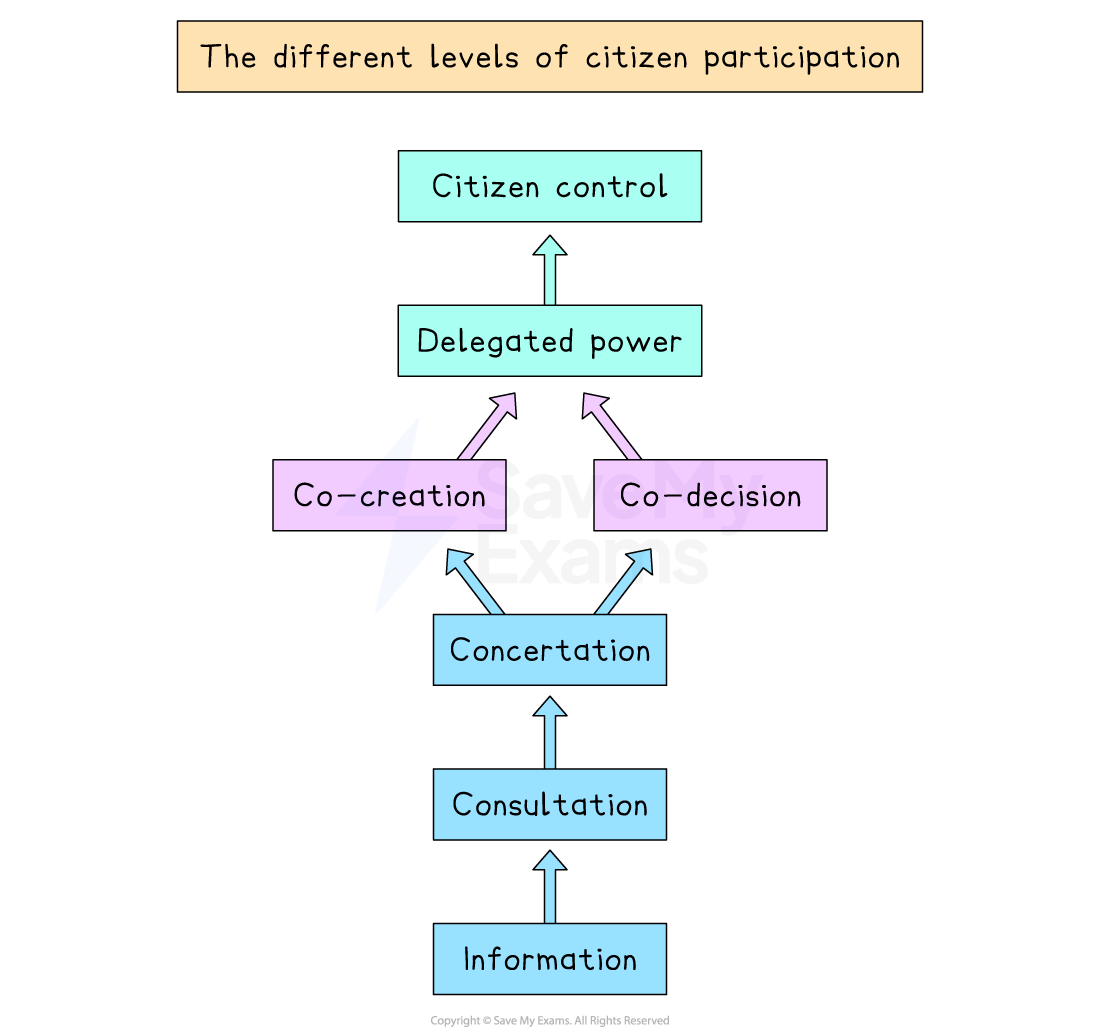
Level | Explanation |
|---|---|
Information |
|
Consultation |
|
Concertation |
|
Co-creation |
|
Co-decision |
|
Delegated power |
|
Citizen control |
|
By having a say in government decision-making, citizens are more likely to approve of them and view the government as legitimate
In states where there is a lack of transparency in decision-making, citizens may not accept policies and the legitimacy of the government could be questioned
Ultimately no state could function if citizens had to be involved in every decision
Although some citizen participation may strengthen legitimacy, it does not guarantee it
International recognition
Some places consider themselves to be states but are not universally recognised by other states and non-state actors
Membership of intergovernmental organisations (IGOs) can indicate whether a state has global recognition and legitimacy
Case Study
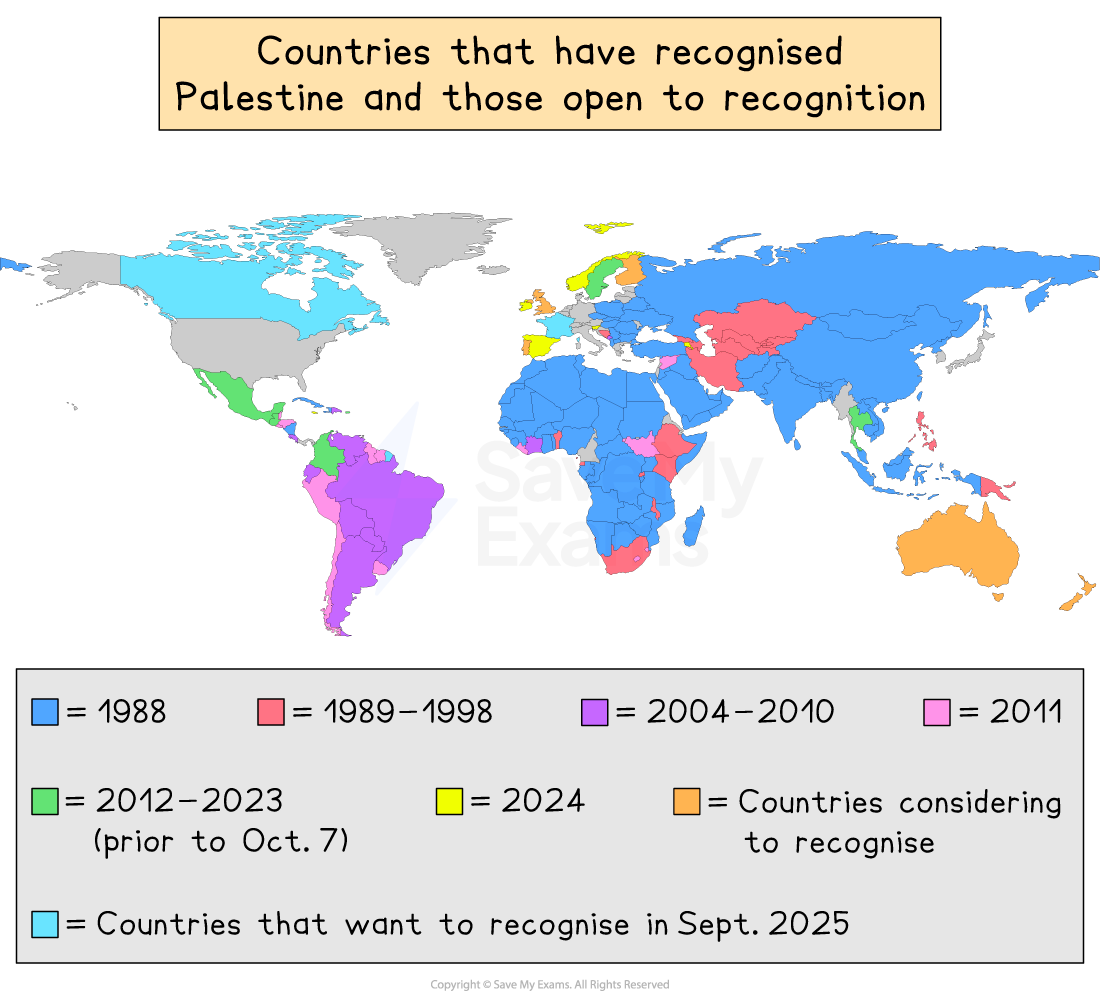
Palestine and recognition at the United Nations
Palestine currently has non-member observer state status at the UN
This allows Palestinian representatives to attend debates in the General Assembly and speak on issues, but they cannot propose resolutions or vote
Barriers to full membership
Although 147 of the 193 UN member states recognise Palestine as a state and support full UN membership, final approval must be granted by the UN Security Council
The United States has repeatedly vetoed attempts to grant Palestine full membership
Significance
As a result, Palestine has limited formal recognition within the UN system, which reduces its international legitimacy in some respects
However, the large number of states supporting Palestinian membership suggests that many countries do recognise Palestine as a legitimate state
The quality of governance can impact global recognition and diminish legitimacy in the eyes of some actors
Legitimacy in global politics is not always universally agreed
Different actors may view the legitimacy of a state in different ways
Case Study
North Korea and international legitimacy

Background
North Korea provides an example of how state legitimacy can vary depending on perspective
The country has faced strong criticism from many states and NGOs because of its human rights record and authoritarian political system, which has reduced its legitimacy in the eyes of many actors
Recognition and criticism
North Korea is still a member of the United Nations, meaning it is formally recognised as a state within the international system
However, some governments question this legitimacy because North Korea has defied UN resolutions, particularly those related to nuclear weapons and international security
Significance
At the same time, some states, including China and Russia, maintain diplomatic relations with North Korea and treat it as a legitimate state

Unlock more, it's free!
Join the 100,000+ Students that ❤️ Save My Exams
the (exam) results speak for themselves:

Was this revision note helpful?