Global Governance & International Law (DP IB Global Politics: HL): Revision Note

The distinction between government and governance
Interdependence in global politics refers to the mutual reliance between actors and stakeholders
Globalisation has strengthened interdependence
Some think states being interdependent with other actors as dangerous because it weakens sovereignty
Others think states being interdependent with other actors promotes peace and stability
Government vs. governance
Government refers to formal state institutions that make and enforce laws, whereas governance refers to the processes and interactions through which decisions are made across multiple actors at national and global levels
Government | Governance |
|---|---|
|
|
National and international law
National law is created and enforced by states within their own borders, whereas international law governs relations between states and relies on their consent for enforcement
National laws are created and enforced by institutions within the state
They can be changed and altered but only by using a judicial process designed to protect the legitimacy of the state’s legal system.
They are usually designed to protect citizens and the stability of the state
They are legally binding, meaning they apply to everyone within the state
There are consequences for breaking national laws
International laws are created and monitored by governance institutions, usually intergovernmental organisations (IGOs)
States cannot usually be forced to accept these laws, as they have sovereignty
In some intergovernmental organisations, such as the European Union (EU), member states are required to accept agreed laws
Interdependence means that states may more readily accept international laws if most other states have done so
If states do accept these laws in principle, it can be said that they have signed the law
If states fully accept the laws, it can be said they have ratified them, making them binding
The goal of governance institutions that create these laws is to have states ratify these international laws
International law is harder to enforce because there is no global authority above states
This is why global governance institutions like the United Nations strongly encourage states to ratify international law into their own legal systems
Sources of international law
These sources provide the basis for international law and help ensure consistency and legitimacy in how rules are created and interpreted
International law develops from recognised sources that states accept as legitimate foundations for legal rules
International laws often emerge as a potential way to work together to address or manage a common global political issue and may come from multiple sources
Foundations of international law
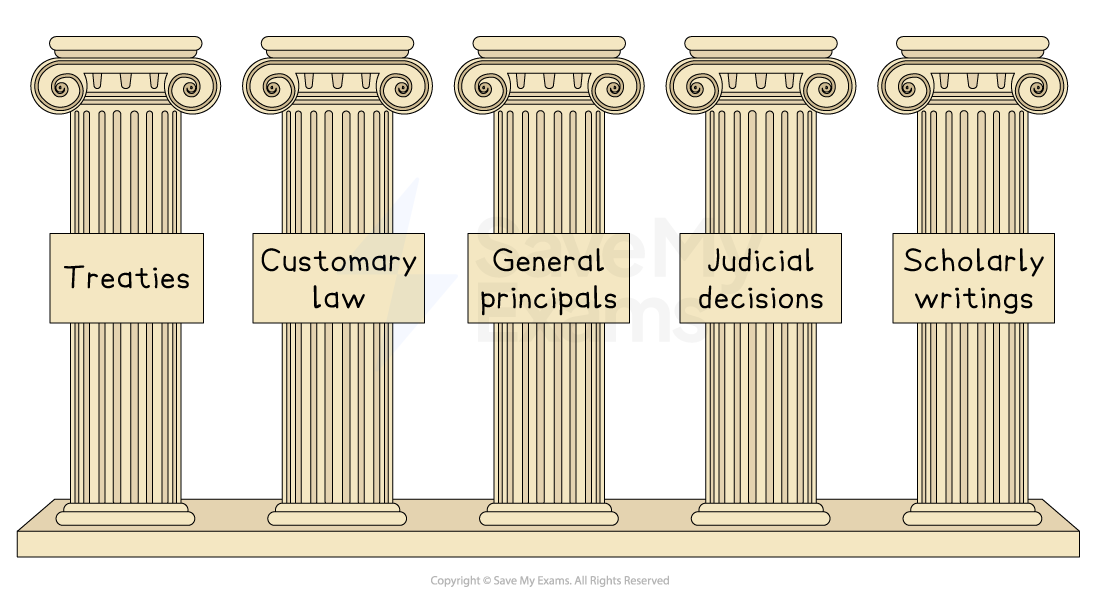
Foundation | Explanation |
|---|---|
Treaties |
|
Customary law |
|
General principles |
|
Judicial decisions |
|
Scholarly writings |
|
Examples of international laws
These examples show how international law regulates cooperation between states, although compliance ultimately depends on state willingness
The Basel Accords on Financial Regulation
International agreements that set rules for banks to manage risk and maintain sufficient capital to prevent financial crises
World Trade Organisation agreements
International rules that govern global trade and aim to reduce trade barriers to ensure fair competition between countries

Unlock more, it's free!
Join the 100,000+ Students that ❤️ Save My Exams
the (exam) results speak for themselves:

Was this revision note helpful?