The United Nations (DP IB Global Politics: HL): Revision Note
The role and significance of the United Nations
The United Nations (UN) plays a central role in global governance by promoting peace, security, cooperation and development between states
It provides a platform for dialogue, helps manage international conflicts and supports economic and social progress worldwide
The significance of the UN lies in its ability to:
Facilitate cooperation between states
Promote international law and norms
Address global challenges such as conflict, poverty and human rights abuses
However, its effectiveness is often limited by state sovereignty, political disagreements and unequal power structures
General achievements and limitations of the UN
Achievements | Limitations |
|---|---|
|
|
The UN Charter and the General Assembly
The United Nations (UN) is an international organisation of countries that aims to maintain global peace and security and promote cooperation on issues like human rights, development and international law
The UN Charter
The UN Charter is a document that sets out the principles, goals and purpose of the organisation.
The charter was created in October 1945 and is the founding document of the UN
The charter emphasises the interconnected nature of global governance
The charter is considered an instrument of international law
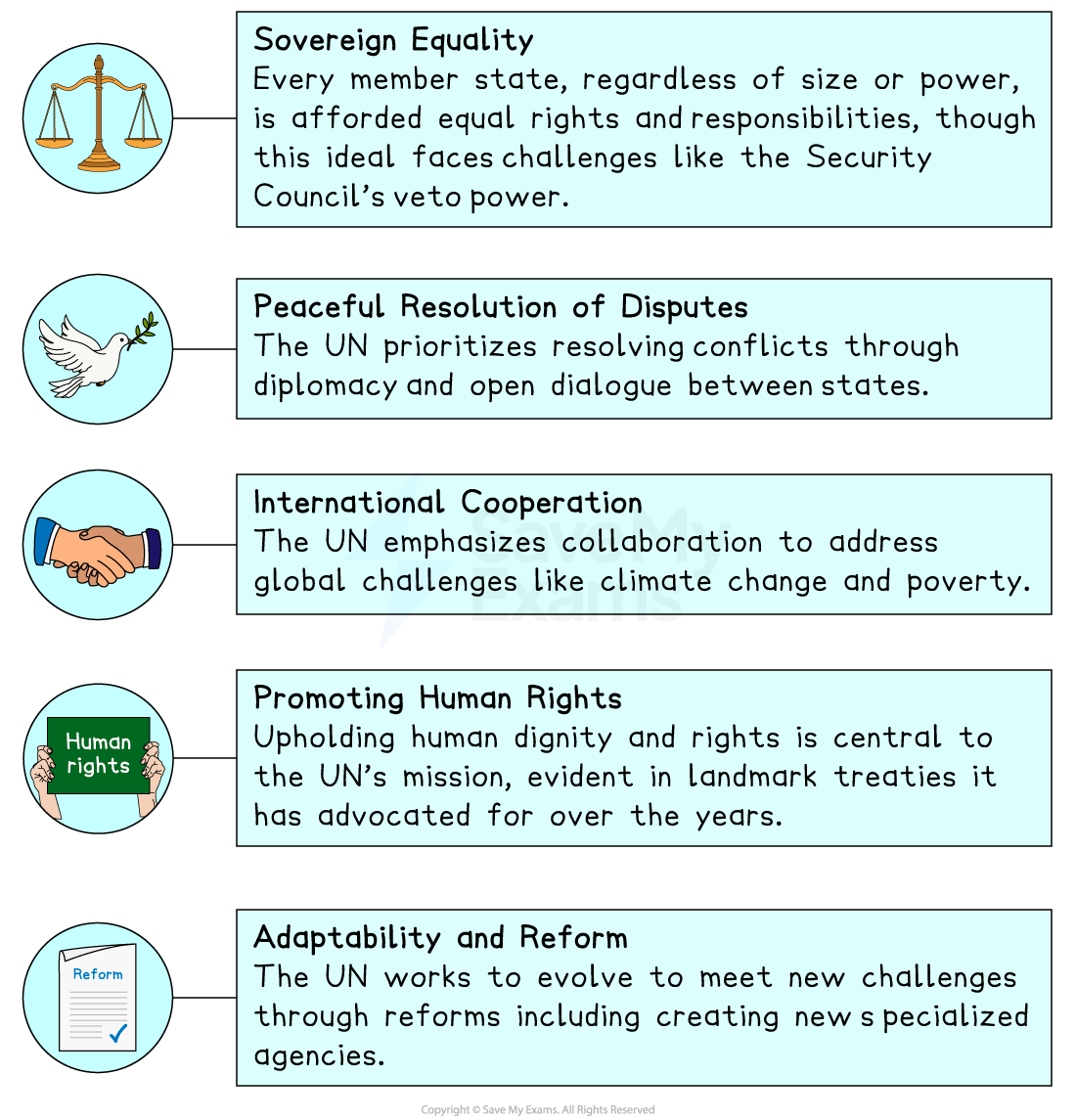
To be a member state, it is expected that the principles below will be respected as norms
UN charter principles
The General Assembly
The UN’s core structure is made up of key organs, including the General Assembly and the Security Council, which perform different roles in global governance
The UN requires state representatives to take part in discussions and debates regarding political issues which are of global relevance and budgetary issues.
They also collaboratively write resolutions which are proposals for possible courses of action and international laws
The group meets in New York from September to January but can remain in session much longer if needed
Currently 193 states are represented
Other actors, including NGOs and nation-states, attend and participate but have no voting rights
Non-voting actors include the EU, Palestine and Red Cross/Red Crescent
Some of the political issues on which representatives worked together in 2025 included:
peacekeeping
human trafficking
human rights in Syria
the rights of children
protection of migrants
tackling terrorism
Security Council
The UN Security Council (UNSC) is the most powerful body of the United Nations responsible for maintaining international peace and security, including hard power to impose sanctions or approve military action
It was created because large groups of people are unable to make quick and decisive decisions
This group has significantly more power than the General Assembly
Any resolutions it passes become binding international laws
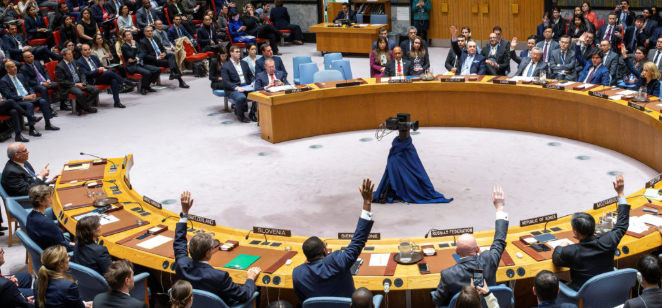
There are 5 permanent members of the UNSC
USA
China
Russia
United Kingdom
France
Permanent members have the right to veto any resolution, meaning if one of them rejects it, it fails instantly
There are also 10 temporary members of the UNSC - these states hold two-year terms
Case Study
Controversy Surrounding the UN Security Council (UNSC)
Criticism of permanent membership
The five permanent members are the victorious powers of the Second World War
Critics argue that this structure reflects an outdated balance of power and gives disproportionate influence to a small group of states
Some scholars and governments argue this represents a form of Western or great-power dominance in global decision-making
Political tensions
The UNSC often struggles to act because of political disagreements between its permanent members
Rivalries between states such as the United States, Russia and China can lead to vetoes and prevent the council from agreeing on responses to international crises
Calls for reform
Many countries have called for reform of the UNSC, including proposals to expand permanent membership or change the veto system
However, these reforms have been repeatedly blocked or delayed, meaning the structure of the council has remained largely unchanged
Impact
These controversies have led some critics to question the effectiveness and fairness of the UNSC, arguing that its structure can limit its ability to respond quickly and fairly to global conflicts
UN Agencies and Programmes
The United Nations (UN) operates a large network of agencies, programmes and organisations that work together to address global political, economic and social issues.
These organisations are designed to support states, guide international cooperation and respond to global challenges
Many UN agencies focus on promoting key UN goals, including:
Human rights – protecting the rights and freedoms of individuals worldwide
Sustainable development – reducing poverty and supporting economic, environmental and social progress
Peace and security – preventing conflict and supporting peaceful resolutions to disputes
Different UN bodies specialise in particular areas of global governance
Examples of UN agencies and programmes
Rights and justice
The UN Human Rights Council (UNHRC) monitors human rights conditions around the world
It investigates abuses, holds debates on human rights issues and encourages states to improve their policies and laws
The council also carries out Universal Periodic Reviews, where each UN member state’s human rights record is examined
Development and sustainability
The United Nations Development Programme (UNDP) works to reduce poverty and promote sustainable economic and social development
It supports countries by providing expertise, funding and advice on issues such as education, climate change, governance and economic growth
The UNDP also helps coordinate global development goals such as the Sustainable Development Goals (SDGs)
Peace and conflict
The International Court of Justice (ICJ) is the main judicial body of the UN
It settles legal disputes between states and provides advisory opinions on international law
By resolving disagreements peacefully through legal rulings, the ICJ helps support international stability and conflict resolution
Examiner Tips and Tricks
These agencies are significant because they allow the UN to address a wide range of global issues beyond security, including development, human rights and international justice
Case Study
UNESCO and the protection of world heritage

The United Nations Educational, Scientific and Cultural Organization (UNESCO) is a UN agency that promotes international cooperation in education, science and culture
Its work aims to protect cultural heritage, encourage scientific collaboration and support education worldwide
World Heritage Programme
One of UNESCO’s most well-known initiatives is the World Heritage List, which identifies and protects sites with outstanding cultural or natural importance
Governments nominate locations within their territory, and if they meet UNESCO’s criteria, they are given World Heritage status
Examples of protected sites
Many famous landmarks are protected through this programme, including the Great Barrier Reef (Australia), Machu Picchu (Peru) and the Pyramids of Giza (Egypt)
World Heritage status can help attract international attention, funding and tourism, which supports conservation efforts
Monitoring and protection
UNESCO also monitors these sites and can place them on the World Heritage in Danger list if they face threats such as conflict, pollution or climate change
Impact
Through these programmes, UNESCO helps countries protect important cultural and environmental sites and encourages global cooperation in preserving heritage for future generations

Unlock more, it's free!
Join the 100,000+ Students that ❤️ Save My Exams
the (exam) results speak for themselves:

Was this revision note helpful?