Human Rights (DP IB Global Politics: HL): Revision Note

European origins of human rights
Human rights are the basic freedoms and protections that every person is entitled to simply because they are human, such as the right to life, liberty, equality and fair treatment under the law
They are the conditions humans need to lead fulfilling and dignified lives
Many of the global norms surrounding human rights have links to European history and philosophical traditions
The idea that democracy is the best system to ensure people are treated well originated in ancient Greece
Greek philosophers including Aristotle developed the concept of natural law — the idea that there are universal moral principles that apply to all humans
Christianity was the dominant religion and outlined how people should behave toward each other and these ideas often became law
The Magna Carta and English Bill of Rights
The Magna Carta of 1215 (United Kingdom) was a document that might be called a constitution if it was written today
It somewhat limited the power of the ruling class
It promoted the idea of fair trials
It condemned unlawful imprisonment
The English Bill of Rights (1689) further limited the power of the monarchy
It protected freedom of speech in Parliament
It prohibited cruel and unusual punishment
It established that governments must respect the rights of citizens
The Era of Enlightenment
The 17th–18th centuries are known as the Era of Enlightenment, when European philosophers began to argue that all people are free and equal
John Locke argued that all people are born with natural rights - life, liberty and property - which no government can take away
Jean-Jacques Rousseau developed the idea of the social contract - governments derive their authority from the consent of the people
Voltaire championed freedom of speech and religion and criticised the abuse of power by rulers and the Church
US independence and the French Revolution
The 1776 American Declaration of Independence was directly influenced by Enlightenment ideas
It declared that all men are created equal and have unalienable rights to life, liberty and the pursuit of happiness
It was one of the first political documents to formally codify Enlightenment rights principles into law
The French Revolution and Declaration of the Rights of Man (1789)
The French Revolution of 1789 challenged the absolute power of the monarchy and aristocracy
The Declaration of the Rights of Man and of the Citizen (1789) proclaimed the universal rights and freedoms of all citizens
Together, the American and French declarations were major steps towards modern human rights frameworks
Limitations
Although these ideas were discussed and promoted by various actors, women were not included
Rights were often limited to men of a particular property, race or social class
The majority of people had very few formal rights until the 20th century
Global context of human rights
Ideas about how people should be treated and what rights they should have can also be seen throughout the world
Examples of global human rights contexts
All of the world’s major religions have the golden rule - treat other people how you would like to be treated
In South Africa, Zulu and Xhosa people refer to the concept of Ubuntu - the focus on community and how each person’s humanity is linked and interdependent
The Hammurabi Code was written almost 4000 years ago in Babylon (modern-day Iraq), outlining property and workers’ rights
In India, the sacred Vedas texts, written around 3,500 years ago, identify all humans as equals with equal rights to food and water
In China, Confucianism, which originated about 2500 years ago, emphasises the duties and obligations to community and the dignity of human beings
Case Study
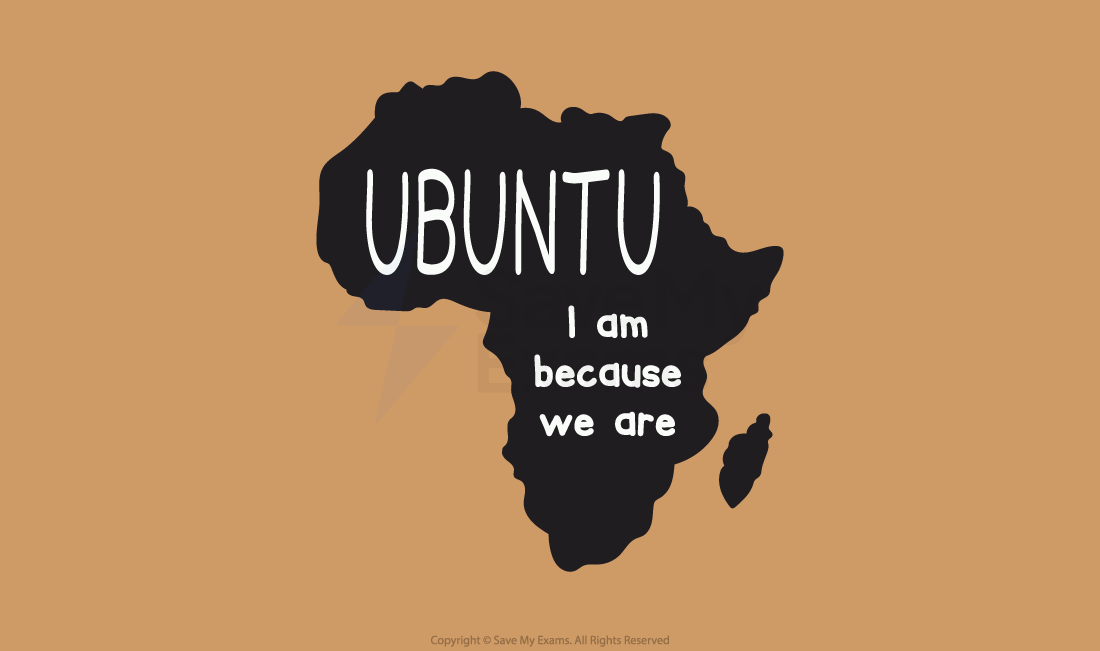
Ubuntu is a moral philosophy associated with many communities in southern Africa, especially the Zulu and Xhosa peoples, summarised as 'I am because we are'
It emphasises that a person’s humanity is connected to the humanity of others. Individuals have responsibilities to treat others with dignity, respect and compassion
Ubuntu and human rights
Ubuntu reflects the broader global idea that all people deserve fair and humane treatment.
The philosophy encourages values such as:
cooperation and community support
forgiveness and reconciliation
respect for human dignity
Post-apartheid South Africa
Ubuntu influenced South Africa’s Truth and Reconciliation Commission (TRC) after the end of apartheid in 1994
The TRC focused on truth, forgiveness and healing, rather than only punishment for past crimes
Leaders such as Desmond Tutu argued that justice should restore community relationships
Significance
Ubuntu shows how African philosophical traditions contribute to global ideas about human rights, highlighting the importance of community, dignity and mutual respect
Islamic human rights frameworks
The Cairo Declaration on Human Rights in Islam (1990) was adopted by the Organisation of Islamic Cooperation (OIC)
It affirmed that all people are equal in dignity and have rights to life, liberty and security
However, it frames rights within Islamic law (Sharia), which has led to debate about whether it offers the same protections as the UDHR
This highlights that different cultures and religions may define and prioritise rights differently
The Asian values debate
Some political leaders, such as Lee Kuan Yew of Singapore, argued in the 1990s that human rights are a Western concept not universally applicable
This Asian values debate suggested that community needs and social harmony should take priority over individual rights
Critics argue this position was used to justify authoritarian governance and suppress political opposition
The debate raises important questions about whether human rights are truly universal or culturally relative
Indigenous rights frameworks
Many indigenous peoples around the world have traditions emphasising connection to land, community and collective rights
The UN Declaration on the Rights of Indigenous Peoples (UNDRIP, 2007) recognised the right of indigenous communities to self-determination, cultural preservation and land rights
This expanded the human rights framework beyond individual rights to include collective and cultural rights

Unlock more, it's free!
Join the 100,000+ Students that ❤️ Save My Exams
the (exam) results speak for themselves:

Was this revision note helpful?
