Networks (Edexcel GCSE Computer Science): Exam Questions

Exam code: 1CP2

33 mins4 questions
1a
4 marks

Networks are described in many different ways.

(i) Give the type of network that covers a small geographical area.

(1)

(ii) Name the characteristic of a wireless network that is measured in metres.

(1)

(iii) Give two disadvantages of a bus network topology.

(2)

1b
2 marks

Network protocols control the rules of communication.

(i) Name a network protocol that transmissions from other electrical devices can interfere with and that can be blocked by walls.

(1)

(ii) Name the network protocol used to download a music file from a server.

(1)

1c
2 marks

Describe how the link layer of the TCP/IP protocol stack works.

1d
4 marks

Construct an expression to calculate the transmission rate, in megabits per second, required to transmit a 1.4 gibibyte file in 13 minutes.

You do not need to do the calculation.

2a
2 marks

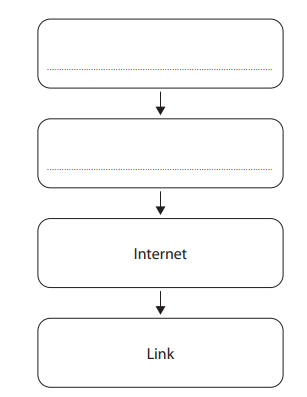
Complete the diagram of the 4‑layer TCP/IP model.

Flowchart with four blank rectangles, each connected by arrows pointing downwards. The third rectangle contains the word "Internet" and the last "Link".
2b
1 mark

Name the network topology that uses terminators to absorb signals.

2c
1 mark

Identify the reason computers are connected in a network.

  • To improve encryption

  • To prevent hacking

  • To reduce latency

  • To share peripherals

2d
1 mark

State the network protocol used to request a webpage.

2e
2 marks

Explain one benefit to a user of using IMAP to access emails.

2f
1 mark

Network speed is the current rate of data transmission, measured in bits per second.

Define the term ‘bandwidth’.

2g
2 marks

High‑speed fibre‑optic cables form the internet backbone. Routers connect other networks to this backbone.

Describe how a router enables data to arrive at its destination.

3a
5 marks

Devices are connected to networks.

(i) Give two reasons for connecting computers in a network.

(2)

(ii) Describe one way a local area network (LAN) is different from a wide area network (WAN).

(2)

(iv) Define the term ‘latency’.

(1)

3b
1 mark

(iii) A network has a speed of 17.08 megabits per second.

Identify the equivalent speed in bits per second.

(1)

  • 17080

  • 17080000

  • 17080000000

  • 17080000000000

4a
1 mark

Data is split up into packets for transmission over a network.

(i) Each device on a network has a unique identifier that is used when sending or receiving packets of data.

State the name of the unique identifier.

(1)

4b
1 mark

(ii) Identify the item included between the header and the footer in a data packet.

(1)

  • Data being sent

  • Destination address

  • Packet number

  • Public key

4c
1 mark

State the name of an email protocol.

4d
2 marks

Explain one disadvantage of using a star network topology.