Post-1914 Prose/Drama Overview (WJEC Eduqas GCSE English Literature): Exam Questions

Exam code: C720

12 hours18 questions
1
40 marks

Write about Ruth in Never Let Me Go and how Ishiguro presents her importance to the novel as a whole.

In your response you should:

  • refer to the extract and the novel as a whole

  • show your understanding of characters and events in the novel.

5 of this question’s marks are allocated for accuracy in spelling, punctuation and the use of vocabulary and sentence structures.

We stopped again further down the street, talking excitedly all at once. Except for Ruth, that is, who remained silent in the middle of it. It was hard to read her face at that moment: she certainly wasn’t disappointed, but then she wasn’t elated either. She had on a half-smile, the sort a mother might have in an ordinary family, weighing things up while the children jumped and screamed around her asking her to say, yes, they could do whatever. So there we were, all coming out with our views, and I was glad I could say honestly, along with the others, that the woman we’d seen was by no means out of the question. The truth was, we were all relieved: without quite realising it, we’d been bracing ourselves for a let-down. But now we could go back to the Cottages, Ruth could take encouragement from what she’d seen, and the rest of us could back her up. And the office life the woman appeared to be leading was about as close as you could hope to the one Ruth had often described for herself. Regardless of what had been going on between us that day, deep down, none of us wanted Ruth to return home despondent, and at that moment we thought we were safe. And so we would have been, I’m pretty sure, had we put an end to the matter at that point.

But then Ruth said: ‘Let’s sit over there, over on that wall. Just for a few minutes.

Once they’ve forgotten about us, we can go and have another look.

’ We agreed to this, but as we walked towards the low wall around the small car park Ruth had indicated, Chrissie said, perhaps a little too eagerly:

‘But even if we don’t get to see her again, we’re all agreed she’s a possible. And it’s a lovely office. It really is.’

‘Let’s just wait a few minutes,’ Ruth said. ‘Then we’ll go back.’

2
40 marks

Write about Jeanette in Oranges are not the Only Fruit and how Winterson presents her at different points in the novel.

In your response you should:

  • refer to the extract and the novel as a whole

  • show your understanding of characters and events in the novel.

5 of this question’s marks are allocated for accuracy in spelling, punctuation and the use of vocabulary and sentence structures.

‘You’ll have to leave,’ she said. ‘I’m not havin’ demons here.’

Where could I go? Not to Elsie’s, she was too sick, and no one in the church would really take the risk. If I went to Katy’s there would be problems for her, and all my relatives, like most relatives, were revolting.

‘I don’t have anywhere to go,’ I argued, following her into the kitchen.

‘The Devil looks after his own,’ she threw back, pushing me out.

I knew I couldn’t cope, so I didn’t try. I would let the feeling out later, when it was safe. For now, I had to be hard and white. In the frosty days, in the winter, the ground is white, then the sun rises, and the frosts melt ...

‘It’s decided then.’ I breezed in to my mother with more bravado than courage, ‘I’m moving out on Thursday.’

‘Where to?’ She was suspicious.

‘I’m not telling you, I’ll see how it goes.’

‘You’ve got no money.’

‘I’ll work evenings as well as weekends.’

In fact I was scared to death and going to live with a teacher who had some care for what was happening. I was driving an ice-cream van on Saturdays; now I would work Sundays as well, and try to pay the woman as best I could. Bleak, but not so bleak as staying there. I wanted the dog, but knew she wouldn’t let me, so I took my books and my instruments in a tea chest, with my Bible on top. The only thing that worried me was the thought of having to work on a fruit stall. Spanish Navels, Juicy Jaffas, Ripe Sevilles.

‘I won’t,’ I consoled myself. ‘I’ll go in the tripe works first.’

I made my bed carefully the last morning at home, emptied the waste paper basket, and trailed the dog on a long walk. She ran off with the Jack from the bowling green. At that time I could not imagine what would become of me, and I didn’t care. It was not judgement day, but another morning.

3
40 marks

Write about Hector in The History Boys and how Bennett presents his importance in the play.

In your response you should:

  • refer to the extract and the play as a whole

  • show your understanding of characters and events in the play.

5 of this question’s marks are allocated for accuracy in spelling, punctuation and the use of vocabulary and sentence structures.

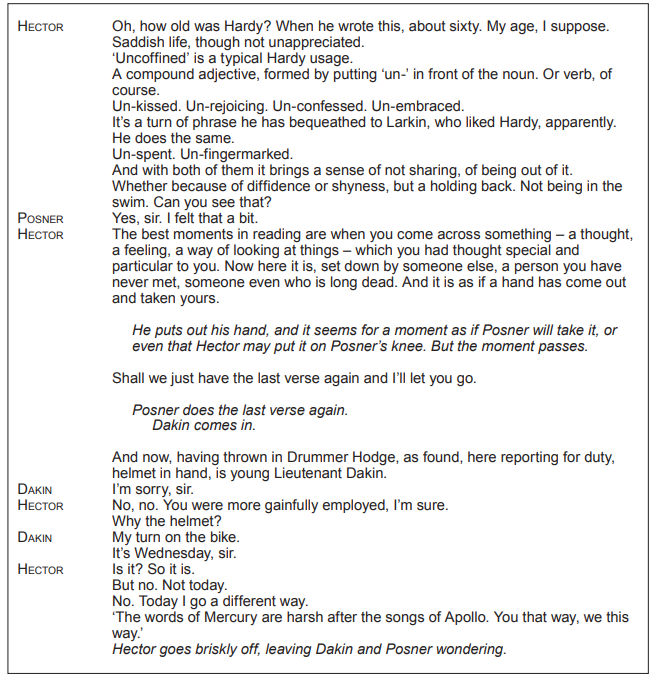
A script excerpt with dialogue involving characters Hector, Posner, and Dakin discussing poets Hardy and Larkin, and an entrance by Dakin dressed as Lieutenant.
4
40 marks

Write about lies and deception in Never Let Me Go and how they are presented at different points in the novel.

In your response you should:

  • refer to the extract and the novel as a whole

  • show your understanding of characters and events in the novel.

5 of this question’s marks are allocated for accuracy in spelling, punctuation and the use of vocabulary and sentence structures.

Miss Emily raised her eyebrows. ‘Lucy Wainright? She was important to you? Forgive me, dear students, I’m forgetting again. Lucy wasn’t with us for long, so for us she’s just a peripheral figure in our memory of Hailsham. And not an altogether happy one. But I appreciate, if you were there during just those years …’ She laughed to herself and seemed to be remembering something. In the hall, Madame was telling the men off really loudly, but Miss Emily now seemed to have lost interest. She was going through her memories with a look of concentration. Finally she said: ‘She was a nice enough girl, Lucy Wainright. But after she’d been with us for a while, she began to have these ideas. She thought you students had to be made more aware. More aware of what lay ahead of you, who you were, what you were for. She believed you should be given as full a picture as possible. That to do anything less would be somehow to cheat you. We considered her view and concluded she was mistaken.’

‘Why?’ Tommy asked. ‘Why did you think that?’

‘Why? She meant well, I’m sure of that. I can see you were fond of her. She had the makings of an excellent guardian. But what she was wanting to do, it was too theoretical. We had run Hailsham for many years, we had a sense of what could work, what was best for the students in the long run, beyond Hailsham. Lucy Wainright was idealistic, nothing wrong with that. But she had no grasp of practicalities. You see, we were able to give you something, something which even now no one will ever take from you, and we were able to do that principally by sheltering you. Hailsham would not have been Hailsham if we hadn’t. Very well, sometimes that meant we kept things from you, lied to you. Yes, in many ways we fooled you. I suppose you could even call it that. But we sheltered you during those years, and we gave you your childhoods. Lucy was well-meaning enough. But if she’d had her way, your happiness at Hailsham would have been shattered. Look at you both now! I’m so proud to see you both. You built your lives on what we gave you. You wouldn’t be who you are today if we’d not protected you. You wouldn’t have become absorbed in your lessons, you wouldn’t have lost yourselves in your art and your writing. Why should you have done, knowing what lay in store for each of you? You would have told us it was all pointless, and how could we have argued with you? So she had to go.

5
40 marks

Write about the relationships between Jeanette and her family in Oranges are not the Only Fruit and how they are presented at different points in the novel.

In your response you should:

  • refer to the extract and the novel as a whole

  • show your understanding of characters and events in the novel.

5 of this question’s marks are allocated for accuracy in spelling, punctuation and the use of vocabulary and sentence structures.

That Awful Occasion was the time my natural mother had come back to claim me. I’d had an idea that there was something curious about the circumstance of my birth, and once found my adoption papers hidden under a stack of flannels in the holiday drawer. ‘Formalities,’ my mother had said, waving me away. ‘You were always mine, I had you from the Lord.’ I didn’t think about it again until there was a knock on the door one Saturday. My mother got there before me because she was praying in the parlour. I followed her down the lobby.

‘Who is it Mum?’

She didn’t answer.

‘Who is it?’ ‘Go inside until I tell you.’

I slunk off, thinking it was either Jehovah’s Witnesses or the man from the Labour party. Before long I could hear voices, angry voices; my mother seemed to have let the person in, which was strange. She didn’t like having the Heathen in the house. ‘Leaves a bad atmosphere,’ she always said.

I remembered something I’d seen Mrs White do on the fornication occasion. Reaching far back into the War Cupboard, behind the dried egg, I found a wine glass and put it against the wall. It worked. I could hear every word. After five minutes I put the glass away, picked up our dog, and cried and cried and cried.

Eventually my mother came in.

‘She’s gone.’

‘I know who she was, why didn’t you tell me?’

‘It’s nothing to do with you.’

‘She’s my mother.’

No sooner had I said that than I felt a blow that wrapped round my head like a bandage. I lay on the lino looking up into the face.

‘I’m your mother,’ she said very quietly. ‘She was a carrying case.’

‘I wanted to see her.’

‘She’s gone and she’ll never come back.’ My mother turned away and locked herself in the kitchen. I couldn’t think and I couldn’t breathe so I started to run.

6
40 marks

Irwin and Hector are very different characters and very different teachers. Write about some of the differences between Irwin and Hector and how they are presented throughout the play.

In your response you should:

  • refer to the extract and the play as a whole

  • show your understanding of characters and events in the play.

5 of this question’s marks are allocated for accuracy in spelling, punctuation and the use of vocabulary and sentence structures.

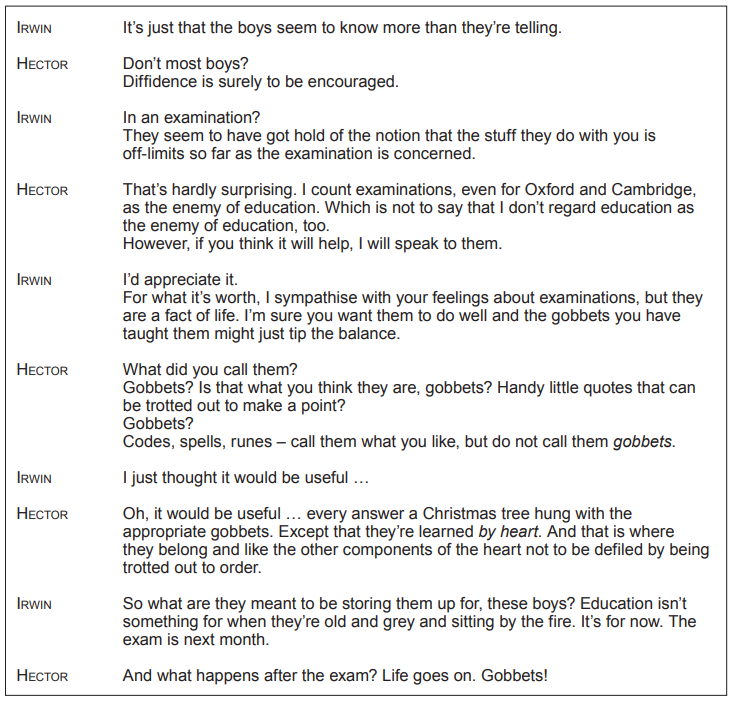
Conversation between Irwin and Hector discussing education and examinations, debating the usefulness of learned information for exams versus lifelong learning.
7
40 marks

Never Let Me Go is a novel about the characters discovering truths. Write about some of the times when truths are discovered and their importance to the novel as a whole.

In your response you should:

  • refer to the extract and the novel as a whole

  • show your understanding of characters and events in the novel

5 of this question’s marks are allocated for accuracy in spelling, punctuation and the use of vocabulary and sentence structures.

‘Peter, go on. Please tell the others what you were just saying.’

Peter shrugged. ‘We were just talking about what it would feel like if we became actors. What sort of life it would be.’

‘Yes,’ Miss Lucy said, ‘and you were saying to Gordon you’d have to go to America to stand the best chance.’

Peter J. shrugged again and muttered quietly: ‘Yes, Miss Lucy.’

But Miss Lucy was now moving her gaze over the lot of us. ‘I know you don’t mean any harm. But there’s just too much talk like this. I hear it all the time, it’s been allowed to go on, and it’s not right.’ I could see more drops coming off the gutter and landing on her shoulder, but she didn’t seem to notice. ‘If no one else will talk to you,’ she continued, ‘then I will. The problem, as I see it, is that you’ve been told and not told. You’ve been told, but none of you really understand, and I dare say, some people are quite happy to leave it that way. But I’m not. If you’re going to have decent lives, then you’ve got to know and know properly. None of you will go to America, none of you will be film stars. And none of you will be working in supermarkets as I heard some of you planning the other day. Your lives are set out for you. You’ll become adults, then before you’re old, before you’re even middle-aged, you’ll start to donate your vital organs. That’s what each of you was created to do. You’re not like the actors you watch on your videos, you’re not even like me. You were brought into this world for a purpose, and your futures, all of them, have been decided. So you’re not to talk that way any more. You’ll be leaving Hailsham before long, and it’s not so far off, the day you’ll be preparing for your first donations. You need to remember that. If you’re to have decent lives, you have to know who you are and what lies ahead of you, every one of you.’

Then she went silent, but my impression was that she was continuing to say things inside her head, because for some time her gaze kept roving over us, going from face to face just as if she were still speaking to us. We were all pretty relieved when she turned to look out over the playing field again.

‘It’s not so bad now,’ she said, even though the rain was as steady as ever. ‘Let’s just go out there. Then maybe the sun will come out too.

8
40 marks

Write about some of the turning points in Jeanette’s life and how they are presented in Oranges are not the Only Fruit.

In your response you should:

  • refer to the extract and the novel as a whole

  • show your understanding of characters and events in the novel

5 of this question’s marks are allocated for accuracy in spelling, punctuation and the use of vocabulary and sentence structures.

Week after week I went back there, just to watch.

Then one week she wasn’t there any more.

There was nothing I could do but stare and stare at the whelks.

Whelks are strange and comforting.

They have no notion of community life and they breed very quietly.

But they have a strong sense of personal dignity.

Even lying face down in a tray of vinegar, there is something noble about a whelk.

Which cannot be said for everybody.

‘Why do I feel like this?’ I wondered. Then, just as I was about to turn away and buy myself a baked potato for comfort, I saw Melanie walking round to the stall. I went straight up to her. She looked a bit surprised.

‘Hello, I thought you’d left.’

‘I have left, I’ve got a job in the library now, just Saturday mornings.’

What could I say next? How could I make her stay?

‘Would you like a baked potato?’ I offered wildly.

She smiled, and said she would and we went to eat it on the bench outside Woolworth’s. I was very nervous, and the pigeons got most of mine. She talked about the weather and her mother, that she had no father. ‘I haven’t either,’ I said, to make her feel better. ‘Well, not much.’ Then I had to explain about our church and my mother and me being dedicated to the Lord. It sounded odd for a moment, but I knew that was because I felt nervous. I asked her if she went to church, and she said she did, but not a very lively one, so of course I invited her to ours the next day.

‘Melanie,’ I plucked up courage to ask at last, ‘why do you have such a funny name?’

She blushed. ‘When I was born I looked like a melon.’

‘Don’t worry,’ I reassured her, ‘you don’t any more.

9
40 marks

Write about Dakin and how he is presented at different points in the play.

In your response you should:

  • refer to the extract and the play as a whole

  • show your understanding of characters and events in the play

5 of this question’s marks are allocated for accuracy in spelling, punctuation and the use of vocabulary and sentence structures.

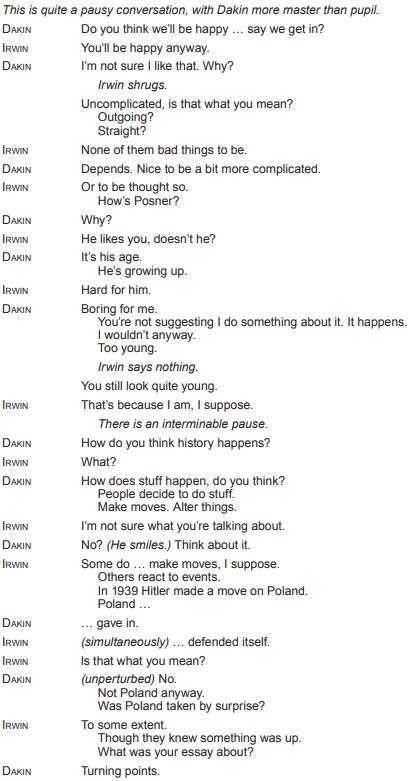
Text from a script featuring a dialogue between characters Dakin and Irwin, discussing topics like happiness, maturity, history, and Poland.
10
40 marks

Write about Kathy and how she is presented at different points in the novel.

In your response you should:

  • refer to the extract and the novel as a whole

  • show your understanding of characters and events in the novel

5 of this question’s marks are allocated for accuracy in spelling, punctuation and the use of vocabulary and sentence structures.

My name is Kathy H. I’m thirty-one years old, and I’ve been a carer now for over eleven years. That sounds long enough, I know, but actually they want me to go on for another eight months, until the end of this year. That’ll make it almost exactly twelve years. Now I know my being a carer so long isn’t necessarily because they think I’m fantastic at what I do. There are some really good carers who’ve been told to stop after just two or three years. And I can think of one carer at least who went on for all of fourteen years despite being a complete waste of space. So I’m not trying to boast. But then I do know for a fact they’ve been pleased with my work, and by and large, I have too. My donors have always tended to do much better than expected. Their recovery times have been impressive, and hardly any of them have been classified as ‘agitated’, even before fourth donation. Okay, maybe I am boasting now. But it means a lot to me, being able to do my work well, especially that bit about my donors staying ‘calm’. I’ve developed a kind of instinct around donors. I know when to hang around and comfort them, when to leave them to themselves; when to listen to everything they have to say, and when just to shrug and tell them to snap out of it.

Anyway, I’m not making any big claims for myself. I know carers, working now, who are just as good and don’t get half the credit. If you’re one of them, I can understand how you might get resentful − about my bedsit, my car, above all, the way I get to pick and choose who I look after. And I’m a Hailsham student − which is enough by itself sometimes to get people’s backs up. Kathy H., they say, she gets to pick and choose, and she always chooses her own kind: people from Hailsham, or one of the other privileged estates. No wonder she has a great record. I’ve heard it said enough, so I’m sure you’ve heard it plenty more, and maybe there’s something in it. But I’m not the first to be allowed to pick and choose, and I doubt if I’ll be the last. And anyway, I’ve done my share of looking after donors brought up in every kind of place. By the time I finish, remember, I’ll have done twelve years of this, and it’s only for the last six they’ve let me choose.

11
40 marks

Write about some of the different types of love in Oranges are not the Only Fruit and how Winterson presents them in the novel.

In your response you should:

  • refer to the extract and the novel as a whole

  • show your understanding of characters and events in the novel

5 of this question’s marks are allocated for accuracy in spelling, punctuation and the use of vocabulary and sentence structures.

‘I’ll bring in the calor gas,’ said Katy, ‘so we won’t be cold.’

We weren’t cold, not that night nor any of the others we spent together over the years that followed. She was my most uncomplicated love affair, and I loved her because of it. She seemed to have no worries at all, and though she still denies it, I think she planned the caravan.

‘Are you sure this is what you want?’ I murmured, not intending to stop.

‘Oh yes,’ she cried, ‘yes.’

We stopped talking about it quickly because the dialogue was getting too embarrassing. She was blissful. I took care never to look at her when I preached, though she always sat in the front row. We did have a genuinely spiritual dimension. I taught her a lot, and she put all her efforts into the church, quite apart from me. It was a good time. To the pure all things are pure…

A year has passed since Melanie’s Easter and my illness. It was Easter time again and the Church of England was winding its way up the hill, carrying the cross. On Palm Sunday Melanie returned, beaming with an important announcement. She was to be married that autumn to an army man. To be fair he had given up the bad fight for the Good Fight, but as far as I was concerned he was revolting. I had no quarrel with men. At that time there was no reason that I should. The women in our church were strong and organised. If you want to talk in terms of power I had enough to keep Mussolini happy. So I didn’t object to Melanie getting married.

12
40 marks

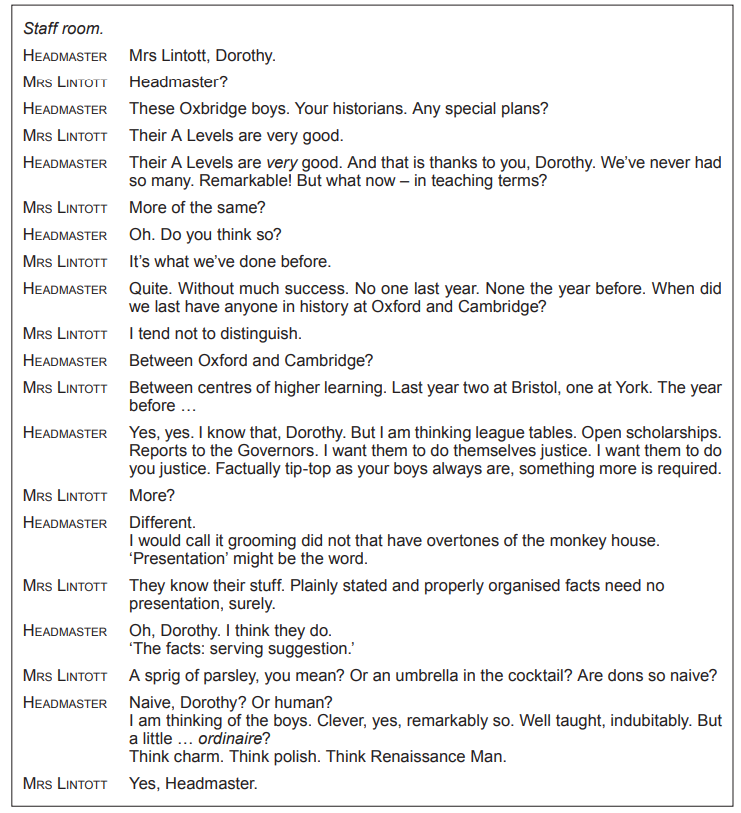
Write about the Headmaster and how he is presented at different points in the play.

In your response you should:

  • refer to the extract and the play as a whole

  • show your understanding of characters and events in the play

5 of this question’s marks are allocated for accuracy in spelling, punctuation and the use of vocabulary and sentence structures.

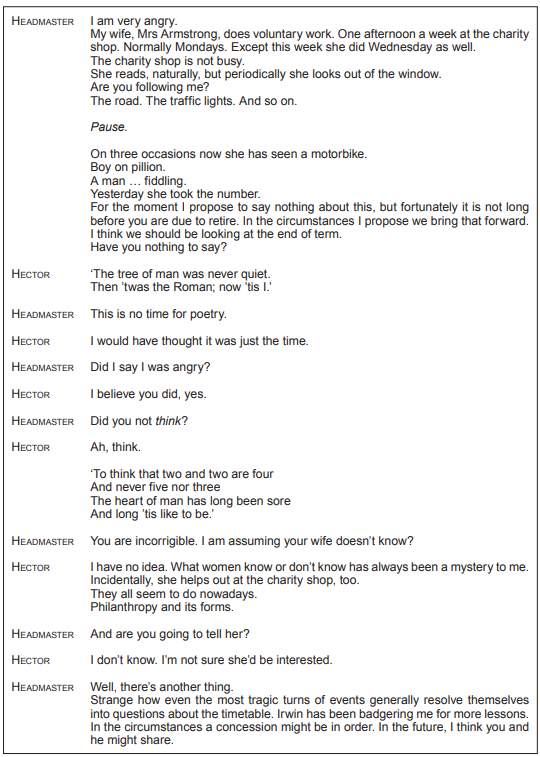
Text conversation between two characters, Headmaster and Hector, discussing charity work, a motorbike incident, and poetry. Dialogue includes frustration and poetic reflection.
13
40 marks

Write about the relationship between Kathy and Ruth and how it is presented at different points in the novel.

In your response you should:

  • refer to the extract and the novel as a whole

  • show your understanding of characters and events in the novel

5 of this question’s marks are allocated for accuracy in spelling, punctuation and the use of vocabulary and sentence structures.

The South Playing Field was the one used most by the Juniors and it was there, in the corner by the poplars, that Ruth came up to me one lunchtime, looked me up and down, then asked:

‘Do you want to ride my horse?’

I was in the midst of playing with two or three others at that point, but it was clear Ruth was addressing only me. This absolutely delighted me, but I made a show of weighing her up before giving a reply.

‘Well, what’s your horse’s name?’

Ruth came a step closer. ‘My best horse,’ she said, ‘is Thunder. I can’t let you ride on him. He’s much too dangerous. But you can ride Bramble, as long as you don’t use your crop on him. Or if you like, you could have any of the others.’ She reeled off several more names I don’t now remember. Then she asked: ‘Have you got any horses of your own?’

I looked at her and thought carefully before replying: ‘No. I don’t have any horses.’

‘Not even one?’

‘No.’

‘All right. You can ride Bramble, and if you like him, you can have him to keep. But you’re not to use your crop on him. And you’ve got to come now.’ My friends had, in any case, turned away and were carrying on with what they’d been doing. So I gave a shrug and went off with Ruth.

The field was filled with playing children, some a lot bigger than us, but Ruth led the way through them very purposefully, always a pace or two in front. When we were almost at the wire mesh boundary with the garden, she turned and said:

‘Okay, we’ll ride them here. You take Bramble.’

I accepted the invisible rein she was holding out, and then we were off, riding up and down the fence, sometimes cantering, sometimes at a gallop. I’d been correct in my decision to tell Ruth I didn’t have any horses of my own, because after a while with Bramble, she let me try her various other horses one by one, shouting all sorts of instructions about how to handle each animal’s foibles.

‘I told you! You’ve got to really lean back on Daffodil! Much more than that! She doesn’t like it unless you’re right back!’

I must have done well enough, because eventually she let me have a go on Thunder, her favourite. I don’t know how long we spent with her horses that day: it felt a substantial time, and I think we both lost ourselves completely in our game. But then suddenly, for no reason I could see, Ruth brought it all to an end, claiming I was deliberately tiring out her horses, and that I’d have to put each of them back in its stable.

14
40 marks

Write about religion in Oranges are not the Only Fruit, and how it is presented at different points in the novel.

In your response you should:

  • refer to the extract and the novel as a whole

  • show your understanding of characters and events in the novel

5 of this question’s marks are allocated for accuracy in spelling, punctuation and the use of vocabulary and sentence structures.

By the time we got to church, the first hymn was under way. My mother glared at me, and I tried to look sorry. We had slid in next to Miss Jewsbury who told me to keep calm.

‘What do you mean?’ I whispered.

‘Come and talk to me afterwards,’ she hissed, ‘But not till we’re out of sight.’

I decided she had gone mad. The church was very full as usual, and every time I caught someone’s eye they smiled or nodded. It made me happy. There was nowhere I’d rather be. When the hymn was over I squeezed a bit closer to Melanie and tried to concentrate on the Lord. ‘Still,’ I thought, ‘Melanie is a gift from the Lord, and it would be ungrateful not to appreciate her.’ I was still deep in these contemplations when I realised that something disturbing was happening. The church had gone very quiet and the pastor was standing on his lower platform, with my mother next to him. She was weeping. I felt a searing pain against my knuckles; it was Melanie’s ring. Then Miss Jewsbury was urging me to my feet saying, ‘Keep calm, keep calm,’ and I was walking out to the front with Melanie. I shot a glance at her. She was pale. ‘These children of God,’ began the pastor, ‘have fallen under Satan’s spell.’ His hand was hot and heavy on my neck. Everyone in the congregation looked like a waxwork.

‘These children of God have fallen foul of their lusts.’

‘Just a minute ...,’ I began, but he took no notice.

‘These children are full of demons.’

A cry of horror ran through the church.

‘I’m not,’ I shouted, ‘and neither is she.’

‘Listen to Satan’s voice,’ said the pastor to the church, pointing at me. ‘How are the best become the worst.’

‘What are you talking about?’ I asked, desperate.

‘Do you deny you love this woman with a love reserved for man and wife?’ ‘No, yes, I mean of course I love her.’

‘I will read you the words of St Paul,’ announced the pastor, and he did, and many more words besides about unnatural passions and the mark of the demon.

‘To the pure all things are pure,’ I yelled at him. ‘It’s you not us.’

‘He turned to Melanie.

‘Do you promise to give up this sin and beg the Lord to forgive you?’

‘Yes.’ She was trembling uncontrollably. I hardly heard what she said.

‘Then go into the vestry with Mrs White and the elders will come and pray for you. It’s not too late for those who truly repent.

’ He turned to me.

‘I love her.’

‘Then you do not love the Lord.’

‘Yes, I love both of them.’

‘You cannot.’ ‘I do, I do, let me go.’ But he caught my arm and held me fast. ‘The church will not see you suffer, go home and wait for us to help you.

I ran out on to the street, wild with distress.

15
40 marks

The characters in The History Boys have different views on teaching and education. Write about some of these views and how Bennett presents them at different points in the play.

In your response you should:

  • refer to the extract and the play as a whole

  • show your understanding of characters and events in the play

5 of this question’s marks are allocated for accuracy in spelling, punctuation and the use of vocabulary and sentence structures.

Dialogue excerpt from a play featuring a conversation about student performance and aspirations for Oxbridge, focusing on teaching methods and educational outcomes.
16
40 marks

Write about the relationship between Kathy and Tommy and how it is presented at different points in the novel.

In your response you should:

  • refer to the extract and the novel as a whole

  • show your understanding of characters and events in the novel

5 of this question’s marks are allocated for accuracy in spelling, punctuation and the use of vocabulary and sentence structures.

‘Tommy, let’s talk now. There’s something I want to talk to you about.’

As soon as I said this, he let the ball roll away and came to sit down beside me. It was typical of Tommy that once he knew I was willing to talk, there was suddenly no trace left of any sulkiness; just a kind of grateful eagerness that reminded me of the way we were back in the Juniors when a guardian who’d been telling us off went back to being normal. He was panting a bit, and though I knew this was from the football, it added to his overall impression of eagerness. In other words, before we’d said anything, he’d already got my back up. Then when I said to him: ‘Tommy, I can tell. You haven’t been too happy lately,’ he said: ‘What do you mean? I’m perfectly happy. I really am.’ And he did a big beam, followed by this hearty laugh. That was what did it. Years later, when I saw a shadow of it every now and then, I’d just smile. But back then, it really used to get to me. If Tommy happened to say to you: ‘l’m really upset about it,’ he’d have to put on a long, downcast face, then and there, to back up his words. I don’t mean he did this ironically. He actually thought he’d be more convincing. So now, to prove he was happy, here he was, trying to sparkle with bonhomie. As I say, there would come a time when I’d think this was sweet; but that summer all I could see was that it advertised what a child he still was, and how easily you could take advantage of him. I didn’t know much then about the world that awaited us beyond Hailsham, but I’d guessed we’d need all our wits about us, and when Tommy did anything like this, I felt something close to panic. Until that afternoon I’d always let it go–it always seemed too difficult to explain– but this time I burst out, saying:

‘Tommy, you look so stupid, laughing like that! If you want to pretend you’re happy, you don’t do it that way! Just take it from me, you don’t do it that way! You definitely don’t! Look, you’ve got to grow up. And you’ve got to get yourself back on track. Everything’s been falling apart for you just lately, and we both know why.’

Tommy was looking puzzled. When he was sure I’d finished, he said: ‘You’re right. Things have been falling apart for me. But I don’t see what you mean, Kath. What do you mean, we both know? I don’t see how you could know. I haven’t told anyone.’

‘Obviously I don’t have all the details. But we all know about you splitting with Ruth.’

17
40 marks

Write about the relationship between Jeanette and Elsie and how it is presented at different points in the novel.

In your response you should:

  • refer to the extract and the novel as a whole

  • show your understanding of characters and events in the novel

5 of this question’s marks are allocated for accuracy in spelling, punctuation and the use of vocabulary and sentence structures.

Elsie Norris, ‘Testifying Elsie’ as she was called, was a great encouragement to our church. Whenever the pastor asked for a testimony on God’s goodness, Elsie leapt to her feet and cried, ‘Listen to what the Lord has done for me this week.’

She needed eggs, the Lord had sent them.

She had a bout of colic, the Lord took it away.

She always prayed for two hours a day;

once in the morning at seven a.m.

and once in the evening at seven p.m.

Her hobby was numerology, and she never read the Word without first casting the dice to guide her.

‘One dice for the chapter, and one dice for the verse’ was her motto. Someone once asked her what she did for books of the Bible that had more than six chapters.

‘I have my ways,’ she said stiffly, ‘and the Lord has his.’

I liked her a lot because she had interesting things in her house. She had an organ that you had to pedal if you wanted it to make a noise. Whenever I went there she played Lead Kindly Light. Her doing the keys, and me doing the pedals because she had asthma. She collected foreign coins and kept them in a glass case that smelled of linseed oil. She said it reminded her of her late husband who had used to play cricket for Lancashire.

‘Hard Hand Stan they called him,’ she said every time I went to see her. She could never remember what she told people. She could never remember how long she kept her fruit cake. There was a time when I got offered the same piece of cake for five weeks. I was lucky, she never remembered what you said to her either, so every week I made the same excuse.

‘Colic,’ I said.

‘I’ll pray for you,’ she said.

Best of all, she had a collage of Noah’s Ark. It showed the two parent Noah’s leaning out looking at the flood, while the other Noah’s tried to catch one of the rabbits. But for me, the delight was a detachable chimpanzee, made out of a Brillo pad; at the end of my visit she let me play with it for five minutes. I had all kinds of variations, but usually I drowned it.

18
40 marks

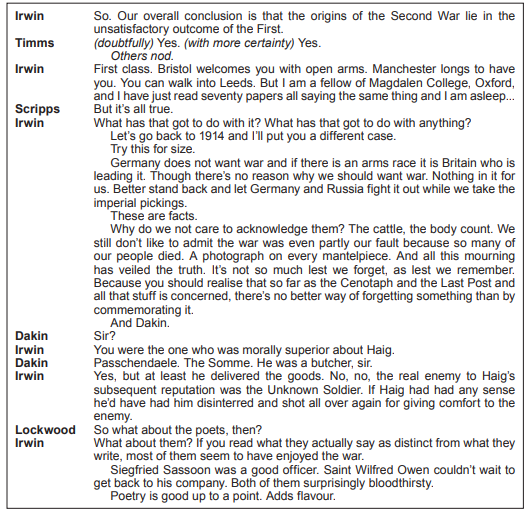
Write about Irwin and how he is presented at different points in the play.

In your response you should:

  • refer to the extract and the play as a whole

  • show your understanding of characters and events in the play

5 of this question’s marks are allocated for accuracy in spelling, punctuation and the use of vocabulary and sentence structures.

A dialogue between characters Irwin, Timms, Scripps, Dakin, and Lockwood discussing World War history, moral superiority, and poetry's role in adding depth.