Fieldwork (AQA GCSE Geography): Exam Questions

Exam code: 8035

41 mins8 questions
1a
1 mark

Study Figure 4, information collected by students about visitors to Bournemouth, a coastal town in Dorset.

fig-4-june-2018-paper3-qp-gcse-aqa-geo

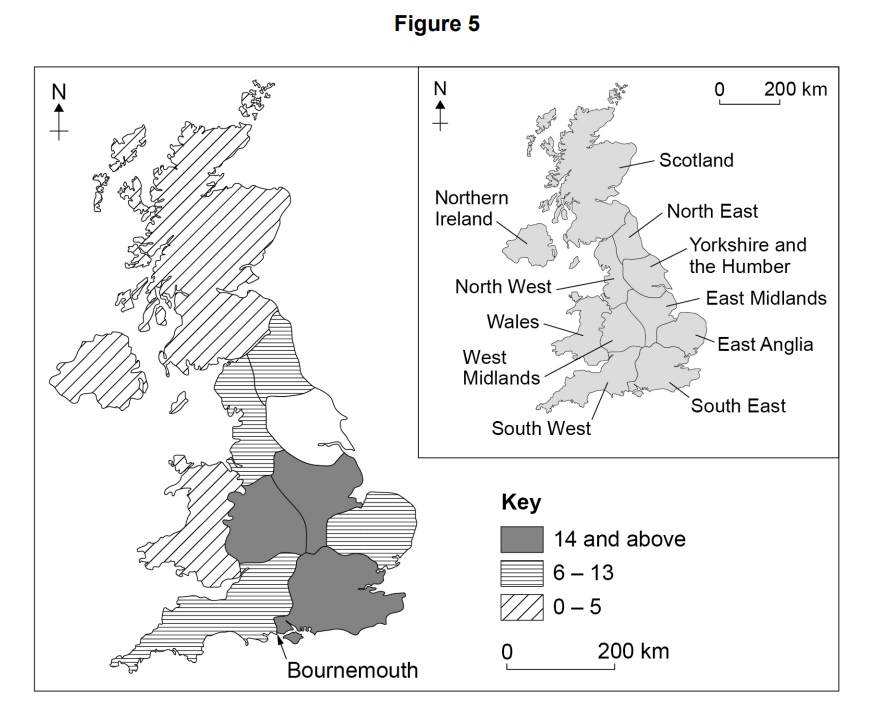
Complete the map below (Figure 5) to show the origin of visitors to Bournemouth using the following data.

Yorkshire and the Humber

6%

Map of the UK showing population density. Regions are marked with three shades: 0-5, 6-13, 14 and above. Bournemouth is highlighted. Inset shows regional labels.
1b
2 marks

Describe the pattern shown by Figure 5. 

1c
2 marks

(a) Suggest one additional question that could be included on the visitor survey.

(b) Give one reason why your chosen question might provide useful information for the visitor survey.

1d
2 marks

Study Figure 6, information about visitor numbers to the main tourist attractions in a city.

Figure 6

Visitor numbers to main tourist
attractions (thousands)

January

80

February

110

March

120

April

180

May

220

June

230

July

270

August

310

September

200

October

190

November

100

December

120

A student used the following presentation method (Figure 7) to show the information in Figure 6

fig-7-june-2018-paper3-qp-gcse-aqa-geo

(a)

Suggest a more appropriate method for presenting the data shown in Figure 6.

(b)

Give a reason for your choice.

2a
1 mark

As part of a geographical enquiry box , students carried out an environmental quality survey in one part of a town centre. The results are shown in Figure 8.

Figure 8


-2

-1

0

+1

+2


Lots of traffic pollution


No traffic pollution

Lots of litter


No litter

Unattractive buildings


Attractive buildings

Lots of vandalism


No vandalism

No landscaping


Good landscaping

What is the total environmental quality score for the area shown in Figure 8?

2b
2 marks

Suggest one advantage and one disadvantage of using the technique shown in Figure 8 to measure environmental quality.

Advantage

Disadvantage

2c
1 mark

Students studied two different rivers over a distance of 1000 metres. For each river box they measured the depth at a number of sites. The results are shown on Figure 9.

fig-9-june-2018-paper3-qp-gcse-aqa-geo

Complete the scattergraph for River B by plotting the following data.

Distance from source – 450 m
Depth of river – 22 cm

2d
1 mark

Draw a line of best fit on the scattergraph for River B.

3
3 marks

Justify one primary data collection method used in your physical geography enquiry.

4a
1 mark

A group of students wanted to investigate variations in temperature in their local area.

To do this, each student measured the temperature in a different place at the same time on one day in the month of June.

Study Figure 5, an isoline map showing the results of the temperature survey.

Isoline map showing temperature readings around a town centre with isolines marked at intervals, illustrating temperature variation in degrees Celsius.

Complete the isoline map for 16oC on Figure 5.

4b
2 marks

Describe the pattern shown by the isoline map (Figure 5).

4c
1 mark

Which of the following would be an appropriate alternative way of presenting the data shown on Figure 5?

A . Desire line map

B. Dot map

C. Flow line map

D. Proportional circle map

  • Desire line map

  • Dot map

  • Flow line map

  • Proportional circle map

5a
1 mark

A student wanted to investigate the pattern of house prices in their local town.

To complete the enquiry, the student collected information from estate agents about the price of three bedroom houses in seven different areas (A-G).

Study Figure 4, a map showing the results of the house price survey.

Map showing average house prices by area, labelled A to G, with prices ranging from under £150,000 to over £250,000. Includes a town centre.
Average house prices by area

Complete Figure 4 using the following data.

Average house price in area G

£148 200

5b
2 marks

Suggest what the map shows about the pattern of house prices in the town.

5c
2 marks

Suggest two ways that the house price survey could be adapted to make it more useful.

6a
1 mark

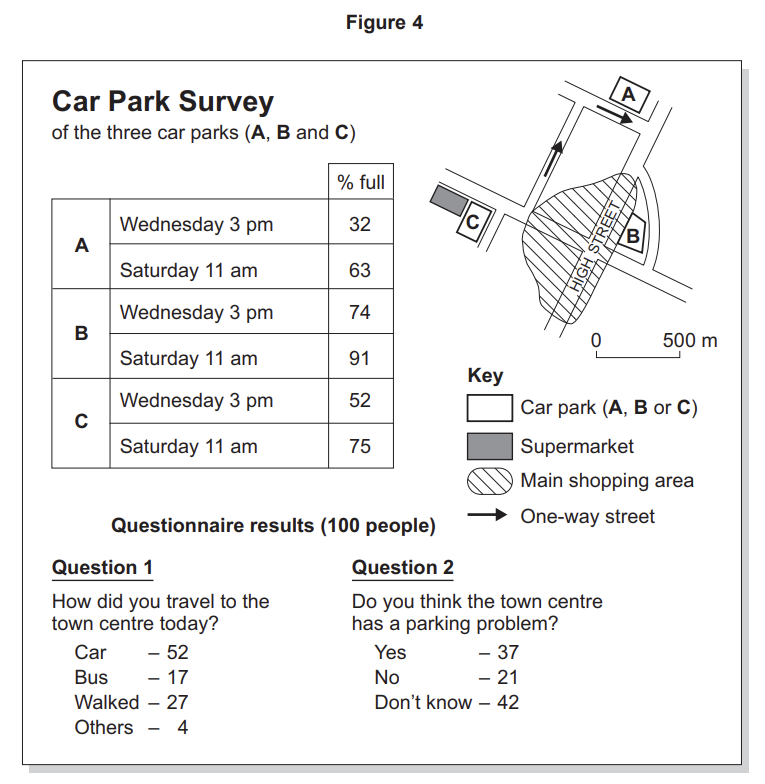
A student wanted to carry out a human geography enquiry in their local town by investigating the question ‘Does the town centre have a parking problem?’

In order to do this the student carried out primary research, including a questionnaire and a car park survey.

Study Figure 4, which shows the results of the questionnaire and car park survey.

fig-4-june-2020-paper3-qp-gcse-aqa-geo

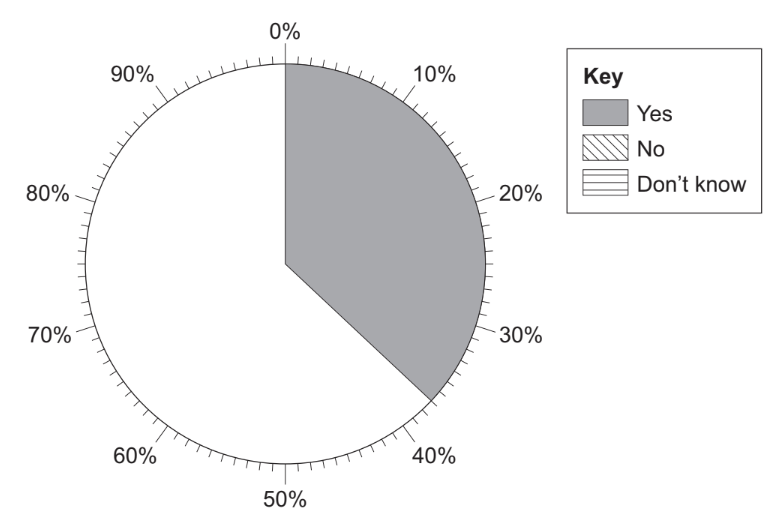
Complete the pie chart below to show the results of Question 2 in the questionnaire (Figure 4).

o4-1-june-2020-paper3-qp-gcse-aqa-geo
6b
2 marks

Using Figure 4, describe the pattern shown by the results of the car park survey.

6c
1 mark

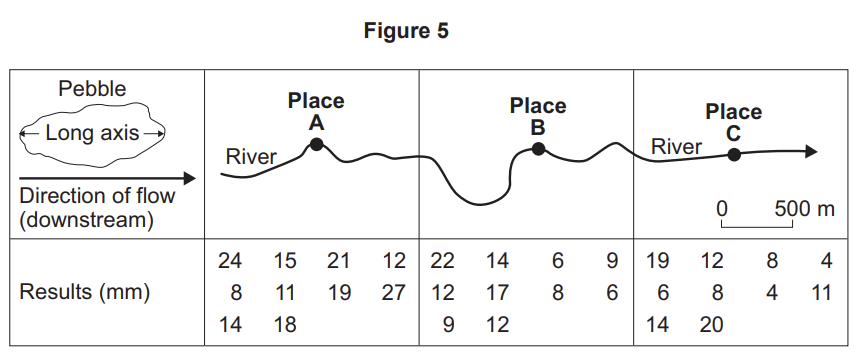
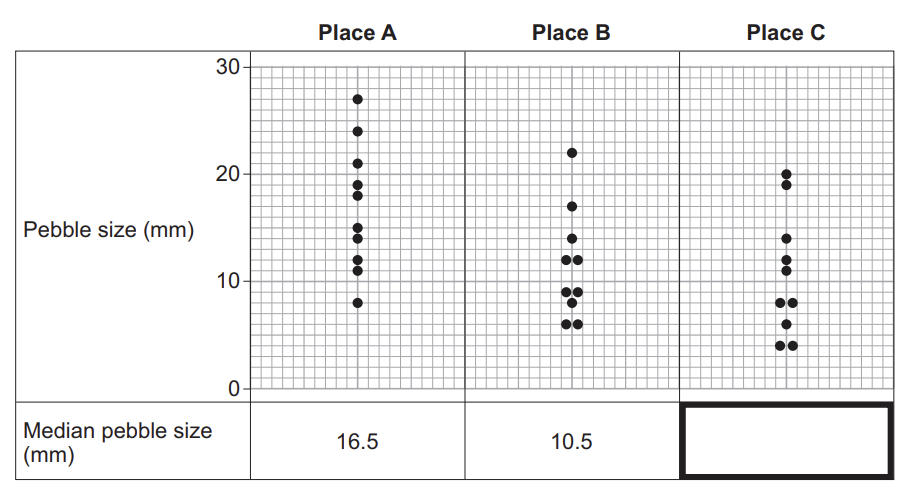
A group of students wanted to investigate the hypothesis that ‘The size of pebbles in a river is smaller as the river flows downstream’.

In order to do this the students measured the long axis of ten pebbles from three different places (A, B and C) along the river.

Study Figure 5, a table showing the results of the survey.

fig-5-june-2020-paper3-qp-gcse-aqa-geo

Complete the diagram below by filling in the median pebble size for place C.

04-4-june-2020-paper3-qp-gcse-aqa-geo
6d
2 marks

Outline the conclusions that the students could draw from the data.

6e
2 marks

Suggest two ways that the data collection method could be adapted in order to make it more useful.

7a
1 mark

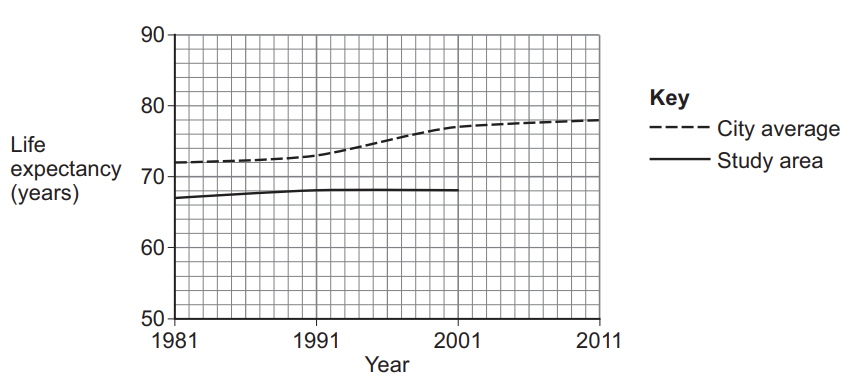
A student wanted to investigate deprivation in an area of a city. As part of their enquiry they used the following secondary data (Figure 6).

Figure 6

Life expectancy (years)

1981

1991

2001

2011

Study area

67

68

68

70

City average

72

73

77

78

Complete the graph below to show life expectancy in the study area.

04-7-june-2020-paper3-qp-gcse-aqa-geo
7b
1 mark

In 2001, how many years lower was life expectancy in the study area than the city average?

7c
2 marks

Suggest two types of primary data that the student could use in their urban deprivation enquiry.

8a
2 marks

For one of your fieldwork enquiries, suggest how anomalies in your data could affect your fieldwork enquiry.

Title of fieldwork enquiry _______________

8b
3 marks

Write the title of your human geography fieldwork enquiry.

Title of human fieldwork enquiry ___________________

Justify the use of one of the following in your human geography enquiry:

  • maps

  • photographs

  • field sketches