International Trade (Edexcel IGCSE Economics): Exam Questions

Exam code: 4EC1

3 hours38 questions
1a3 marks

In January 2023, China introduced a quota on imports of crude oil into the country.

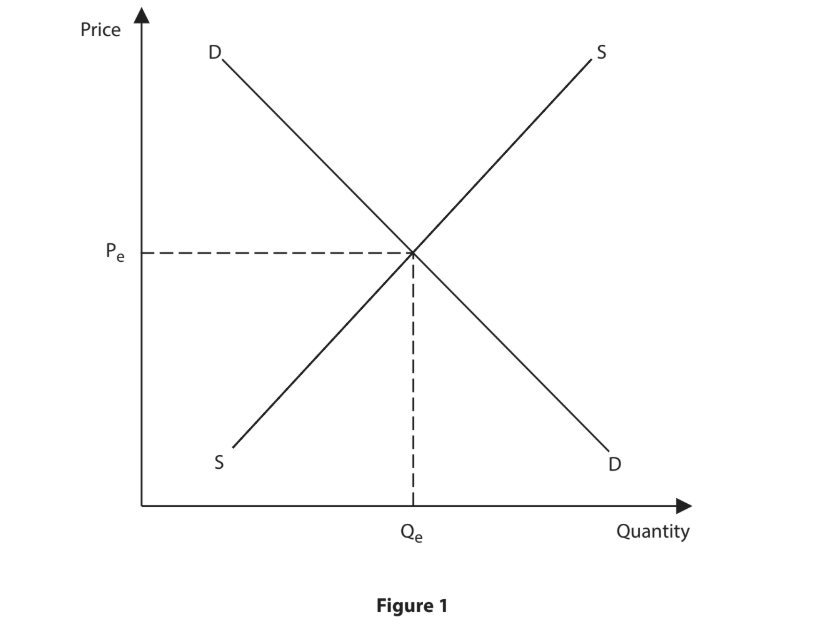
Using the diagram below, draw the effects of the introduction of the quota on the equilibrium price and quantity of crude oil in China. Label the new curve, the new equilibrium price and the new equilibrium quantity.
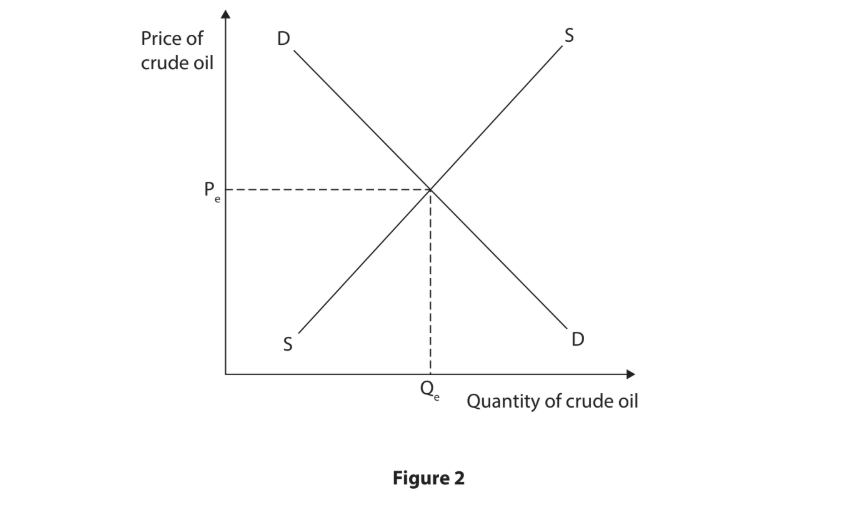
Supply and demand graph for crude oil, showing equilibrium at intersection of demand and supply curves with price and quantity axes.
1b6 marks

The African Continental Free Trade Area (AfCFTA) is a free trade area that includes most of Africa. It connects 1.3bn people across 55 countries with a combined gross domestic product (GDP) of $3.4 trillion. South Africa is an important member of the AfCFTA.

With reference to the data above and your knowledge of economics, analyse the disadvantages to firms in South Africa of being a member of the AfCFTA.

29 marks

In 2022, President Biden introduced legislation to increase investment in green technology in the US. Subsidies of $369bn are given through grants, loans and tax credits to public and private firms.

These subsidies are to be used to increase battery, solar panel and wind turbine production in the US creating new factories and millions of new green jobs in the country.

There is widespread opinion amongst EU and UK politicians and business leaders that US subsidies will have a negative impact on their economies.

With reference to the data above and your knowledge of economics, assess the possible benefits for the US of giving subsidies for green technology.

33 marks

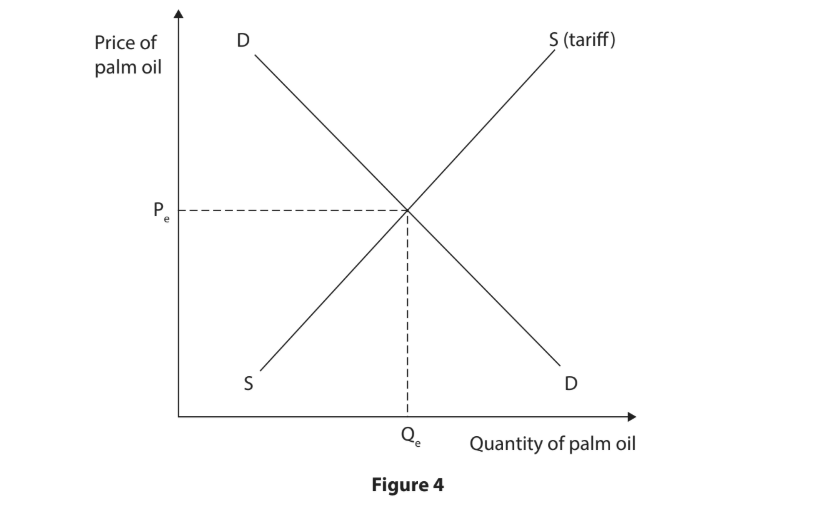
The UK Government has removed the 12% import tariff on palm oil from Malaysia.

Using the diagram below, draw the effects of the removal of the tariff on the equilibrium price and quantity of palm oil imported into the UK from Malaysia. Label the new curve, the new equilibrium price and the new equilibrium quantity.

Supply and demand graph for palm oil, showing impact of tariffs. Axes labelled price and quantity. Equilibrium at Pe and Qe, with shifted supply curve.
46 marks

In March 2023, the UK joined the Comprehensive and Progressive Agreement for Trans‐Pacific Partnership (CPTPP), an 11‐member Asia‐Pacific trading bloc, after two years of negotiations. The current members of the CPTPP are Australia, Canada, Japan, Mexico, New Zealand, Singapore, Brunei, Chile, Malaysia, Peru and Vietnam.

With reference to the data above and your knowledge of economics, analyse the advantages for UK firms of the UK joining the CPTPP trading bloc.

51 mark

Which one of the following describes a role of the World Trade Organization (WTO)?

  • Help with trade negotiations

  • Regulates multinational corporations

  • Provides financial assistance to developing countries

  • Stabilises exchange rates

69 marks

Brazilian tyre producers previously had a fall in production caused by an increase in imports. As a result, producers were warning that they might need to stop production, which would result in job losses.

In March 2023, the Brazilian Government put an import tariff on tyres. The tariff on tyres increased from 0% to 16%. A government source said, “The previous government believed in more open trade. The current one has a different view and they think they must protect domestic producers.”

With reference to the data above and your knowledge of economics, assess the possible benefits for the Brazilian economy of introducing a tariff on tyres.

76 marks

Costa Rica is a developing country that relies on the export of agricultural commodities such as coffee, bananas, pineapples and vegetables. In 2022, exports from Costa Rica to the UK were valued at £516m. Vegetables and fruit accounted for 73.4% of all goods exported to the UK from Costa Rica.

With reference to the data above and your knowledge of economics, analyse how the trade patterns may differ between a developed and a developing country.

83 marks

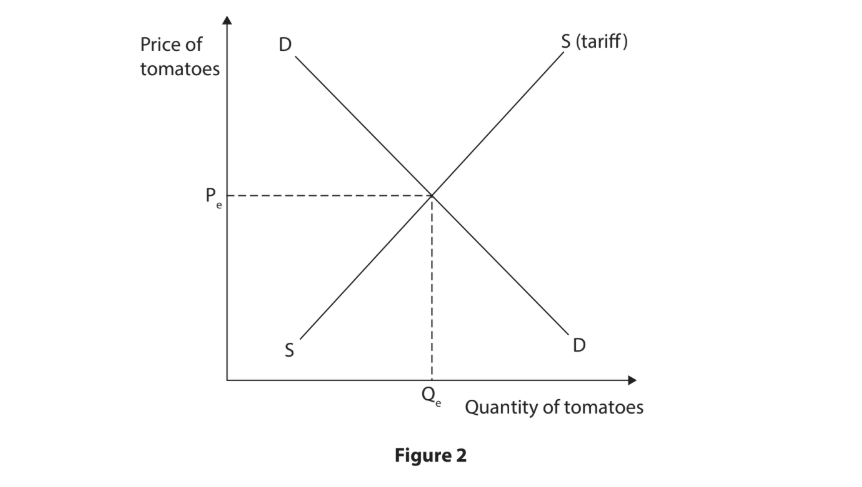
In August 2024, India removed a tariff on imports of tomatoes from Nepal.

Using the diagram below, draw the effects of the removal of the tariff on the equilibrium price and quantity of tomatoes in India. Label the new curve, the new equilibrium price and the new equilibrium quantity.

Supply and demand graph for tomatoes with price and quantity axes. Curves intersect at equilibrium, labelled Pe and Qe. Tariff shifts supply curve left.
91 mark

Which one of the following is a reason why there is protection for international trade?

  • To allow dumping

  • To promote free trade

  • To protect domestic jobs

  • To increase the current account deficit

101 mark

Which one of the following is an advantage of a government giving subsidies to domestic producers?

  • Reduces government spending

  • Increases imports from other countries

  • Increases production of goods and services

  • Reduces trade disputes

1112 marks

In October 2023, India was once again considering joining the Regional Comprehensive Economic Partnership (RCEP).

The RCEP is the world’s largest trading bloc, accounting for about 30% of global trade. It consists of 15 member countries including China, Japan and South Korea, the three largest economies in Asia.

India withdrew from RCEP negotiations in 2019, saying that it had concerns about the impact of the agreement on its domestic industries, particularly agriculture and manufacturing.

The Indian Government has been in talks with RCEP member countries to obtain a fair and balanced trade deal that would benefit all stakeholders.

With reference to the data above and your knowledge of economics, evaluate the possible benefits for India of joining the RCEP trading bloc.

12a1 mark

Which one of the following is a role of the World Trade Organization (WTO)?

  • Writing off debts

  • Settling trade disputes

  • Increasing trade barriers

  • Paying subsidies to producers

12b2 marks

Describe one advantage of free trade for consumers.

12c3 marks

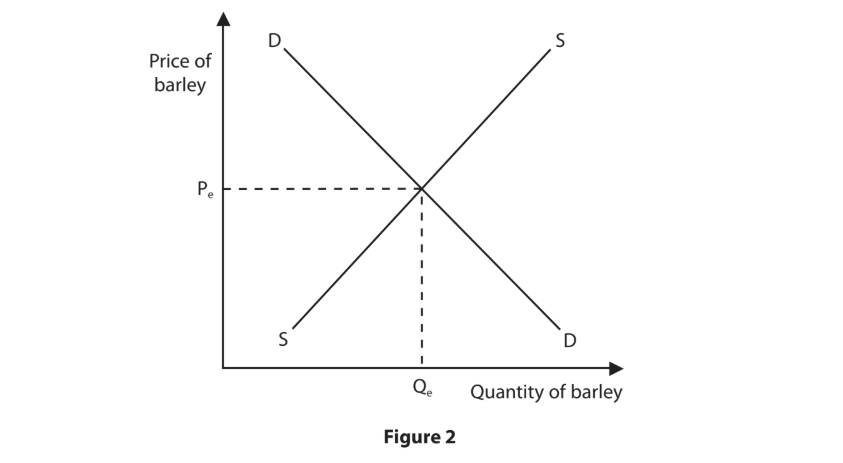
In May 2020, China introduced a tariff of 80% on Australian barley.

Using the diagram below, draw the effects of the introduction of a tariff on the equilibrium price and quantity of Australian barley. Label the new curve, the new equilibrium price and new equilibrium quantity.

Supply and demand graph for barley, showing equilibrium price (Pe) and quantity (Qe) where supply (S) and demand (D) curves intersect.
133 marks

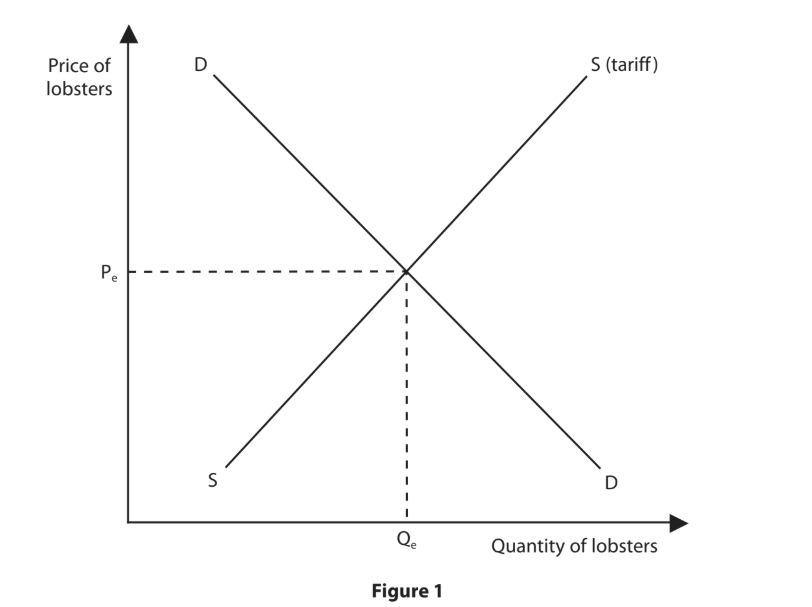
In December 2020, the European Union (EU) decreased the 8% import tariff on lobsters from the US.

Using the diagram below, draw the effects of the decrease in the tariff on the equilibrium price and quantity of US lobster imports into the EU. Label the new curve, the new equilibrium price and new equilibrium quantity.

Supply and demand graph for lobsters showing equilibrium price (Pe) and quantity (Qe), with supply shift due to tariff.
14a1 mark

State one advantage of free trade.

14b3 marks

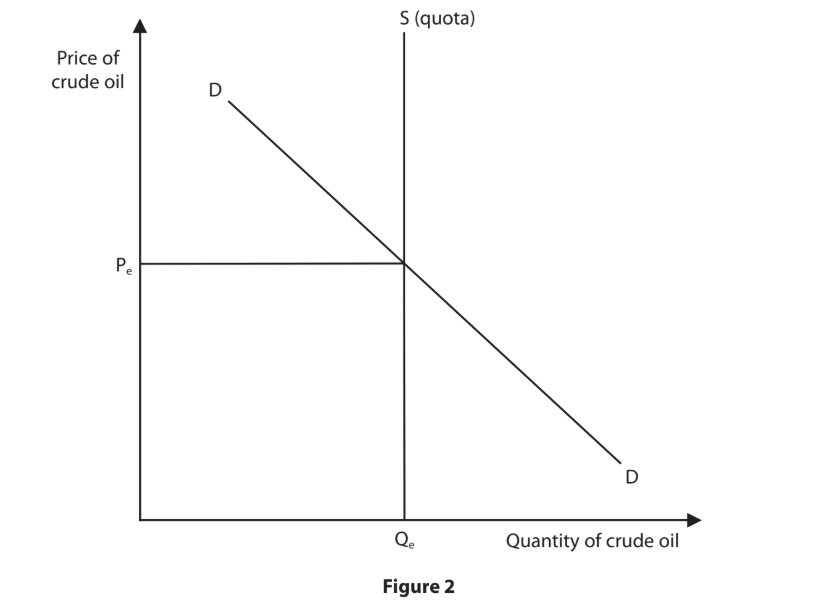
China announced that in 2021 it would increase its import quota for crude oil by 20%.

Using the diagram below, draw the effect of the introduction of the new quota. Label the new curve, the new equilibrium price and the new equilibrium quantity.

Supply and demand graph for crude oil showing equilibrium price (Pe) and quantity (Qe) with supply quota line intersecting demand (D) line.
15a2 marks

Describe one role of the World Trade Organization (WTO).

15b3 marks

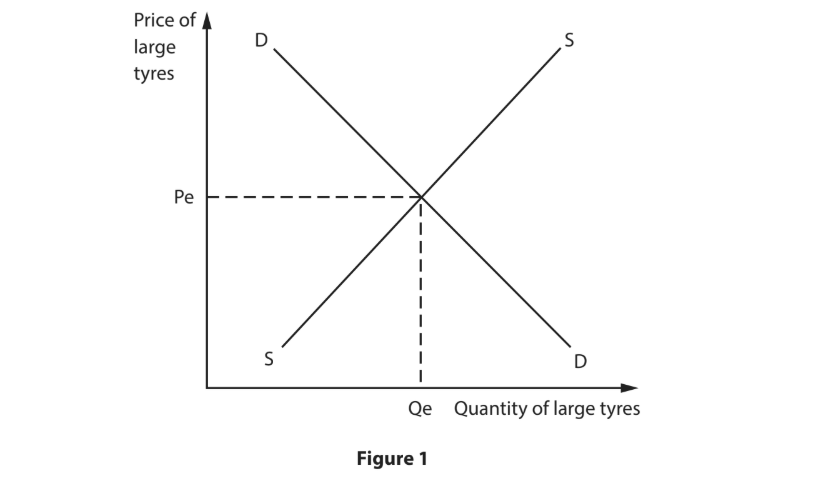
In January 2023, China introduced a tariff on imports of large tyres.

Using the diagram below, draw the effects of the introduction of the tariff on the equilibrium price and quantity of large tyres. Label the new curve, the new equilibrium price and the new equilibrium quantity.

Supply and demand graph for large tyres, with equilibrium at Pe and Qe. Demand (D) slopes downward, supply (S) upward, intersecting at equilibrium.
15c3 marks

In January 2023, China and Ecuador announced they would be signing a free trade agreement after a year of negotiations. The deal is expected to boost Ecuador’s exports of shrimp, bananas, flowers, cocoa and coffee to China.

Explain one advantage of free trade for businesses in Ecuador.

163 marks

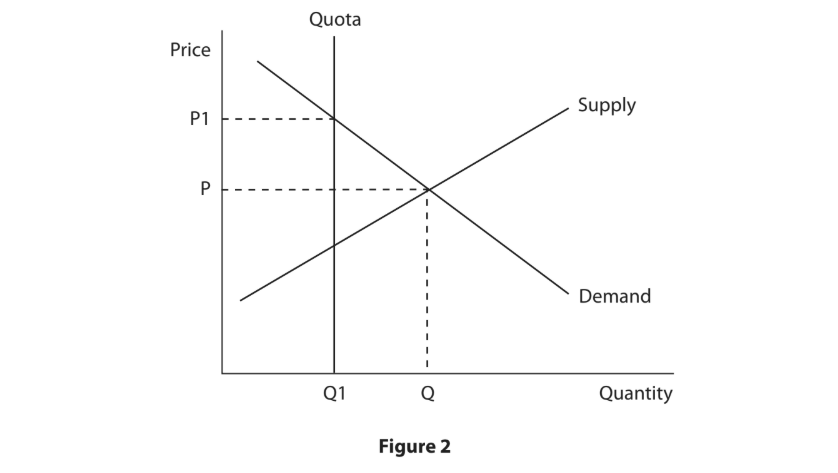
In December 2019, the UK and the European Union (EU) negotiated North Sea fishing quotas for 2020. It was agreed to increase the fishing quota for haddock by 30%.

Using the diagram below, draw the effects of the introduction of the new quota on the equilibrium price and quantity of haddock. Label the new curve, the new equilibrium price and new equilibrium quantity.

Supply and demand graph showing a quota at Q1, price increase from P to P1, and equilibrium at price P and quantity Q.
179 marks

After nearly 20 years of negotiations, the European Union (EU) and Mercosur, the South American trading bloc, have agreed a draft trade deal. It would create the largest free trade area in the world consisting of 770 million people. The two blocs currently trade more than €88bn in goods and €34bn in services every year.

The EU would eventually end 92% of the tariffs on Mercosur imports. Mercosur would gradually remove its tariffs on 91% of EU goods, which amounts to €4bn. This includes removing the tariffs on clothing, chemicals, wine and canned peaches. Mercosur farmers would be allowed to export a specific quantity of beef, sugar and chicken at a lower tariff rate to the EU each year.

(Source: https://www.dw.com/en/eu-mercosur-free-trade-deal-what-you-need-to- (opens in a new tab) know/a-49414103)

With reference to the data above and your knowledge of economics, assess the advantages of free trade for firms located within the EU.

18a2 marks

What is meant by the term exports?

18b6 marks

In March 2020, the European Union (EU) and Vietnam reached a free trade agreement.

With reference to the data above and your knowledge of economics, analyse the disadvantages of free trade for domestic businesses located within this free trade area.

193 marks

In 2020, the Kazakhstan Government introduced quotas of 200,000 tonnes on imported wheat and 70,000 tonnes on imported flour.

Explain one possible reason why the Kazakhstan Government introduced quotas on imports of wheat and flour.

20a1 mark

Which one of the following terms refers to a tax on imported goods?

  • Subsidy

  • Tariff

  • Fine

  • Pollution permit

20b2 marks

What is meant by the term dumping?

212 marks

What is meant by the term free trade?

22a1 mark

Member countries of a trading bloc agree to

  • trade together with low or no barriers

  • have the same rate of income tax

  • only trade with members within the bloc

  • have common borders between members

22b3 marks

Brazil currently only allows a quota of 600 million litres of ethanol per year to be imported from the US.

Explain one advantage of using quotas for a country such as Brazil.

23a1 mark

Which one of the following terms refers to a physical limit on the quantity of imported products allowed into a country?

  • Devaluation

  • Dumping

  • Public good

  • Quota

23b2 marks

What is meant by the term infant industries?

23c3 marks

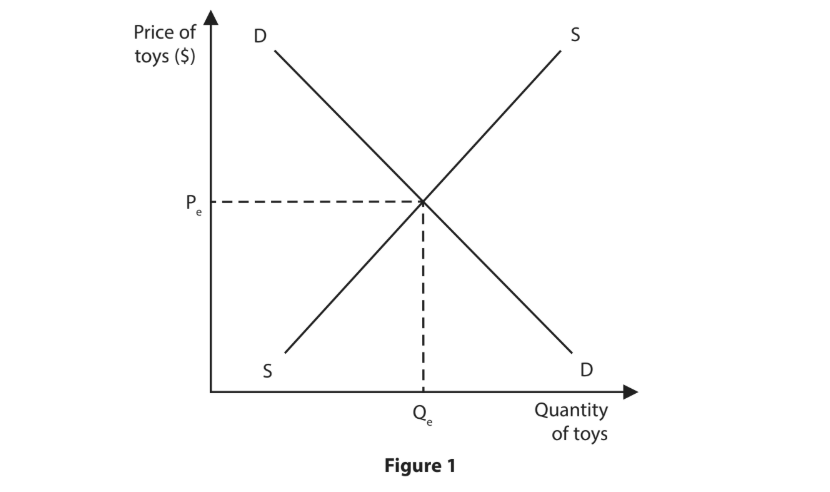
In December 2019, the USA imposed a 10% tariff on toys imported from China.

Using the diagram below, draw the likely effect of the introduction of this tariff on the equilibrium price and quantity of toys imported from China. Label the new curve, the new equilibrium price and new equilibrium quantity.

Supply and demand graph for toys, showing equilibrium point where supply and demand curves intersect at price Pₑ and quantity Qₑ.
243 marks

The Government of Bangladesh provides subsidies of between 2% and 4% on the export of clothing. In 2019, it introduced additional subsidies of up to 10% for the export of 10 new products including home appliances.

Explain one advantage of using subsidies for a country such as Bangladesh.

256 marks

India is a member of the Asia-Pacific Trade Agreement (APTA). This preferential trade agreement has five members including Bangladesh, China, South Korea and Sri Lanka.

With reference to the data above and your knowledge of economics, analyse the benefits for India from being a member of a trading bloc.

26a1 mark

International trade that takes place with no restrictions is known as

  • globalisation

  • protectionism

  • free trade

  • Foreign Direct Investment

26b3 marks

Using the diagram below, draw the effects of the introduction of a tariff on the equilibrium price and quantity of a good. Label the new curve, the new equilibrium price and quantity.

Supply and demand graph showing equilibrium point where supply (S) and demand (D) curves intersect at price Pe and quantity Qe.
26c6 marks

Australia has referred India to the World Trade Organization (WTO) because of the $725m subsidies it pays to its sugar cane farmers.

Analyse why the Indian Government might have given subsidies to its sugar cane farmers.

273 marks

In November 2018, China launched its first ever anti-dumping investigation against Australia over the export of Australian barley.

Explain one reason why a country such as Australia might export its products below the cost of production.

28a1 mark

Which one of the following is likely to result from an increase in free trade?

  • Increased prices

  • Increased choice for consumers

  • Decrease in standards of living

  • Decrease in market opportunities for business

28b3 marks

In 2017, the tertiary sector contributed 69.3% to Germany’s GDP and the secondary sector contributed 30.1%. In comparison, the primary sector only accounted for 0.6% of GDP.

Explain a typical trade pattern for a developed country such as Germany.

291 mark

Which method of protection is used to reduce the price of exports?

  • Free trade

  • Tariffs

  • Subsidies

  • Quotas

30a1 mark

In 2019, India introduced tariffs against US agricultural products including apples, almonds and lentils.

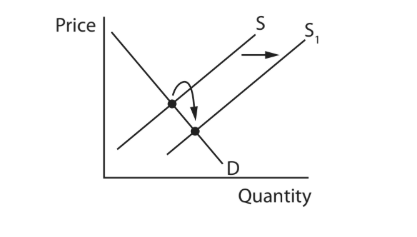
Which one of the following diagrams shows the Indian market for apples, almonds and lentils following the introduction of the tariffs?

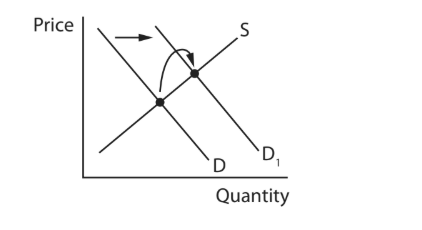
  • Supply and demand graph showing a supply shift to the left with arrows indicating the resulting increase in price and decrease in quantity.
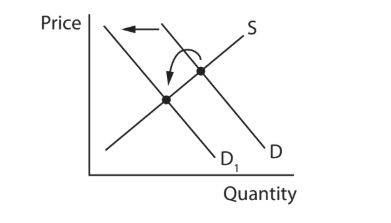
  • Supply and demand graph showing a leftward shift in demand from D to D1. Equilibrium points are marked where curves intersect on price-quantity axes.
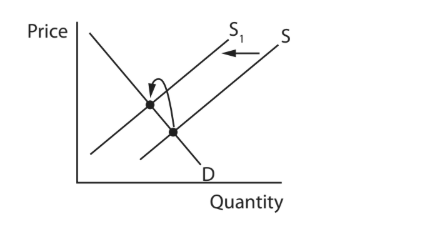
  • Supply and demand graph showing a leftward shift in supply from S to S1, causing a price increase and quantity decrease. Demand curve labelled D.
  • Supply and demand graph showing a rightward shift in supply from S to S1, with price decrease and quantity increase, labelled axes for price and quantity.
30b1 mark

State one disadvantage of free trade.

31a2 marks

Describe one disadvantage of free trade for domestic businesses.

31b3 marks

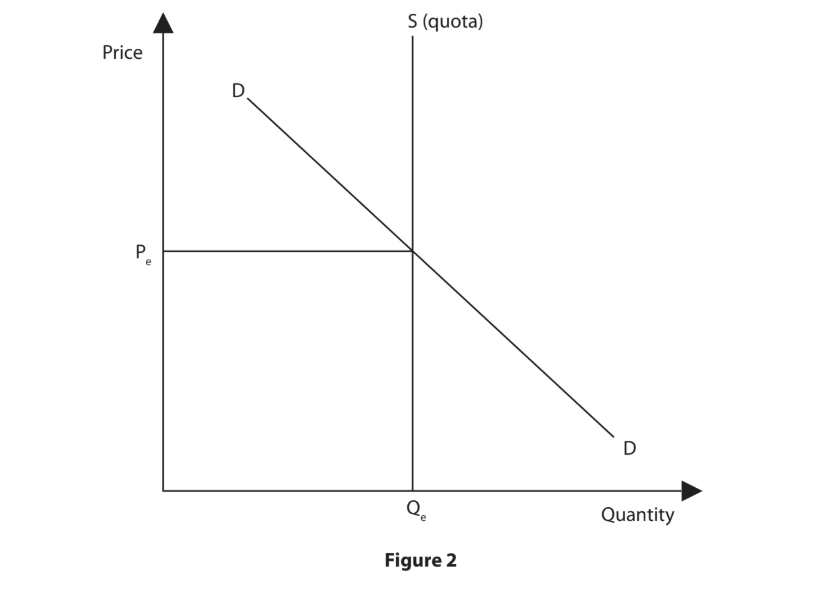
Using the diagram below, draw the effect of the introduction of a new quota that is less than the original quota. Label the new curve, the new equilibrium price and the new equilibrium quantity.

Supply and demand graph showing equilibrium price (Pe) and quantity (Qe) with demand (D) and supply (S, quota) lines intersecting.
31c6 marks

In March 2018, 44 African countries signed a deal to create one of the world’s largest trade blocs, the African Continental Free Trade Area (AfCFTA). AfCFTA will create a market of 1.2bn people with a gross domestic product (GDP) of $2.5 trillion.

Analyse the benefits to a country of being a member of the African Continental Free Trade Area (AfCFTA).

323 marks

In December 2018, consumers in the UK were warned to avoid some imported plastic toys because they contained banned chemicals. Many were being sold through online marketplaces.

Explain one reason why UK consumers need protecting from some imported goods.

336 marks

The World Trade Organisation (WTO) has 164 members representing 98% of world trade. The US joined in 1995 and has been involved in 422 trade disputes.

Analyse the role of the World Trade Organisation (WTO) in the growth of international trade.

34a3 marks

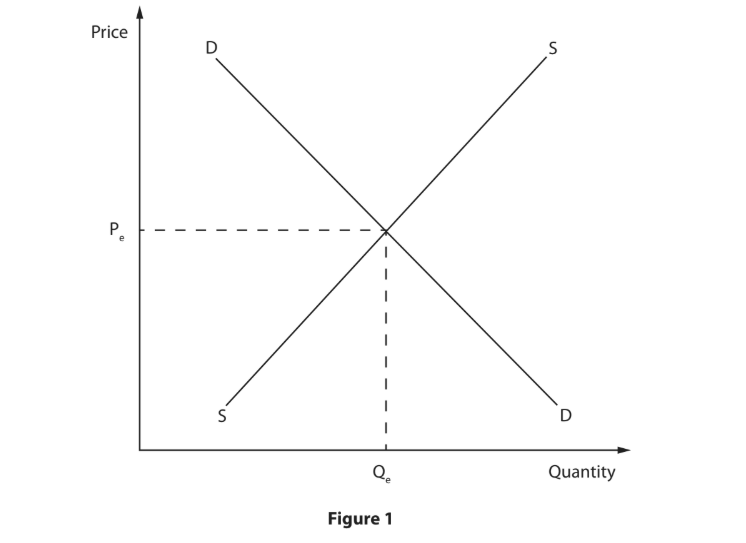
Using the diagram below, draw the effects of the introduction of a quota on the equilibrium price and quantity of a good. Label the new curve, the new equilibrium price and new equilibrium quantity.

Supply and demand graph showing equilibrium point where supply curve (S) and demand curve (D) intersect at price (Pe) and quantity (Qe).
34b3 marks

In 2017 the US government wanted to introduce a 300% tariff on imported aircraft made by Canadian manufacturer Bombardier.

Explain one way the World Trade Organisation could promote free trade between countries such as Canada and the US.

359 marks

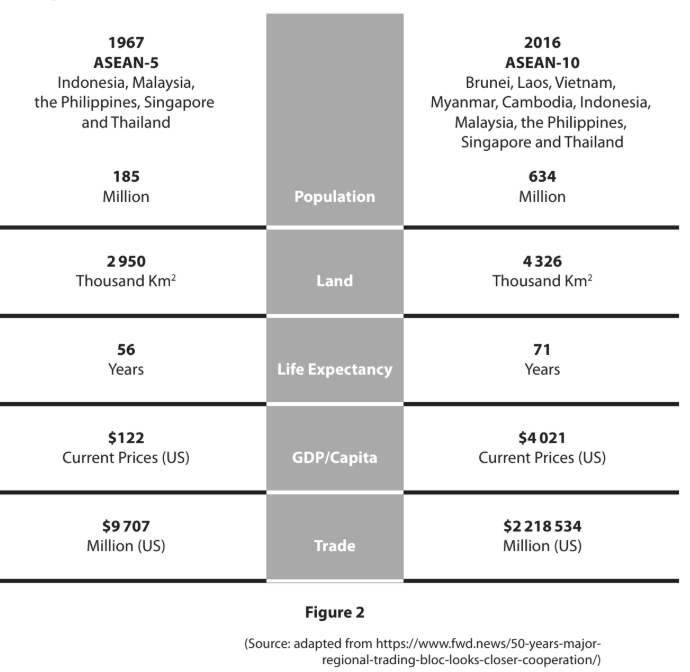
The Association of South East Asian Nations (ASEAN) is a trade bloc. It was set up in 1967 by Indonesia, Malaysia, the Philippines, Singapore and Thailand. Later it was joined by Brunei, Laos, Vietnam, Myanmar and Cambodia and became a 10 member trading bloc in 2016.

Comparison of ASEAN in 1967 and 2016 showing changes in population, land, life expectancy, GDP per capita, and trade.

With reference to the data above and your knowledge of economics, assess the benefits for a country, such as Thailand, of being a trade bloc member.

361 mark

What term refers to a firm or country selling an export below the cost of production?

  • Quotas

  • Dumping

  • Deregulation

  • Tariffs

371 mark

A trade bloc is a group of countries that have

  • the same interest rate

  • common borders between members

  • the same currency

  • a reduction in trade barriers between members

38a2 marks

Figure 4 shows the tariff on clothing imported into China in 2018.

Product Imported

Price yuan (¥)

Tariff (%)

Clothing

225

8

Figure 4

Calculate the final selling price of clothing in yuan (¥) after the tariff has been added. You are advised to show your working.

38b12 marks

Following a trip to Asia in 2017 by US President Donald Trump, China has reduced tariffs from 17.3% to 7.7% on over 200 consumer products. These include pharmaceuticals, food, health supplements and clothing.

Many multinational corporations may have major financial gains. Nestle’s sales could increase by 15% or $18.7bn because of the reduction in tariffs. Procter & Gamble, will also benefit from tariff reductions on items ranging from shampoos to electronic toothbrushes.

With reference to the data above and your knowledge of economics, evaluate the possible benefits of reducing the level of tariffs on imported goods and services to China.