11 mark
An increase in which one of the following is most likely to cause a decrease in the supply of labour?
The retirement age
The school‐leaving age
The population
The demand for the final product
Was this exam question helpful?
Exam code: 4EC1
An increase in which one of the following is most likely to cause a decrease in the supply of labour?
The retirement age
The school‐leaving age
The population
The demand for the final product
Was this exam question helpful?
State one factor that may affect the supply of labour.
Was this exam question helpful?
What is meant by the term trade union?
Was this exam question helpful?
A trade union is an organisation that aims to improve
profit margins
tax revenue
the environment
working conditions
Was this exam question helpful?
Which one of the following would lead to an increase in the supply of labour?
Decrease in the retirement age
Increase in the school-leaving age
Increase in female participation
Decrease in population
Was this exam question helpful?
A trade union is an organisation that aims to protect
consumer interests
the environment
employee rights
the government
Was this exam question helpful?
Which one of the following is most likely to cause an increase in the supply of labour?
A higher retirement age
A higher school-leaving age
A fall in population
A fall in demand for the final product
Was this exam question helpful?
Which one of the following is an example of derived demand?
Consumer demand for clothes to wear
Tourist demand for foreign holidays
Producer demand for labour to make goods
Student demand for computer games to play
Was this exam question helpful?
Which one of the following best describes the relationship shown by the demand curve for labour?
As the wage rate rises, the quantity of labour demanded falls
As the wage rate rises, the quantity of labour demanded rises
As the wage rate falls, the quantity of labour supplied rises
The wage rate has no effect on the quantity of labour demanded
Was this exam question helpful?
Define the term 'geographical mobility of labour'.
Was this exam question helpful?
State one way a firm could lower its labour costs.
Was this exam question helpful?
What is meant by the term 'occupational mobility of labour'?
Was this exam question helpful?
A worker is paid an hourly wage rate of $15 and works 35 hours in a week. Calculate the worker's total pay for the week. You are advised to show your working.
Was this exam question helpful?
In 2028, the lowest age at which workers can receive a private pension in the UK will rise from 55 to 57. This means that the age of retirement will increase for many people.
Explain one advantage for firms of an increase in the retirement age.
Was this exam question helpful?
In 2015, the school‐leaving age in England was raised from 16 to 18.
Explain one possible effect on the supply of labour of the school‐leaving age being raised.
Was this exam question helpful?
Technology has been used to perform some of the jobs previously done for many years by humans, for example, robots in factories and self-checkout machines. This substitution of capital for labour is likely to increase as technology advances. At most call centres, humans currently respond to customer queries but Google has developed an automated assistant. Many telecom firms have switched to using calls made by these automated assistants.
With reference to the data above and your knowledge of economics, analyse how the demand for labour might be affected by the use of machines.
Was this exam question helpful?
Tony Simpson is an artist whose income comes from selling his paintings to small craft shops. However, sales have recently fallen due to the closure of many of these types of shops. To avoid the risk of unemployment, he is considering training to become an art teacher by applying to a government scheme. This would provide an income while Tony is training to be a teacher.
With reference to the data above and your knowledge of economics, analyse how an increased ability to move to different types of employment might affect the supply of labour.
Was this exam question helpful?
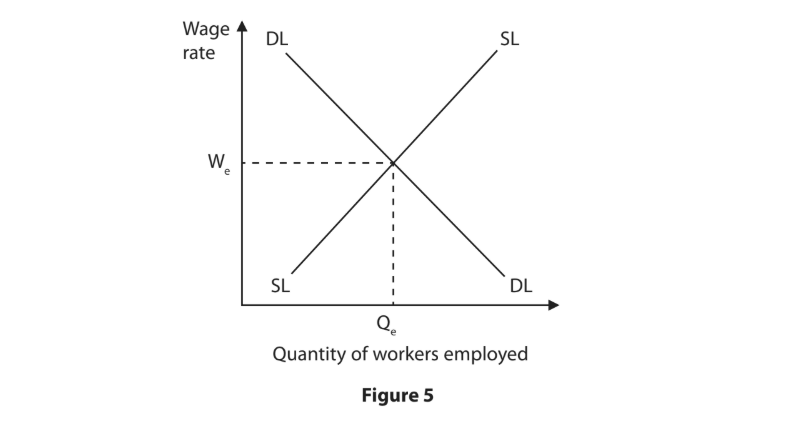
Using the diagram below, draw the effects of an increase in the retirement age on the labour market in a country. Label the new curve, the new equilibrium wage rate and the new equilibrium quantity of workers employed.
Was this exam question helpful?
Firms in Canada, the world’s second largest country, have been struggling to find the labour needed for specialist positions such as computer engineers and web designers. The ‘Global Talent Stream’ is a government programme that provides firms with a quick way to hire highly skilled foreign workers. High costs and long time commitments often stop Canadians from training. Although a processing fee is payable for each new employee, firms have welcomed the programme.
(Source: adapted from http://www.canada.ca/en/employment-socialdevelopment/ (opens in a new tab))
With reference to the data above and your knowledge of economics, analyse why Canadian firms may have been struggling to hire the labour they need.
Was this exam question helpful?
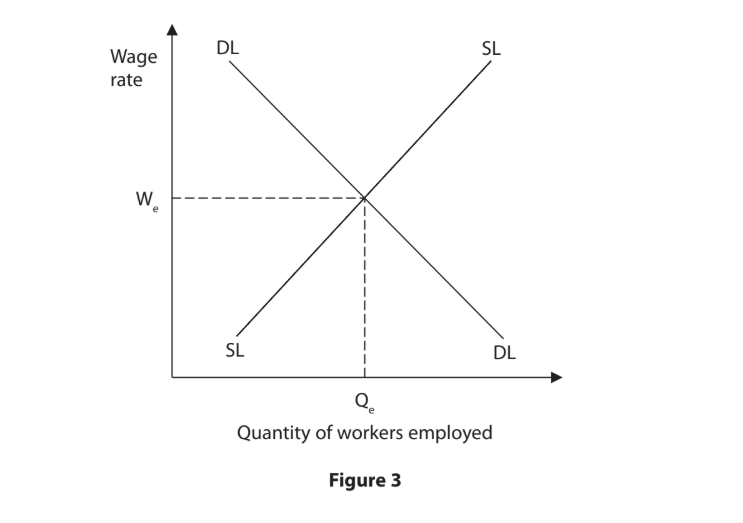
On the diagram below, draw the effects of an increase in the school-leaving age on the labour market in a country. Label the new curve, the new equilibrium wage rate and the new equilibrium quantity of workers employed.
Was this exam question helpful?
Fewer students have been choosing to train as electricians in a country, reducing the number of qualified electricians available to work. Explain one effect this is likely to have on the wage rate for electricians.
Was this exam question helpful?
A country reduces the visa application fee for skilled workers and shortens the visa processing time from six months to six weeks. Explain one way this change is likely to affect the supply of labour in that country.
Was this exam question helpful?
Explain one way that lower labour costs could benefit a firm.
Was this exam question helpful?
An online shopping company has seen a large rise in the number of orders placed by customers each week.
With reference to the data above and your knowledge of economics, analyse why this rise in orders is likely to increase the company's demand for delivery drivers.
Was this exam question helpful?
A clothing factory installs automated sewing machines that can complete tasks previously done by hand.
With reference to the data above and your knowledge of economics, analyse why this investment is likely to reduce the factory's demand for labour.
Was this exam question helpful?
In April 2023, 2.5 million German transport workers and their employers agreed to a deal that ended an employment dispute. The dispute had caused major disruption on railways and at airports, due to strike action.
Although Germany’s second largest trade union, Verdi, had been arguing for a 10.5% increase in pay, each worker instead received a 5.5% increase.
With reference to the data above and your knowledge of economics, assess the effectiveness of trade unions in increasing wages, such as for the transport workers in Germany.
Was this exam question helpful?
In 2021, Morrisons, a leading UK-based supermarket chain, became the first in the retail industry to pay workers at least £10 per hour. This increased its hourly wage rate from £9.20 to at least £10 per hour for its 110,000 workers. This increase was a result of negotiations with the trade union, Usdaw. The majority of Morrisons’ workers are trade union members.
(Source adapted from: https://www.hrmagazine.co.uk/content/news/morrisons-is-the-first- (opens in a new tab)uk-supermarket-to-pay-minimum-10-an-hour)
With reference to the data above and your knowledge of economics, assess the impact of trade union activity on Morrisons and its employees.
Was this exam question helpful?
Dubai in the UAE has a population of more than 2.5 million people. Immigrant workers make up over 80% of this population. Many of the immigrants provide construction, cleaning or care services.
(Source adapted from: https://www.futurelearn.com/info/courses/migration-theories/0/ (opens in a new tab)steps/35094)
With reference to the data above and your knowledge of economics, assess the benefits to Dubai of employing such a high proportion of migrant labour.
Was this exam question helpful?
In England, there has been an increase in the number of science, maths and modern language graduates. Some of these graduates choose to enter the teaching profession with these qualifications. Many are encouraged to do so by a government bonus payment of £9000, only available to graduates in these subjects. However, many do not stay in the profession for more than one or two years. This is due to problems of long working hours, bureaucracy and student behaviour. Those with science qualifications often find different types of employment quite easily.
(Source adapted from: https://www.theguardian.com/education/2019/oct/05/science-and- (opens in a new tab)language-teachers-to-get-9000-staying-on-bonus)
With reference to the data above and your knowledge of economics, assess whether an increase in the number of people with skills and qualifications will always lead to an increase in the supply of teachers.
Was this exam question helpful?
Each year, in the UK there are an increasing number of shops closing down in town centres. At least 10% of all shops have been empty for the last five years. At the same time online sales are growing and reached more than 20% of total retail sales in 2019.
The continuing development of technology has made it easier for consumers to buy online. However, this is at a cost to some shop employees whose jobs have been replaced by machines that send out online orders from warehouses.
With reference to the data above and your knowledge of economics, assess whether the availability of substitutes, such as machines, will reduce the demand for labour.
Was this exam question helpful?
The current retirement age in Singapore is 62. However, it will gradually be raised to 63 in 2022 and to 65 by 2030. People are living longer and the life expectancy in the country is now over 84 years.
The manufacturing sector contributes almost 25% of Singapore’s Gross Domestic Product (GDP). The financial services sector, which is growing, is also making a significant contribution to GDP.
With reference to the data above and your knowledge of economics, assess whether raising the retirement age is likely to be the most effective method to increase the supply of labour.
Was this exam question helpful?
A new report from New Zealand Kiwifruit Growers Incorporated showed a serious shortage of seasonal workers. This could slow down the kiwifruit industry’s predicted growth. The report showed that the industry will require an additional 7,000 seasonal workers if it is to double in size by 2027. Revenue from the sale of kiwifruits was predicted to increase from NZ$2.1bn in 2017 to NZ$4bn by 2027. At the start of the 2018 season, the industry was short of 1,200 workers with 70% of the crop still to be picked.
(Source adapted from: https://www.nzherald.co.nz/business/news/article.cfm?c_id=3&objectid=12099643 (opens in a new tab))
With reference to the data above and your knowledge of economics, assess the ways a country such as New Zealand could reduce the shortage of seasonal workers.
Was this exam question helpful?
South Africa has a new trade union federation
The newly formed trade union group, the South African Federation of Trade Unions (SAFTU), aims to represent workers in the country. In the past, trade unions in South Africa have played an important role, but the influence of trade unions has declined globally in recent years. SAFTU has nearly 700,000 members and is the second largest group of trade unions in South Africa.
(Source: adapted from http://theconversation.com/south-africa-has-a-new- (opens in a new tab)trade-union-federation-can-it-break-the-mould-76609)
With reference to the data above and your knowledge of economics, assess how trade unions, such as those in the SAFTU, might have an impact on the labour market.
Was this exam question helpful?
Global demand for health workers is projected to rise by 29%, from 65.1 million in 2020 to 84 million by 2030.
Despite the size of the global nursing workforce growing from 27.9 million in 2018 to 29.8 million in 2023, the World Health Organization still projects a shortage of around 4.5 million nurses by 2030.
With reference to the data above and your knowledge of economics, assess the likely effect of this rising demand for nurses on the wage rate for nursing in countries facing the greatest shortages.
Was this exam question helpful?
The United Arab Emirates is home to around 8.7 million migrant workers, equivalent to more than 80% of the country's total population.
Migrant workers make up over 90% of private sector employees in the UAE, and around 30% of non-Emirati workers are employed in the construction industry, the largest single sector for migrant employment.
With reference to the data above and your knowledge of economics, assess whether the construction industry's dependence on migrant labour makes it more vulnerable to changes in migration policy than other private sector industries in the UAE.
Was this exam question helpful?
In October 2024, the International Longshoremen's Association (ILA), representing dockworkers along the US East and Gulf coasts, went on strike for the first time since 1977.
The strike ended with a tentative agreement between the ILA and the United States Maritime Alliance, which included a 62% pay increase for workers over the length of a six-year contract.
With reference to the data above and your knowledge of economics, assess the effectiveness of trade union action, such as strikes, in raising wages for workers.
Was this exam question helpful?
AI-powered voice assistants handling routine customer enquiries are estimated to have contributed to a 41% fall in call centre job openings at firms that have adopted them.
In warehouses, the increasing use of robotics has led to a 19% fall in demand for manual warehouse packers, and one major retailer plans to automate 65% of its stores by 2026, a change that has already resulted in over 2,000 job losses in its online fulfilment centres.
The World Economic Forum estimates that automation and AI will eliminate around 83 million jobs globally between 2023 and 2027, while also creating around 69 million new roles over the same period, a net loss of around 14 million jobs worldwide.
With reference to the data above and your knowledge of economics, evaluate whether the growing use of AI and automation is reducing the overall demand for labour.
Was this exam question helpful?
Singapore's SkillsFuture programme offers government-funded training credits to help workers develop new skills, including a non-expiring $4,000 top-up for all citizens aged 40 and over.
In 2024, around 555,000 people enrolled in SkillsFuture-supported training, up from 520,000 the year before, and 24,000 companies sent a total of 241,000 employees for training, 95% of which were small and medium-sized businesses.
Of those who completed training in 2024, 69% said it had improved their work performance.
With reference to the data above and your knowledge of economics, evaluate whether government investment in training programmes like SkillsFuture is an effective way to improve the quality of a country's labour force.
Was this exam question helpful?