Energy Flows in an Ecosystem (Cambridge (CIE) IGCSE Environmental Management): Revision Note
Exam code: 0680

Energy flow in an ecosystem
All living organisms need energy to survive
This energy originally comes from the Sun
Plants capture sunlight during photosynthesis and turn it into chemical energy stored in glucose
Animals get energy by eating plants or other animals
Energy flow shows how energy moves
from the Sun → to producers → to consumers → to apex predators
As energy moves through the ecosystem, some is always lost, which is why food chains never have endless levels
Food chains
A food chain is a simple model showing how energy passes from one organism to the next
Example:
sun → grass → mouse → owl
The grass is the producer
The mouse is the primary consumer
The owl is the secondary consumer
Food chains show the direction of energy transfer, not who eats the most

Food webs
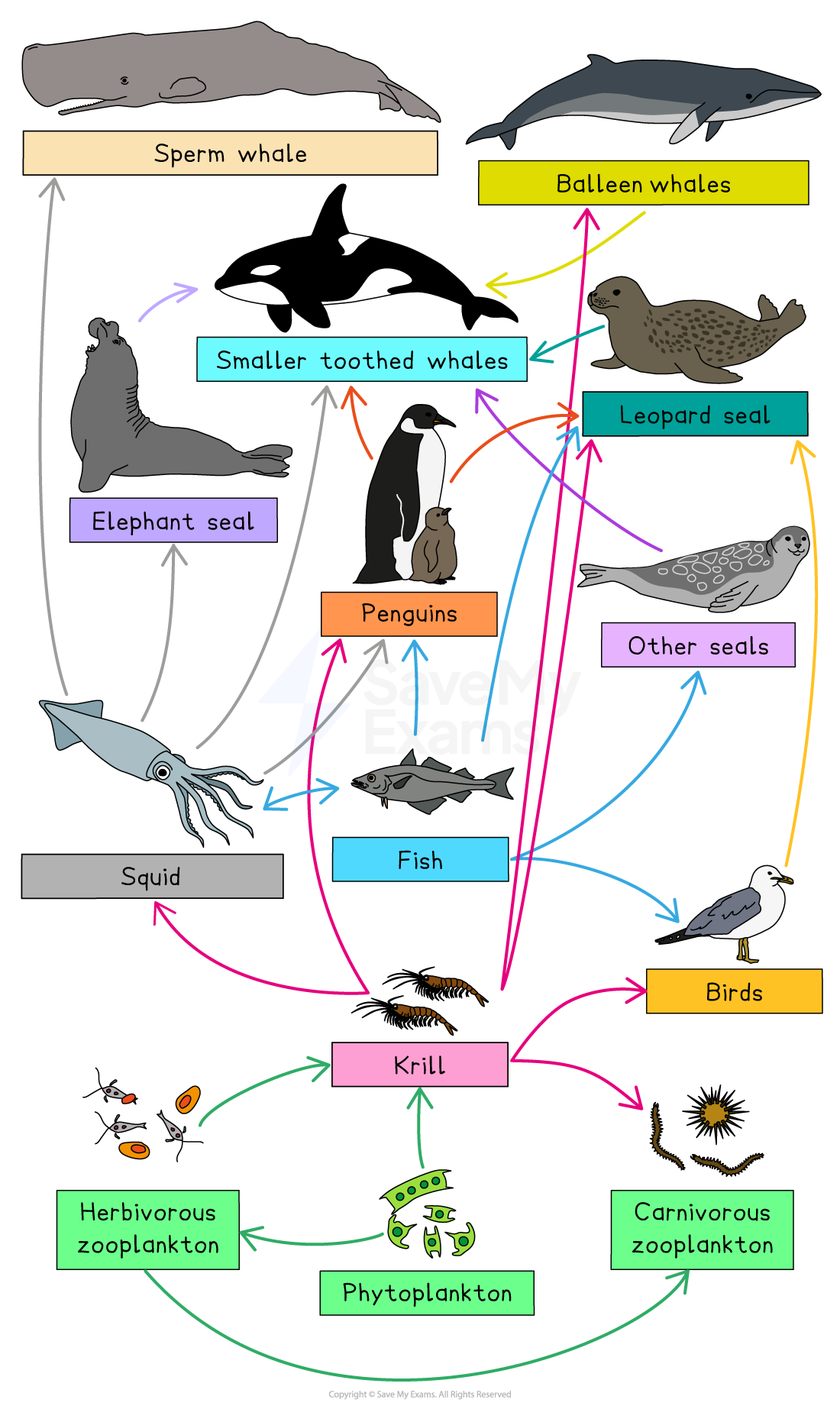
In reality, many animals eat more than one type of organism, and food chains combine to make food webs
Food webs show:
All feeding relationships in an ecosystem
How energy moves through many species
How one change affects the whole ecosystem
If one species disappears:
Prey populations may increase
Predator populations may fall
The whole food web becomes unbalanced
Trophic levels
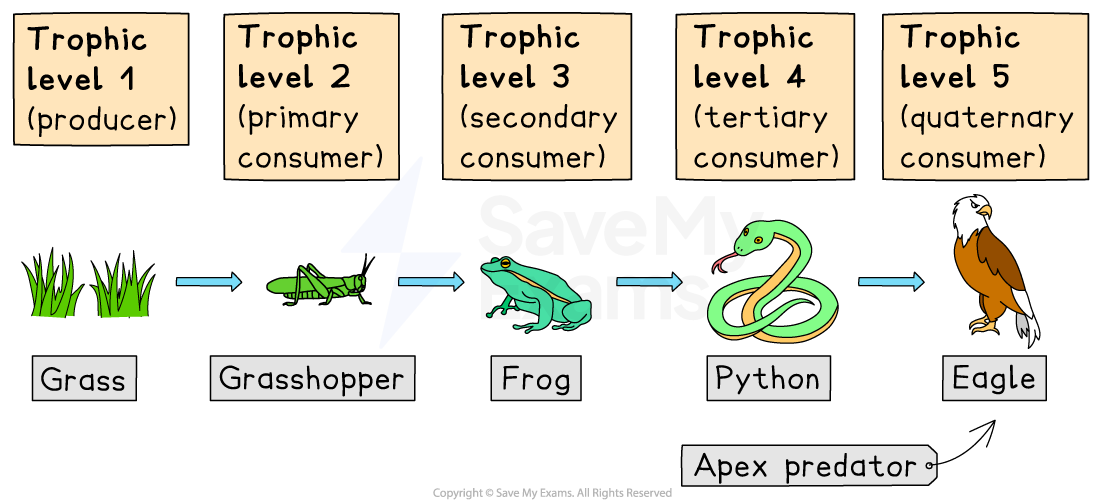
A trophic level is a feeding level in a food chain
If multiple organisms occupy the same position in a food chain, they are in the same trophic level
Trophic levels:
Producers
Primary consumers
Secondary consumers
Tertiary consumers
Apex predators
Each step up the chain gets less energy, so top predators are fewer in number
Producers capture solar energy:
Producers (e.g., plants, algae, phytoplankton) convert solar energy into chemical energy through photosynthesis
Example: A grassland ecosystem where grass (producers) captures sunlight to grow
Consumers transfer energy:
Primary consumers (herbivores) eat producers
Secondary and tertiary consumers eat other consumers, transferring energy upward in the food chain
Example: Earthworms decompose organic matter in forests, enriching the soil
The 10% rule
The 10% rule explains how energy decreases as it moves through trophic levels in an ecosystem
Roughly 10% of energy is transferred from one trophic level to the next
For example, if a producer captures 1,000 kcal of energy, only 100 kcal is available to primary consumers
So much energy is lost because of:
movement
respiration
digestion
heat loss
excretion
not all parts of an organism are eaten
Because so much energy is lost:
Food chains are usually short
Apex predators need large spaces
There are more producers than consumers
Energy pyramids show how total energy decreases at each trophic level
The base (producers) is widest
Each level above is narrower
The top has the least energy and the fewest organisms
This helps explain why apex predators are rare

Examiner Tips and Tricks
Producers always start the chain because they bring in the energy.
Use the word 'trophic levels' in exam answers to sound confident.
Always explain why only 10% is passed on.
Link energy loss to fewer organisms at higher levels.
Remember that food webs are more realistic than simple chains.
Ecological pyramids
Ecological pyramids are diagrams that show how living things are organised in an ecosystem
They help visualise patterns that can be hard to see in food chains
Pyramids represent different types of information:
The number of organisms
The amount of energy available
All pyramids show that producers form the widest base, because they capture sunlight and bring new energy into the system
As you go up the pyramid, there is less energy and usually fewer organisms, because energy is lost at every trophic level
Why ecological pyramids are important
They show how energy decreases through a food chain
They help predict how ecosystems change if one level is affected
They show why top predators are fewer in number
They reveal the structure and stability of an ecosystem
Pyramids of numbers
A pyramid of numbers shows how many organisms exist at each level of a food chain
The width of the box indicates the number of organisms at that trophic level
For example, consider the following food chain:
grass → vole → owl
A pyramid of numbers for this food chain would look like the one shown below
Often, the number of organisms decreases along food chains, as there is a decrease in available energy since some energy is lost to the surrounding environment at each trophic level
Therefore, pyramids of numbers usually become narrower towards the apex (the top)

Despite the name, a pyramid of numbers doesn’t always have to be pyramid-shaped
For example, consider the following food chain:
oak tree → insects → woodpecker
The pyramids of numbers for this food chain will display a different pattern to the first food chain
When individuals at lower trophic levels are relatively large, like the oak tree, the pyramid becomes inverted or distorted
Only a single oak tree is needed to support large numbers of insects (which can then support large numbers of woodpeckers)

Examiner Tips and Tricks
You should know this because examiners may show diagrams that are not perfect triangles.
Pyramids of energy
Shows the energy available at each trophic level
Always measured over a period of time, for example, kJ per m² per year
The length of each box, or bar, represents the quantity of energy present
These pyramids of energy are always pyramid-shaped
Energy always decreases as you go up the trophic levels
This is the most accurate way of showing ecosystem structure
This supports the 10% rule of energy transfer

Pyramids of energy never invert because energy is always lost through:
respiration
movement
heat
digestion
excretion
uneaten parts
No feeding level can ever have more energy than the level below it
Examiner Tips and Tricks
Interpreting ecological pyramids
You must be able to interpret, not just describe, pyramid diagrams.
This means spotting patterns such as:
A wide producer base means a healthy source of energy.
A narrow producer base suggests the ecosystem might be unstable.
A large drop between levels shows big losses of energy.
A small top level suggests only a few apex predators can survive.
Examiners often test your ability to explain what these changes mean for:
Stability
Biodiversity
Carrying capacity
Predator–prey relationships
Respiration in an ecosystem
Aerobic respiration is a chemical process that releases energy from glucose when oxygen is available
It happens in the cells of plants, animals, fungi and many bacteria
Respiration is not the same as breathing
Breathing brings oxygen into the body, but respiration is the chemical reaction that uses oxygen to release energy
All organisms need energy for:
movement
growth
repair
keeping warm
staying alive
Without respiration, cells cannot work and organisms cannot survive
Respiration links to photosynthesis because:
Photosynthesis stores energy
Respiration releases energy
Together, they form the core cycle that supports all life on Earth
The equation for respiration
glucose + oxygen → carbon dioxide + water ( + energy)
Examiner Tips and Tricks
You only need to learn the word equation.
Respiration produces carbon dioxide and water as waste products and releases energy.
Where aerobic respiration happens
Respiration happens inside cells
You do not need to know the names of cell structures, but you should understand that:
Every living cell respires
Respiration releases energy that the cell can use
Plants respire all the time, even at night
Plants still need oxygen for respiration
Respiration is happening 24 hours a day, even when photosynthesis stops in the dark
Why organisms need energy
Organisms use the energy released by aerobic respiration for:
Movement such as running, swimming or flying
Active transport inside cells
Building new cells for growth
Repairing damaged tissues
Keeping a stable body temperature in mammals and birds
This explains why animals need large amounts of food and oxygen — they must release lots of energy daily
Respiration in ecosystems
Respiration affects ecosystem structure because:
It controls how much energy organisms can use from food
It reduces energy available to the next trophic level
It explains why only about 10% of energy is passed on
It helps drive the carbon cycle because it releases carbon dioxide
Respiration is one of the main reasons food chains are short
How respiration links to the carbon cycle
Respiration plays a vital role because:
Organisms take in carbon as glucose when they feed
They release carbon dioxide back into the atmosphere when they respire
This carbon dioxide is later used by plants in photosynthesis
Respiration and photosynthesis form a continuous loop that keeps carbon cycling through the ecosystem
Aerobic respiration vs anaerobic respiration
You only need to know aerobic respiration for this syllabus, but it helps to understand why oxygen is essential
Aerobic respiration:
Uses oxygen
Releases large amounts of energy
Produces carbon dioxide and water
Anaerobic respiration:
Happens without oxygen
Releases much less energy
Produces harmful waste products
This explains why organisms prefer aerobic respiration whenever possible
Examiner Tips and Tricks
Take the time to carefully learn the word equation.
Don’t confuse breathing with respiration.
Remember that all organisms respire, including plants.
Link respiration to energy loss and trophic levels for higher marks.
Mention how respiration connects to the carbon cycle.

Unlock more, it's free!
Join the 100,000+ Students that ❤️ Save My Exams
the (exam) results speak for themselves:

Was this revision note helpful?