Population Sampling (Cambridge (CIE) IGCSE Environmental Management): Revision Note
Exam code: 0680

Population sampling techniques
Population sampling is the process of taking a portion of subjects that is representative of the entire population
Sampling techniques include quadrats, sweep nets, pooters, etc.
Pitfall traps
What they are:
Containers sunk flush with the soil surface to collect small ground-dwelling invertebrates (e.g. beetles, ants, spiders)
How they work:
Animals accidentally fall into the trap; a cover may be used to reduce rain entry while still allowing organisms to fall in
Used for:
Ground-active species that move unpredictably
Pooters
What they are:
Small hand-held suction devices are used to collect tiny invertebrates safely
How they work:
The user sucks gently on the mouthpiece; the organism is pulled through a tube into a container, usually behind a mesh so the user doesn’t inhale it
Used for:
Very small, delicate organisms living on vegetation or surface litter
Sweep nets
What they are:
Light nets swept through vegetation to capture flying or plant-dwelling invertebrates
How they work:
The net is moved in a figure-of-eight or a consistent sweeping motion across vegetation; collected organisms are transferred to containers for counting
Used for:
Butterflies, grasshoppers, leafhoppers and other mobile insects
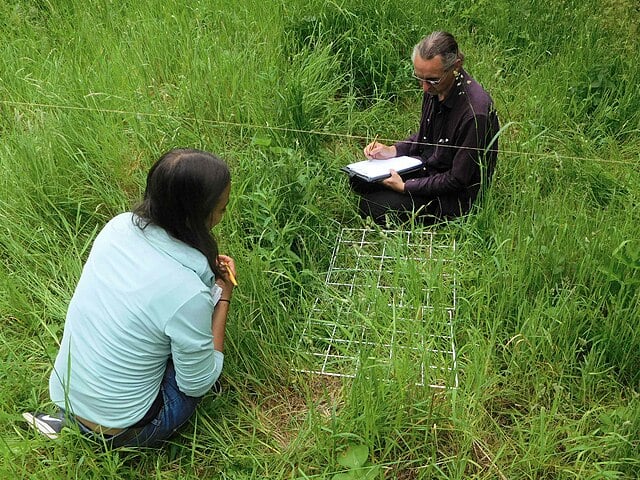
Quadrats
What they are:
Square frames (open or gridded) placed on the ground to sample plants or slow-moving organisms
How they work:
Placed randomly or systematically, all organisms inside are counted or estimated (e.g. % cover for plants)
Used for:
Plants, lichens, algae, and sessile or slow fauna like limpets
Transects
What they are:
Straight lines (tape measures or ropes) laid across a habitat to study changes along a gradient
How they work:
Quadrats or point sampling are used at regular intervals along the line
Used for:
Zonation studies such as sand dunes, rocky shores, woodland edges, and pollution gradients
Aerial photography and drones
What they are:
Drones or aircraft capture high-resolution images
How they work:
Images are analysed for animal numbers, vegetation cover, nest counts, habitat structures, or large-scale patterns
Used for:
Bird colonies, large mammals, canopy surveys, mapping habitat change
Automated sampling
What it is:
Sensors and recording devices track species without constant human presence
Examples:
Camera traps, acoustic recorders for bats, birds, and frogs, automated insect traps, and motion sensors
Used for:
Species that are nocturnal, elusive, fast-moving or difficult to observe directly
Benefits & sampling of population sampling strategies
Pitfall traps
Benefits
Excellent for ground-dwelling invertebrates
Cheap and easy to deploy in large numbers
Provide continuous sampling over time
Limitations
Can harm organisms if not checked regularly
Miss species that climb or fly
Weather conditions (rain, heat) affect capture rates
Pooters
Benefits
Precise: ideal for small and delicate organisms
Minimal harm when used correctly
Good for comparing microhabitats
Limitations
Only captures very small organisms
Slow and labour-intensive
Dependent on user skill and reaction time
Sweep nets
Benefits
Efficient for mobile vegetation-dwelling insects
Covers large areas quickly
Useful where species move unpredictably
Limitations
Difficult in dense or thorny vegetation
Species may escape or be damaged
Strong wind and wet conditions reduce effectiveness
Quadrats
Benefits
The best method for estimating plant abundance and distribution
Provides quantitative, repeatable data
Works well with random or systematic sampling
Limitations
Ineffective for fast-moving animals
Can miss rare species outside quadrat locations
Results vary with quadrat size and placement
Estimates of percentage cover can vary between observers, reducing reliability
Transects
Benefits
Ideal for studying environmental gradients and zonation
Produces clear patterns and spatial changes
Repeatable over time for monitoring
Limitations
May miss species between sampling points
Time-consuming over long distances
Bias if the transect route avoids difficult terrain
Aerial photography and drones
Benefits
Covers large areas rapidly and repeatedly
Minimises disturbance to wildlife
Useful for counting large or visible species and mapping habitats
Limitations
Weak for small or camouflaged species
Weather and battery life can limit flights
Requires technical skill and can be costly
Automated sampling
Benefits
Operates continuously, even at night or in remote locations
Captures elusive or shy species effectively
Reduces human disturbance
Limitations
Equipment can be expensive
Requires careful placement and maintenance.
Generates large volumes of data that need processing
Automated sensors can generate false triggers (e.g., wind or vegetation movement), increasing data-processing demands

Unlock more, it's free!
Join the 100,000+ Students that ❤️ Save My Exams
the (exam) results speak for themselves:

Was this revision note helpful?