Formation of Earthquakes & Volcanoes (Cambridge (CIE) IGCSE Environmental Management): Revision Note

Exam code: 0680

Jacque Cartwright

Written by: Jacque Cartwright

Reviewed by: Alistair Marjot

Updated on

Convection currents

  • The heat within the Earth's core (geothermal energy), which is estimated to reach up to between 5000 and 6000°C, is generated by radioactive decay

  • Heat rises from the Earth's core and creates convection currents in the mantle

  • The tectonic plates which make up the crust move on top of the semi-molten mantle below

  • The current theory of tectonic plate movement is called slab pull theory 

    • This means that plate movement is caused by more than just convection currents

    • The heavier oceanic plates subduct and pull the lighter plates along with them
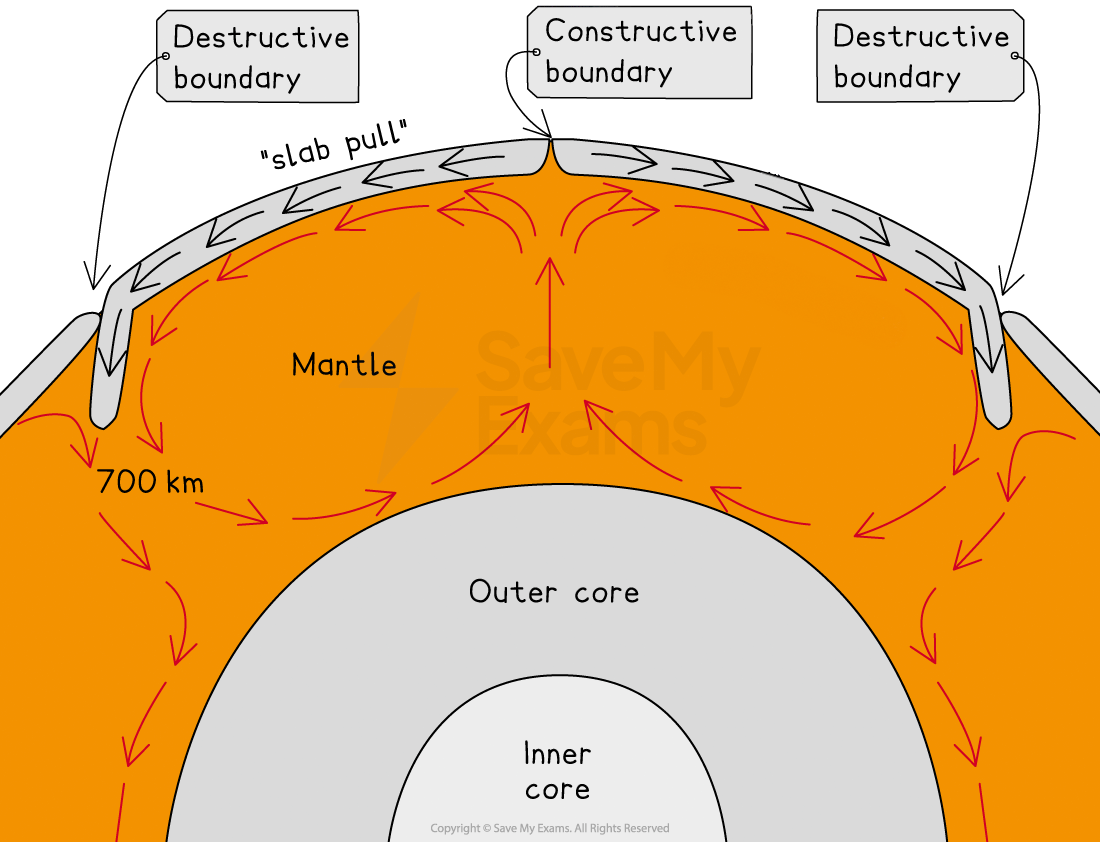
    Diagram of Earth's layers showing mantle, asthenosphere, lithosphere, with slab pull, convergent and divergent boundaries, and directional arrows.
    Convection currents and slab pull

Plate boundaries

  • Volcanic eruptions and earthquakes most commonly occur at or near plate boundaries

Divergent (constructive) boundaries

  • Plates move apart

  • Magma rises to fill the gap, creating new crust

  • Produces:

    • Mid-ocean ridges

    • Volcanoes (often gentle lava eruptions)

    • Shallow earthquakes

  • Example: Mid-Atlantic Ridge (Iceland)

Diagram of ocean ridge formation shows plates moving apart, magma rising to form lava, and new crust forming at the ocean ridge.
Constructive (divergent) plate boundary

Convergent (destructive) boundaries

  • Plates move towards each other

  • One plate subducts beneath another

  • The subducting plate melts, forming magma that rises to create a volcanic arc

  • Produces:

    • Powerful earthquakes

    • Explosive volcanoes

    • Ocean trenches

  • Example: Andes (Nazca Plate beneath South American Plate)

Diagram of tectonic plates showing subduction zone, forming a volcano. Arrows indicate plate movement. Magma rises as friction melts rock.
Destructive (convergent) plate boundary

Conservative (transform) boundaries

  • Plates slide past one another horizontally

  • No crust is created or destroyed

  • Friction locks plates together until stress is released as sudden, violent earthquakes

  • No volcanoes because there is no magma generation

  • Example: San Andreas Fault, California

Diagram showing two tectonic plates sliding past each other horizontally, with arrows indicating movement direction; labelled "Plates move passed each other".
Conservative (transform) boundary

Unlock more, it's free!

Join the 100,000+ Students that ❤️ Save My Exams

the (exam) results speak for themselves:

Jacque Cartwright

Author: Jacque Cartwright

Expertise: Geography Content Creator

Jacque graduated from the Open University with a BSc in Environmental Science and Geography before doing her PGCE with the University of St David’s, Swansea. Teaching is her passion and has taught across a wide range of specifications – GCSE/IGCSE and IB but particularly loves teaching the A-level Geography. For the past 5 years Jacque has been teaching online for international schools, and she knows what is needed to get the top scores on those pesky geography exams.

Alistair Marjot

Reviewer: Alistair Marjot

Expertise: Environmental Systems and Societies & Biology Content Creator

Alistair graduated from Oxford University with a degree in Biological Sciences. He has taught GCSE/IGCSE Biology, as well as Biology and Environmental Systems & Societies for the International Baccalaureate Diploma Programme. While teaching in Oxford, Alistair completed his MA Education as Head of Department for Environmental Systems & Societies. Alistair has continued to pursue his interests in ecology and environmental science, recently gaining an MSc in Wildlife Biology & Conservation with Edinburgh Napier University.