Strategies for Managing Impacts of Tectonic Events (Cambridge (CIE) IGCSE Environmental Management): Revision Note
Exam code: 0680

Strategies for managing impacts of tectonic events
Tectonic hazards cannot be prevented, but their impacts can be reduced through planning, engineering, monitoring, and effective emergency response
Management strategies fall into three main phases:
Before the event: preparation and risk reduction
During the event: immediate survival and protection
After the event: recovery and rebuilding
Monitoring and warning
Governments and scientists track tectonic activity to provide early warnings
Earthquakes:
Seismometers record ground movement
Global Positioning Systems (GPS) detect strain buildup along faults
While earthquakes cannot be predicted precisely, warning systems can detect initial P-waves and send alerts seconds before shaking arrives
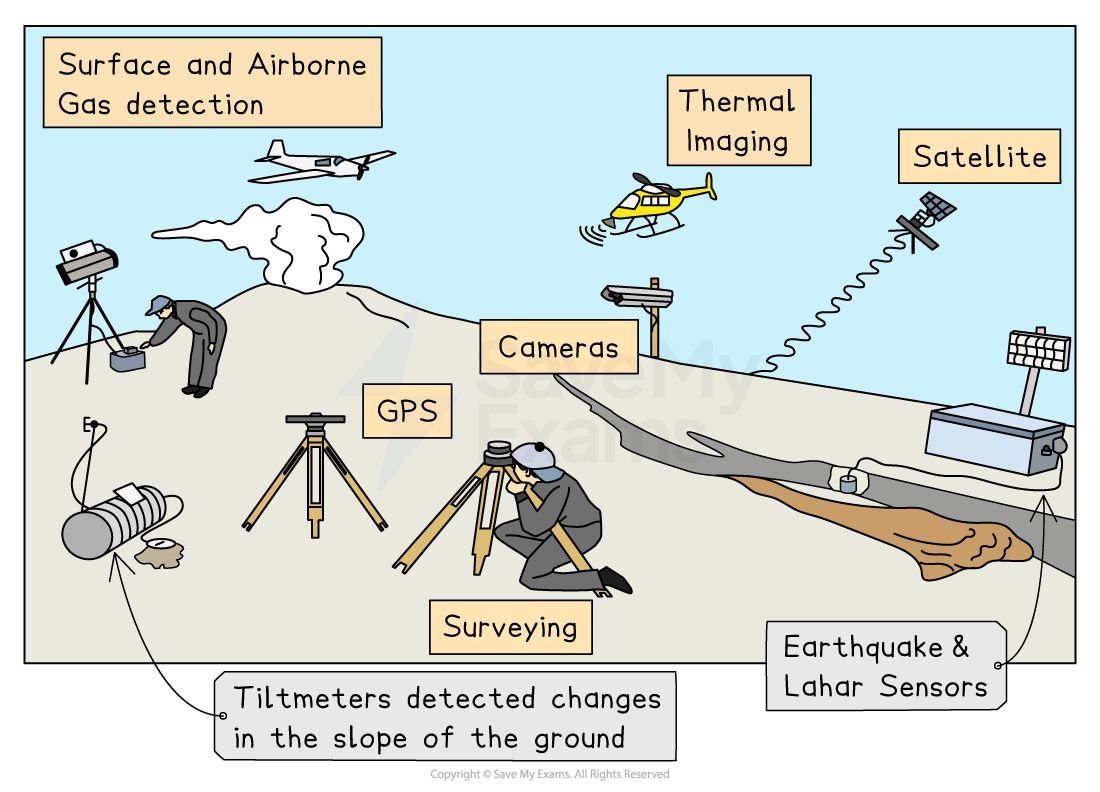
Volcanoes:
Gas emissions (SO₂, CO₂) monitored using sensors
Seismographs detect magma movement
Ground deformation measured by GPS and tiltmeters
Thermal imaging detects rising temperatures
Combined monitoring can give days or weeks of warning
Land use zoning
Planning authorities restrict development in high-risk zones
Examples:
No building allowed near volcanic vents, lava flow paths, or lahar channels
Avoiding construction on steep slopes in earthquake-prone regions to reduce landslide risk
Keeping coastal lowlands free of settlements due to tsunami hazards
Zoning reduces casualties by preventing high population density in the most dangerous areas
Structure of buildings
Engineering creates structures that resist shaking, ash loading, or lava heat
Earthquake-resistant design:
Flexible steel frames absorb shaking
Base isolation uses rubber bearings to reduce ground movement transfer
Lightweight roofs prevent collapse
Cross-bracing prevents buildings from twisting or buckling

Volcanic areas:
Steep roofs prevent ash accumulation
Heat-resistant materials reduce fire risks
Buildings are elevated to avoid lahars
Disaster preparation
Preparation aims to reduce panic and improve survival
Plans & drills:
Schools and workplaces practise evacuation and 'drop, cover, hold on' procedures
Communities learn safe routes away from tsunami or lahar zones
Emergency supplies:
Water, food, medical kits, masks (for ash), blankets and radios are stored at home
Hospitals and emergency centres stock essential equipment
Rescue teams:
Specialised teams trained in search and rescue, medical care, and fire management
Rapid-response units save lives in the first crucial hours
Evacuation
When monitoring indicates imminent danger, people are moved away from hazardous zones
Examples:
Evacuating coastal areas after a tsunami warning
Moving communities out of pyroclastic flow valleys during volcanic unrest
Night evacuations after strong earthquake foreshocks
Evacuation reduces loss of life, provided communication is fast and clear
Shelters
Temporary safe structures provide refuge for displaced people
Shelter features:
Food, water, sanitation, and medical care
Protection from ash, weather, tsunamis or aftershocks
Often located in schools, sports halls or specially built emergency centres
Shelters reduce immediate suffering and prevent disease outbreaks
Rebuilding of damaged areas
Long-term recovery
Rebuilding steps:
Repairing infrastructure such as bridges, power grids, and water pipes
Reconstructing homes using hazard-resistant designs
Restoring farmland contaminated by ash or landslides
Rebuilding can take years and is often the most expensive stage
International aid
Countries often require assistance after major tectonic disasters
Forms of aid:
Emergency supplies (food, water, medicine, tents)
Rescue specialists, engineers and medical teams
Long-term financial support for rebuilding
Technical expertise for monitoring and hazard mapping
Aid is crucial for low-income countries that lack resources
Benefits & limitations of managing impacts of tectonic events
Monitoring and warning
Benefits:
Provides early warnings for volcanoes and tsunamis
Reduces casualties by giving people time to evacuate
Limitations:
Earthquakes cannot be predicted accurately
Monitoring equipment is expensive
Warnings may arrive too late in densely populated areas
Land use zoning
Benefits:
Prevents building in the most dangerous areas
Reduces loss of life and property damage
Limitations:
Difficult to enforce where land is scarce
People may ignore rules or build illegally
Existing settlements in hazard zones cannot be easily moved
Structure of buildings
Benefits:
Significantly reduces deaths from collapse
Keeps essential buildings (hospitals, emergency centres) operational
Limitations:
Very costly—high-income countries adopt these designs far more easily
Older buildings remain vulnerable and cannot always be retrofitted
Volcanic hazards like pyroclastic flows overwhelm all structures
Disaster preparation
Benefits:
Increases public awareness and quick response
Reduces panic and confusion
Improves survival rates
Limitations:
Requires ongoing funding and training
Some communities lack access to education or resources
Drills may be ineffective if too infrequent
Evacuation
Benefits:
Early evacuation can save lives
Limitations:
This requires excellent communication and transport networks
People may refuse to leave livelihoods behind
Traffic congestion delays evacuation
Shelters
Benefits:
Protects displaced populations
Reduces disease outbreaks after disasters
Limitations:
Can become overcrowded
May be under-supplied, especially in low-income countries
Long-term sheltering affects mental and physical health
Rebuilding
Benefits:
Restores communities and infrastructure
It offers a chance to improve building standards
Limitations:
Extremely expensive and slow
Aftershocks or further eruptions can disrupt the process
In low-income settings, the process can take years to complete
International aid
Benefits:
It provides essential support for countries lacking resources
Enables rapid rescue and effective recovery
It offers both expertise and relief supplies
Limitations:
Aid may arrive too late
Reliance on aid can slow local recovery
Political tensions or corruption can hinder distribution

Unlock more, it's free!
Join the 100,000+ Students that ❤️ Save My Exams
the (exam) results speak for themselves:

Was this revision note helpful?