Rock Permeability (Cambridge (CIE) IGCSE Environmental Management): Revision Note
Exam code: 0680

What is rock & soil permeability?
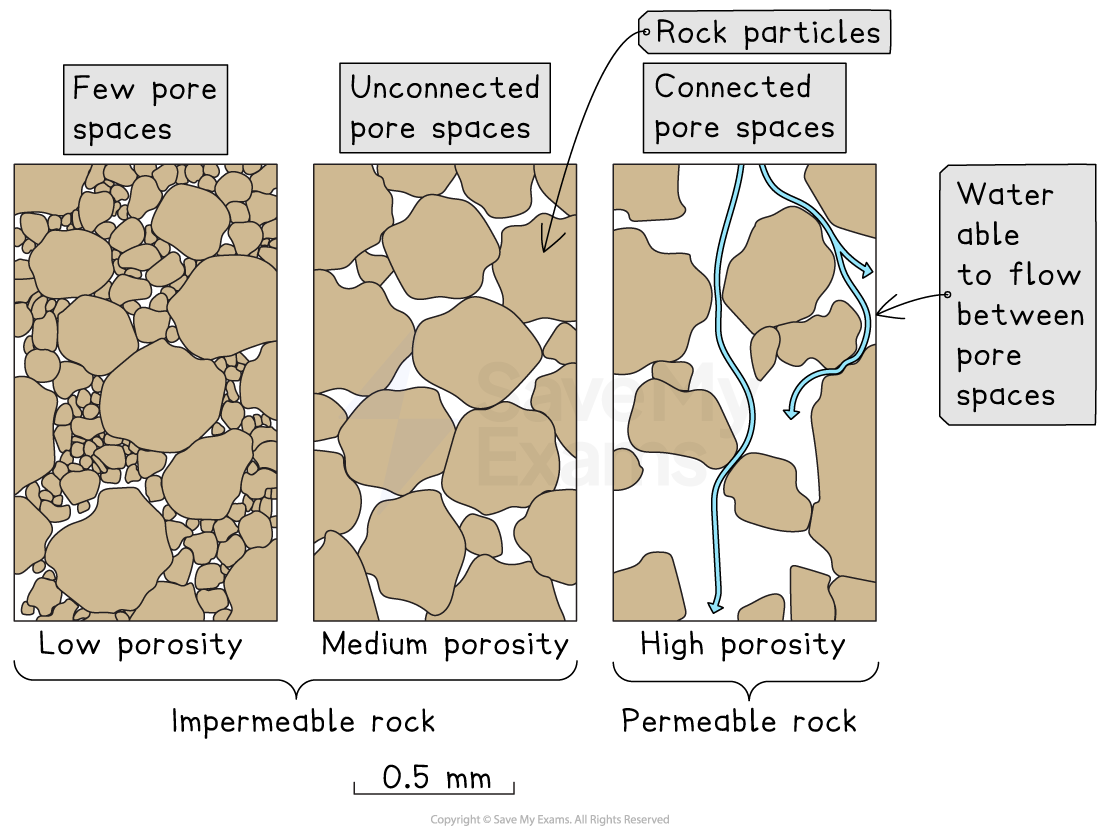
Permeability is the ability of water to pass through the pore spaces of rock and soil
Pore spaces are the tiny gaps or holes between rock or soil particles that allow water and air to move through
Rocks and soils with many connected pore spaces allow water to flow through easily
They are described as permeable
Rocks and soils with few or no connected pore spaces do not let water pass through easily
They are described as impermeable
The size and connection of the pores determine how quickly water can move through the material
Examiner Tips and Tricks
Students sometimes mix up 'porous' and 'permeable'. 'Porous' means the rock has spaces; 'permeable' means water can actually flow through. If the pores aren’t connected, the rock might be porous but still impermeable.
Permeable rocks
Permeable rocks allow water to pass through them because they contain many connected pores or cracks
Most sedimentary rocks are permeable because they form from layers of particles that leave spaces between grains
Examples of permeable rocks include:
Limestone has small cracks and spaces that let water flow through
Sandstone is made of sand-sized grains with spaces between them that allow water to move easily
Permeable rocks often store groundwater
This forms aquifers, which are underground layers of rock that hold water
Impermeable rocks
Impermeable rocks do not allow water to pass through easily because their pores are very small or not connected
Igneous and metamorphic rocks are usually impermeable
This is because they have a dense, compact structure with few spaces
Some sedimentary rocks, such as shale, are also impermeable
This is because the fine clay particles are packed tightly together
Water cannot soak into impermeable rocks
This means that water often flows over their surface or collects above them to form springs or surface water
Examiner Tips and Tricks
When classifying rock types, avoid vague answers like 'igneous rocks are hard.' Instead, state why they’re impermeable—because the crystals fit tightly together and there are no spaces for water to pass through.

Unlock more, it's free!
Join the 100,000+ Students that ❤️ Save My Exams
the (exam) results speak for themselves:

Was this revision note helpful?