Desalination (Cambridge (CIE) IGCSE Environmental Management): Revision Note

Exam code: 0680

Alistair Marjot

Written by: Alistair Marjot

Reviewed by: Jacque Cartwright

Updated on

Desalination: distillation

  • Desalination is the process of removing salt from seawater to produce potable (safe-to-drink) water

  • Two main methods are used:

    • Distillation

    • Reverse osmosis

  • Distillation involves heating seawater until it boils

    • Salt and impurities do not evaporate and remain in the liquid

    • The water turns into steam, which is pure water vapour

    • Steam rises and leaves the salty water behind

    • The steam is then cooled and condensed

    • Turns back into liquid fresh water

  • Produces potable water, safe for drinking
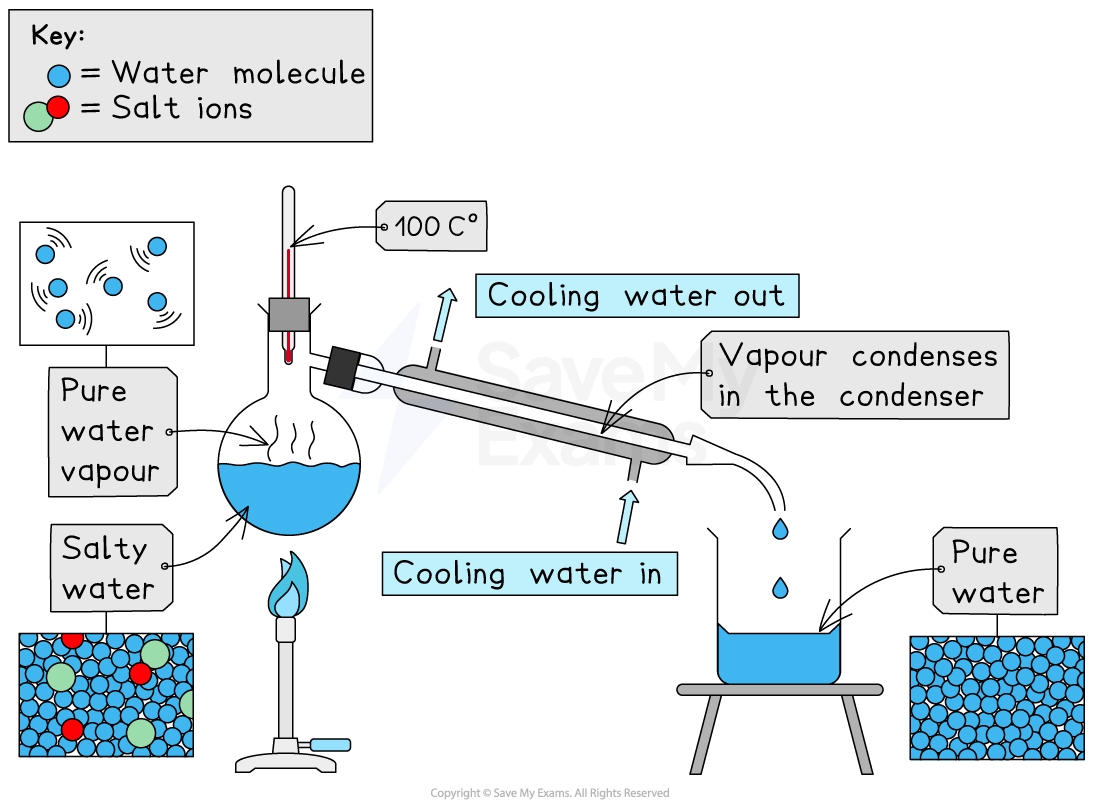
Diagram of a distillation process showing salty water heated to 100°C, forming vapour that condenses to pure water in a condenser.
Salt and water can be separated by distillation

Desalination: reverse osmosis

  • Reverse osmosis involves forcing seawater through a semipermeable membrane using high pressure

    • The membrane allows small water molecules to pass through

    • It blocks salt ions and most other dissolved substances

  • Produces fresh water on one side of the membrane

  • Leftover salty water (brine) must be safely disposed of
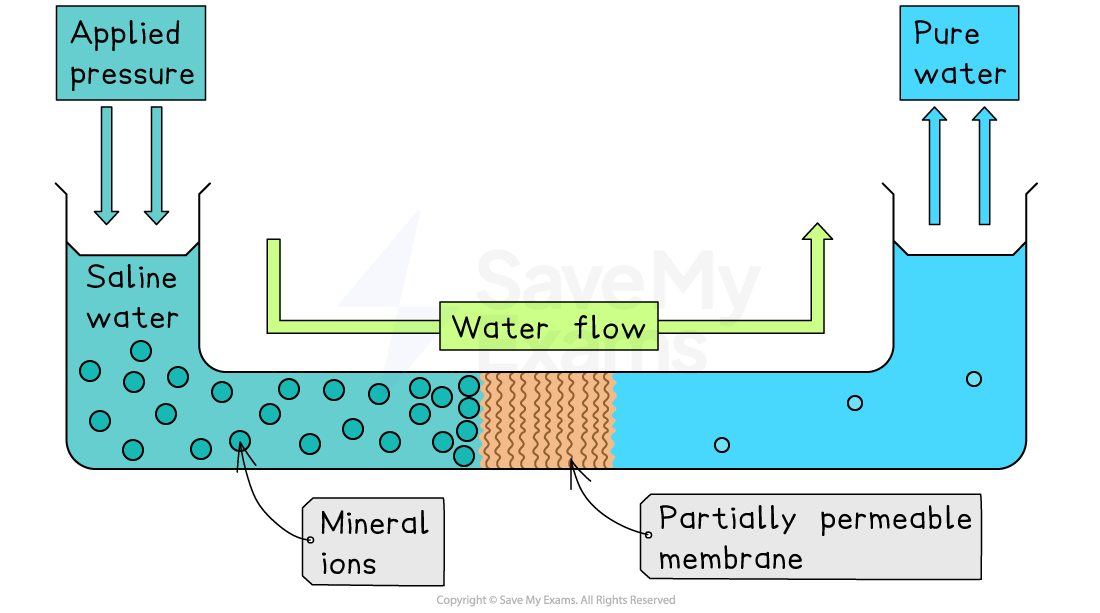
Diagram illustrating reverse osmosis: saline water under pressure passes through a partially permeable membrane, yielding pure water, with mineral ions excluded.
Only water molecules can get through the semi-permeable membrane 

Benefits & limitations of desalination

Benefits of desalination

  • Provides a reliable source of drinking water in dry or water-poor regions

    • Useful where rainfall is low or rivers and lakes are limited

  • Not affected by drought, because the ocean is a constant supply

  • Can supply large populations, including major cities

  • Helps countries reduce dependence on imported water or overused rivers
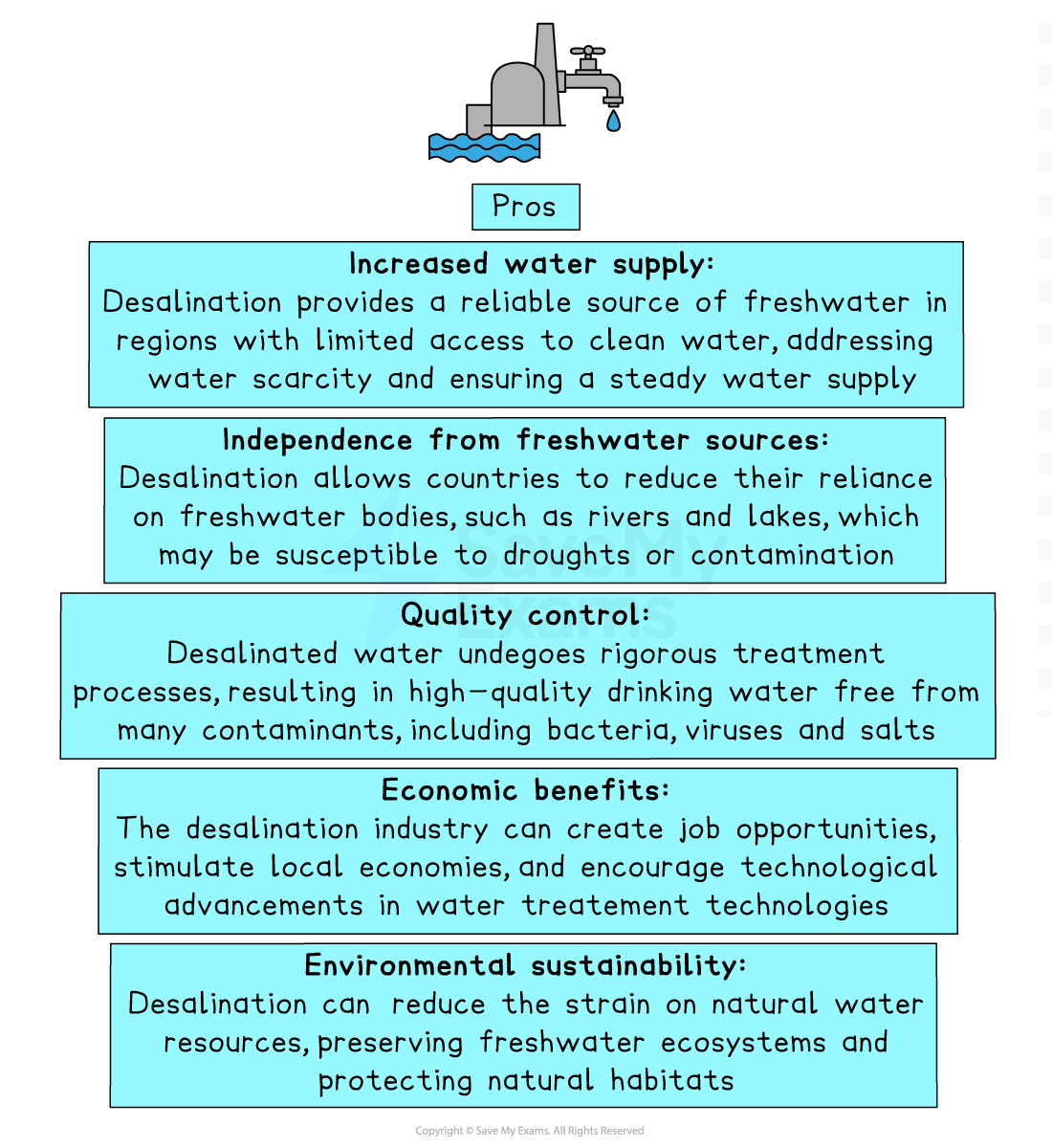
Infographic detailing the pros of desalination: increased water supply, independence from freshwater, quality control, economic benefits, and sustainability.
The advantages of desalination

Limitations of desalination

  • Requires large amounts of energy, making it expensive to run

    • Especially for distillation, which involves heating water

  • Produces brine, a very salty waste product

    • Must be disposed of carefully to avoid harming marine ecosystems

  • Building and maintaining desalination plants is costly

  • Not all countries can afford the infrastructure needed

  • Reverse osmosis membranes need regular cleaning or replacing, increasing costs
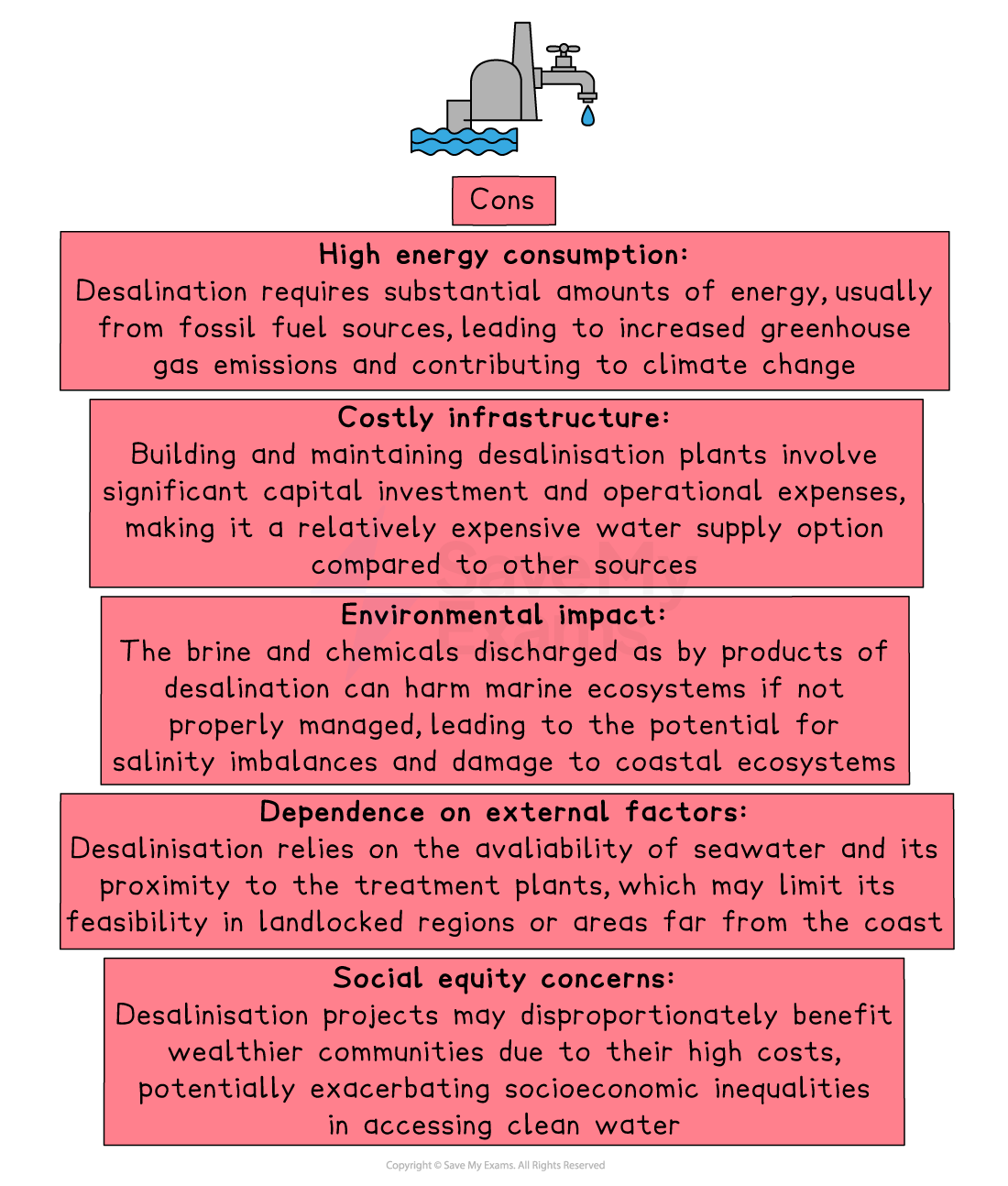
Infographic on desalination cons: high energy use, costly infrastructure, environmental impact, external factor dependence, and social equity concerns.
The disadvantages of desalination

Unlock more, it's free!

Join the 100,000+ Students that ❤️ Save My Exams

the (exam) results speak for themselves:

Alistair Marjot

Author: Alistair Marjot

Expertise: Environmental Systems and Societies & Biology Content Creator

Alistair graduated from Oxford University with a degree in Biological Sciences. He has taught GCSE/IGCSE Biology, as well as Biology and Environmental Systems & Societies for the International Baccalaureate Diploma Programme. While teaching in Oxford, Alistair completed his MA Education as Head of Department for Environmental Systems & Societies. Alistair has continued to pursue his interests in ecology and environmental science, recently gaining an MSc in Wildlife Biology & Conservation with Edinburgh Napier University.

Jacque Cartwright

Reviewer: Jacque Cartwright

Expertise: Geography Content Creator

Jacque graduated from the Open University with a BSc in Environmental Science and Geography before doing her PGCE with the University of St David’s, Swansea. Teaching is her passion and has taught across a wide range of specifications – GCSE/IGCSE and IB but particularly loves teaching the A-level Geography. For the past 5 years Jacque has been teaching online for international schools, and she knows what is needed to get the top scores on those pesky geography exams.