Give Me a Break: Why Students Feel Burnt Out During School Holidays
Written by: Liam Taft
Reviewed by: Lucy Kirkham
Published
Contents
- 1. About the data
- 2. Key findings
- 3. How do students feel during school holidays?
- 4. What impact does burnout have on academic performance?
- 5. What impact does burnout from revision have on students’ mental health?
- 6. What causes burnout during school holidays?
- 7. Do students feel supported in managing burnout?
- 8. How can students balance schoolwork and rest during school holidays?
- 9. Where can students, parents and teachers find support?
- 10. Conclusions
- 11. Methodology
School holidays – once a break from academic work, a chance to rest and recuperate – are increasingly being taken over by homework and revision.
In fact, schools in England hold revision sessions for children as young as six (opens in a new tab) during half-term and Easter holidays. But what impact is this having on students?
A Save My Exams survey reveals that 89% of UK secondary school students experience burnout during or after school holidays due to revision.
Only 20% of respondents said they have enough time to relax during school holidays, and 14% of students admitted they feel burnt out for a whole month.
This level of exhaustion has serious consequences: burnout not only harms students’ academic performance, but also affects their overall mental health.
Students feel a great number of competing pressures to spend their school holidays working. At the same time, they don’t believe schools and teachers are supporting them adequately when they are burnt out.
This report explores the scale of the issue, the impact on students, and what parents and teachers can do to support them.
About the data
Save My Exams surveyed 1,026 UK secondary school students in October 2025 about academic burnout during school holidays.
Key findings
Burnout is widespread: 89% of UK students experience burnout during or after school holidays.
Burnout harms academic performance: 76% of students say burnout sometimes or always affects their academic results.
Students’ mental health suffers: 71% of students report feelings of guilt, stress, overwhelm or pressure during the Christmas break.
Support is insufficient: Just 16% feel well-supported by their school, and almost a third turn to nobody for help.
How do students feel during school holidays?
89% of students said they experience burnout during school holidays due to revision.
According to Mental Health UK (opens in a new tab), burnout is “a state of physical, mental, and emotional exhaustion”, which often occurs due to long-term stress and constant pressure.
40% of students said burnout from revision lasted for a few days, 27% for a week, and 14% for a month. Only 11% said they experience burnout rarely or never.
When asked what statement best describes how they feel during school holidays, the most common answers students chose were:
“I feel guilty that I’m not doing enough” (21%)
“I feel overwhelmed by everything that I need to do” (18%)
“I feel stressed” (16%)
“I feel under pressure” (16%)
Only one in five (20%) students said they had enough time to relax during school holidays.
What impact does burnout have on academic performance?
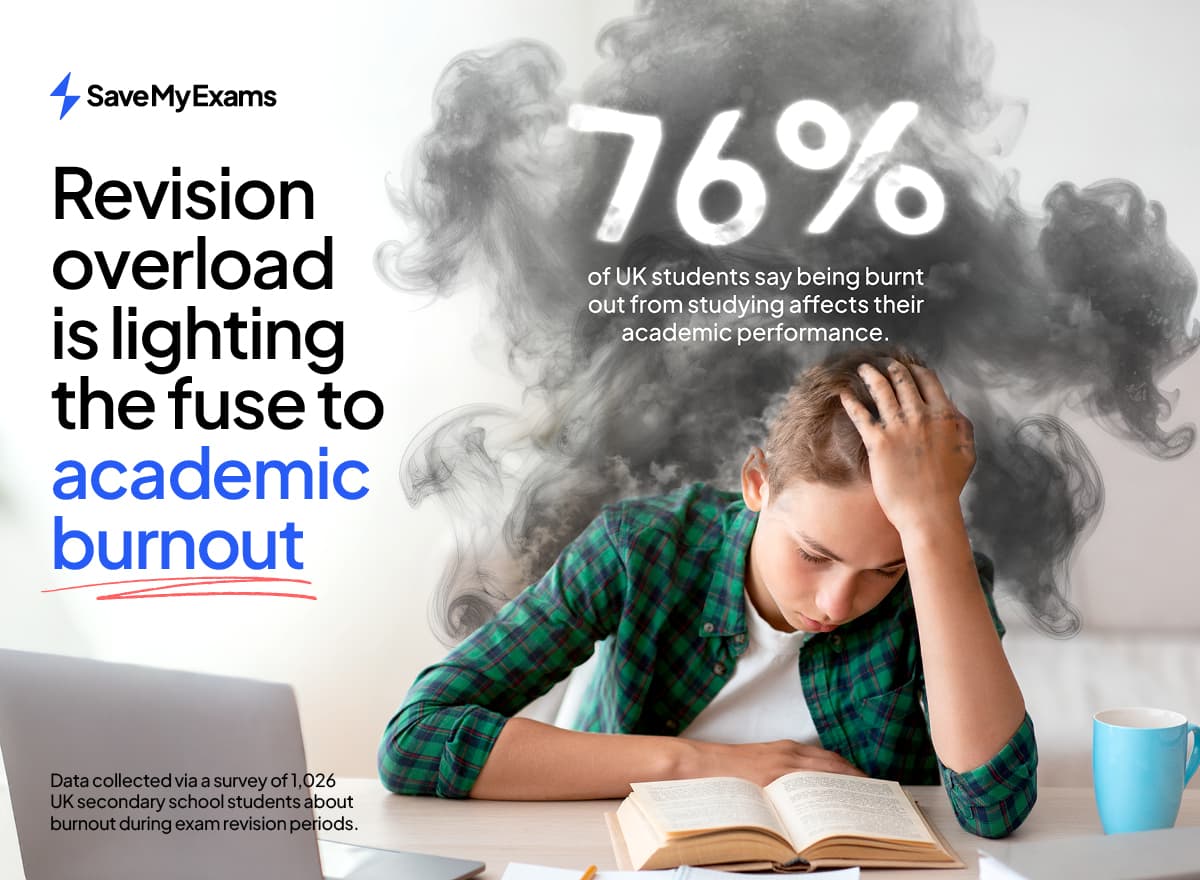
76% of students in our survey said that burnout sometimes or always affects their academic performance.
These findings are supported by academic research. Meta analysis from York St John University and the LSE of 100,000 students found that students suffering from academic burnout achieve worse academic results (opens in a new tab).
Burnout weakens concentration, memory and motivation. As a result, this can lead to lower performance in tests and exams.
Another study (opens in a new tab) reported that anxiety around exams, homework and school had a negative impact on grades in reading, science and maths.
What impact does burnout from revision have on students’ mental health?
Almost three-quarters (71%) of respondents to our survey reported feeling guilty, overwhelmed, pressured or stressed during the Christmas break.
Research from UCL has shown a clear link between academic pressure and mental health issues in adolescence (opens in a new tab). The lead author of the study claimed that “there are concerns that extensive testing and exams are causing undue stress” among adolescents and that they are “increasingly feeling pressure from schools, parents, or themselves to achieve higher grades”.
Childline, a helpline for children and young people, also reported a rise in calls about exam and revision stress (opens in a new tab) during the 2025 exam period.
Key themes of these conversations included struggling with balance between revision and downtime, loss of sleep over revision worries, and feeling hopeless about the future.
What causes burnout during school holidays?
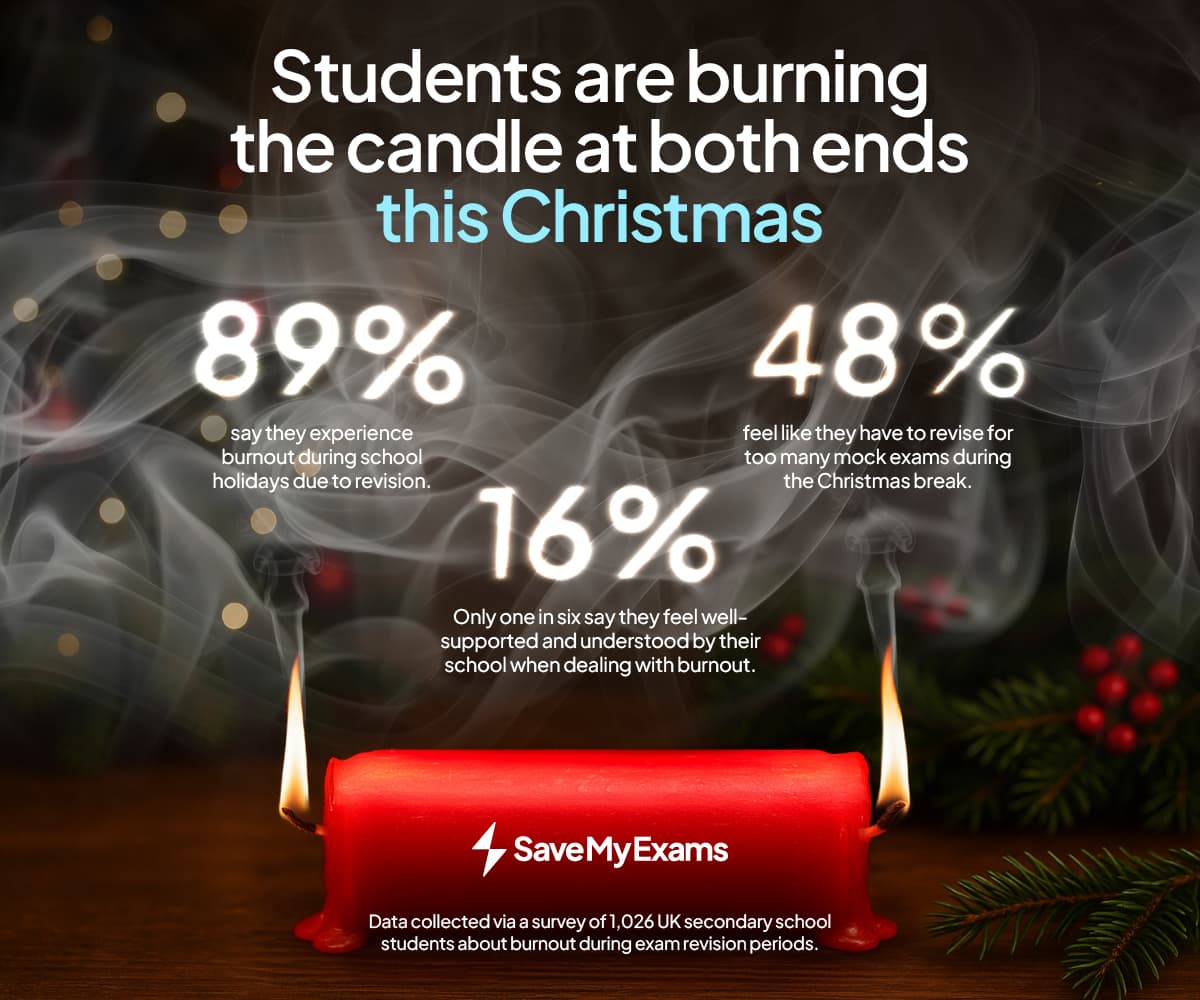
Almost half (48%) of UK students say they have to revise for too many mock exams over the Christmas break, with the same percentage agreeing this leads to burnout.
Timetables vary between schools, but some students sit more than 10 mock exams in January.
Although mock exams don’t determine actual exam results, they can influence predicted grades. Therefore, there is a lot of pressure for students to perform well.
Students in the UK spend more time in exam halls than pupils from almost any other country. With standardised tests taken from reception to sixth form, the UK is described as an “overexamined nation (opens in a new tab).”
As explored earlier in this report, exams are a big cause of students’ stress and anxiety, and loom over school holidays.
When asked what they think causes this pressure to revise, students’ most common answers were:
“Fear of falling behind” (26%)
“Personal motivation or perfectionism” (26%)
“School or teacher expectations” (18%)
“Parental pressure” (16%)
Therefore, a range of factors lead to burnout during school holidays: exams, mock exams, pressure from teachers and parents, and students’ own fears and motivations.
Do students feel supported in managing burnout?
Only 16% of students said they feel well-supported and understood by their school when dealing with revision burnout during school holidays.
Four in ten (40%) admitted there is some support available from their school to help deal with burnout, but said more could be done to help students.
One in three (31%) UK students claim that most teachers don’t seem trained to recognise or manage student burnout leading up to, during, and after the school holidays.
As a result, students often look elsewhere for help. When asked who they turn to for support with burnout, only 7% said they go to their teachers for help. Instead, 19% turn to friends and 18% to their parents or guardians.
Concerningly, 29% of students said they sought help from nobody, and 19% said they turned to AI tools like ChatGPT to manage burnout.
So what support are students looking for to prevent revision overwhelm during school holidays? Here are students’ top requests:
Space out mock exams so they don’t all fall at the same time (21%)
Allow more genuine rest time with no schoolwork (19%)
Provide clearer revision guidance or study plans (18%)
Set less work over the school holidays (13%)
Offer more optional catch-up or support (12%)

How can students balance schoolwork and rest during school holidays?
Lucy Kirkham, former teacher and Head of Content Creation at Save My Exams, says: “When studying over the Christmas break, balancing work and rest is key. Small signs of fatigue mean your focus is already fading, and taking a quick break at that point can help you reset before productivity drops and burnout creeps in.
“If you catch yourself re-reading the same line without taking it in, forgetting key points, or simply feeling restless, bored, or distracted, then we advise you to take a quick break to help you reset and reduce becoming burnt out.
“Short breaks of 5–10 minutes are best after 25–50 minutes of focused work to help keep your energy steady and stop your brain from switching off. Longer breaks of 15–30 minutes can be particularly useful after several study cycles or 1–2 hours of deep work. This will help you recharge before starting again. Even micro-breaks to stretch, breathe or rest your eyes can improve focus and help reduce fatigue.
“However, the quality of the break is more important than the length. The best revision routines include breaks by design, not by accident.
“For the most beneficial breaks, try making them part of your day by adding break times to your revision timetable. We also recommend using a timer or app to help you stick to certain helpful study techniques, like the Pomodoro or 50/10 cycles.
“Remember to also finish each session with a proper rest. Step away from your desk, move your body, get fresh air, do something relaxing, and keep a good sleep routine on an evening to help give your brain the time it needs to reset.
“Once breaks become part of your rhythm, you’ll study more efficiently and feel less drained at the end of the day.”
Where can students, parents and teachers find support?
For students, we recommend this downloadable PDF from Save My Exams on coping strategies to deal with exam-related stress and anxiety (opens in a new tab), and this useful guide on exam stress (opens in a new tab) from the charity Mind.
Parents can access the NHS’s guidance on supporting children through exam periods (opens in a new tab), and this blog on how to help children cope with exam stress (opens in a new tab) from the Department for Education and Childline.
Schools and teachers can find useful resources on helping their students articulate and cope with exam stress (opens in a new tab) from the Anna Freud mental health charity.
Conclusions
Save My Exams’ study reveals that burnout is widespread amongst UK students during school holidays.
This is caused by a range of factors, including busy exam timetables, pressure from teachers and parents, and students’ own fears.
Burnout has a negative impact on both students’ academic performance and their mental health more generally.
Students desire clearer guidance from schools, better spaced assessments and more time to rest.
Although we recognise that teachers, parents and students are under immense pressure to perform, a balanced schedule of schoolwork and rest is recommended to avoid burnout.
Methodology
Save My Exams surveyed 1,026 UK secondary school students in October 2025.
Themes of the survey included:
The effects of burnout on students’ academic performance
The effects of burnout and pressure to succeed on students’ mental and emotional health
How well students are able to rest and recover during school holidays
Whether students feel supported by schools, and who they turn to when they’re experiencing burnout
What students are looking for when it comes to revision, school holidays and mock exams
References
Schools in England hold half-term Sats classes for pupils as young as six | The Guardian (opens in a new tab)
Burnout | Mental Health UK (opens in a new tab)
Does Burnout Affect Academic Achievement? A Meta-Analysis of over 100,000 Students | Educational Psychology Review (opens in a new tab)
The impact of stress on students in secondary school and higher education | International Journal of Adolescence and Youth (opens in a new tab)
Link found between academic pressure and mental health problems in adolescence | UCL News (opens in a new tab)
Tested to destruction: how an obsession with exams is failing our children | The Observer (opens in a new tab)
Rise in calls to Childline about exam and revision stress during the exam period last year | NSPCC (opens in a new tab)
25 UK Exam Stress Statistics & What to Do About It | Save My Exams
Info on exam stress - for 11-18 year olds | Mind (opens in a new tab)
Help your child beat exam stress | NHS (opens in a new tab)
How to cope with exam stress | Department for Education (opens in a new tab)
Supporting Children and Young People’s Wellbeing at School or College | Anna Freud (opens in a new tab)
Was this article helpful?
Sign up for articles sent directly to your inbox
Receive news, articles and guides directly from our team of experts.

Share this article

 written revision resources that improve your