How To Make A Concept Map: Step-By-Step Guide

Written by: Angela Yates
Reviewed by: Holly Barrow
Published
Contents
When you’re revising a big topic, it’s easy to feel overwhelmed by the amount of information you need to remember. Notes, textbooks and revision guides can quickly become difficult to organise.
A concept map can help you turn all that information into a clear visual structure. Instead of memorising disconnected facts, you can see how ideas link together.
Concept maps are especially useful when you are revising complex topics with lots of relationships between ideas, such as science processes, historical causes or psychological theories.
In this guide, you’ll learn what a concept map is, when it can help with revision, and how to make a concept map step-by-step. Get ready to make your revision sessions even more effective.
Key Takeaways
A concept map shows how ideas connect, helping you understand complex topics.
It organises information using concepts, linking words and a hierarchical structure.
Concept maps are useful for subjects where ideas build on each other, such as science or humanities.
You can create a concept map by identifying key ideas, organising them and linking them with clear relationships.
What Is A Concept Map?
A concept map (opens in a new tab) is a visual diagram that shows relationships between ideas or concepts.
Concept maps were developed by education researcher (opens in a new tab)Joseph Novak (opens in a new tab) as a way to represent knowledge and support meaningful learning. They help learners organise information and understand how different ideas connect.
Concept maps usually include four key elements:
Concepts
Concepts are the main ideas you want to understand. These are usually written inside boxes or circles.
Linking Words
Linking words explain the relationship between two concepts.
For example:
causes
leads to
results in
is part of
These words turn the diagram into meaningful statements.
Hierarchical Structure
Concept maps are usually organised from general ideas to more specific ones.
For example:
Topic → main ideas → detailed concepts
Cross-links
Cross-links show relationships between different parts of the diagram. These connections often reveal important relationships between topics that may not appear obvious at first.
Together, these elements help learners visualise knowledge structures and understand how ideas fit together.
Benefits of Using Concept Maps
Concept maps can be a powerful learning tool, especially when studying complex subjects.
They Help You See How Ideas Connect
Many topics are easier to understand when you can see how ideas relate to each other. Concept maps highlight these relationships clearly.
Instead of memorising separate facts, you can understand how the ideas form a larger system.
They Make Revision More Manageable
When you’re revising a large topic, it can be hard to know where to start.
Concept maps allow you to summarise an entire topic on one page, helping you organise your revision and focus on the most important ideas.
They Help You Remember Information
Visual learning tools can improve memory because they organise information in a structured way.
By building the concept map yourself, you actively process the information rather than simply reading it.
You can find more revision strategies in our Learning Hub, including our guide to the best memorisation techniques for revision.
When To Use Concept Maps
Concept maps are especially helpful when you are studying topics with many connected ideas.
You might create a concept map when you need to:
understand a science process such as photosynthesis or respiration
organise causes and consequences in history
structure ideas for a long exam answer or essay
revise a large chapter or unit of work
Concept maps are most useful when your goal is to understand relationships between ideas, not just memorise definitions.
How To Make A Concept Map: Step-By-Step Process
Step 1: Choose Your Main Topic
Start with the topic you want to revise.
Write the main concept at the top or centre of your page.
Example:
Photosynthesis
Step 2: List Key Concepts
Next, list the most important ideas connected to the topic.
These might include key terms, processes or major themes
Example:
Photosynthesis key concepts:
chloroplasts
sunlight
carbon dioxide
water
glucose
oxygen
Step 3: Arrange Concepts From General To Specific
Arrange the ideas so that broad concepts appear first, followed by more detailed information.
This creates the hierarchical structure that concept maps rely on.
Step 4: Add Linking Words
Connect the concepts using arrows and linking words or phrases. These linking words show how the concepts relate to one another.
Example:
Photosynthesis linking words:
Photosynthesis takes place in chloroplasts
Photosynthesis uses carbon dioxide
Photosynthesis uses water
Photosynthesis requires sunlight
Photosynthesis produces glucose
Step 5: Add Cross-Links Between Sections
Finally, look for connections between different parts of your map.
These cross-links often help you discover new relationships between ideas, which improves your understanding of the topic.
The example below shows how these concepts and linking words might appear in a simple concept map.
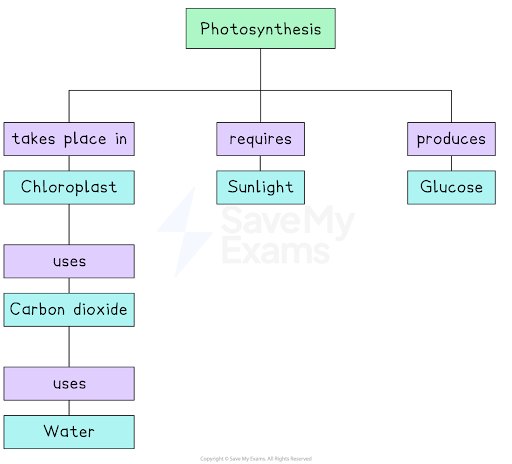
Caption: Example of a concept map for photosynthesis.
Alt-text: Concept map for photosynthesis
Concept Map Examples
Concept maps can be used across many different subjects.
Biology Topic Example
In GCSE Biology, a concept map might show how different parts of the cell work together.
For example, a concept map could connect ideas such as:
cell membrane
nucleus
cytoplasm
mitochondria
ribosomes
The links might show relationships such as:
The nucleus controls the cell
Mitochondria release energy for cell activities
Ribosomes produce proteins
Geography Example
In GCSE Geography, a concept map could show how the whole water cycle works as a system, rather than memorising each stage separately.
For example, a concept map might connect ideas such as:
evaporation
condensation
precipitation
collection
sunlight
The map could show relationships such as:
Sunlight causes evaporation
Evaporation leads to condensation
Condensation forms clouds
Clouds produce precipitation
History Example
In GCSE History, a concept map might show causes and consequences of a major event.
For example, a map of the causes of World War I could link:
Nationalism
Militarism
Alliances
Political tensions
This helps you see how different factors interact to produce historical outcomes.
Frequently Asked Questions
What Is The Difference Between A Concept Map And A Mind Map?
Concept maps show relationships between ideas using linking words, while mind maps usually start with a central idea and branch outward into related topics.
Concept maps focus on explaining how ideas connect, while mind maps are often used for brainstorming or summarising information. You can learn more in our guide to revision mind maps and how to use them effectively.
Can I Use Concept Maps For All Subjects?
Yes. Concept maps can be useful in many subjects, especially when topics involve ideas that connect together, such as scientific processes, historical causes, or social science theories.
Can Concept Maps Help With Exam Revision?
Yes. Concept maps can make revision easier by helping you organise key ideas and understand how topics link together.
This can improve recall and help you apply your knowledge more effectively in exam questions.
Final Thoughts
Concept maps are a simple way to organise complex information and understand how ideas connect. By identifying key concepts and linking them clearly, you can turn large topics into structured visual summaries.
Used regularly, concept maps can help you revise more efficiently and feel more confident when preparing for exams. If you haven’t tried them, why not start here? Try creating a concept map for the topic you’re currently revising using the relevant section in Save My Exams’ revision notes. Good luck with your revision!
References:
The Theory Underlying Concept Maps and How to Construct and Use Them (opens in a new tab)
Was this article helpful?
Sign up for articles sent directly to your inbox
Receive news, articles and guides directly from our team of experts.

Share this article








 written revision resources that improve your