How to Revise for IB Chemistry: Tactics That Work

Written by: Emma Dow
Reviewed by: Angela Yates
Published
Contents
- 1. Key Takeaways
- 2. Understanding the IB Chemistry Syllabus
- 3. How is IB Chemistry Assessed?
- 4. Where Most Students Go Wrong When Revising IB Chemistry
- 5. How to Revise IB Chemistry: 8 Proven Tactics
- 6. Don’t Neglect Your Wellbeing
- 7. Frequently Asked Questions
- 8. Smash Your IB Chemistry Grades with Save My Exams
When it comes to revising for IB Chemistry, the process can feel daunting. With complex concepts, detailed equations, and lots of information to remember, it can be easy to get overwhelmed.
But don’t worry! In this article, we’ll walk you through how to revise IB Chemistry effectively, so that you can improve your grades and be ready for your exams.
Key Takeaways
The new IB Chemistry syllabus (first exams May 2025) is structured around two themes: Structure and Reactivity. Your revision must reflect this.
The Internal Assessment (IA) is worth 20% of your total grade. Don't over-invest at the expense of your written papers.
Past papers are your most powerful revision tool - but only when used alongside the mark scheme analytically.
The IB Chemistry Data Booklet is provided in the exam. Learning to use it quickly is a skill you need to practise in advance.
Understanding the IB Chemistry Syllabus
The new IB Chemistry syllabus (opens in a new tab) took effect from first teaching in August 2023, with the first assessments in May 2025.
The biggest structural change is that content is now organised around two core themes:
Structure - the nature of matter, from particles to complex molecules.
Reactivity - how and why chemical reactions occur.
This replaces the old topic-by-topic approach and means you need to understand how different areas of chemistry connect to each other.
Explore our IB Chemistry topics overview for more information.
How is IB Chemistry Assessed?
Understanding the assessment format is the first step to revising effectively for IB Chemistry.
Component | What it tests | Weighting |
|---|---|---|
Paper 1A | Multiple choice questions | 80% |
Paper 1B | Data-based questions | |
Paper 2 | Short and extended response | |
Internal Assessment (IA) | Individual scientific investigation | 20% |
You will take different papers, depending on whether you follow the SL or HL course. But, the written papers always make up 80% of your total grade. Your exam revision should reflect this. The IA is worth 20%.
Where Most Students Go Wrong When Revising IB Chemistry
Many students revise IB Chemistry passively. They:
Reread notes
Highlight textbooks
Watch videos
IB Chemistry requires you to apply knowledge. Examiners award marks for:
Specific command terms
Correct use of units
Accurate chemical equations
Reading your notes won't prepare you for that.
Another common mistake is starting revision with the easiest topics. By the time students reach the harder content - like electrochemistry - they're running out of time.
A third issue is ignoring the Data Booklet (opens in a new tab). Many students treat it as a last-minute addition to their exam prep, rather than a resource to practise with throughout their revision.
How to Revise IB Chemistry: 8 Proven Tactics
1. Use Past Papers
Past papers are your most powerful revision tool, but only when used correctly.
Don't just answer questions and move on. After completing a paper, go through the mark scheme carefully and identify the specific language examiners expect. IB Chemistry mark schemes reward precise vocabulary and correct command-term responses.
Save My Exams' has a huge bank of IB Chemistry past paper questions, so you can familiarise yourself with the content and format of your exams.
2. Create Mind Maps and Diagrams
Chemistry can often feel like a web of interlinked ideas. Understanding the connections between different concepts is key to mastering the subject. One of the most effective ways to reinforce this understanding is through mind maps and diagrams.
Start by focusing on key areas like:
Organic chemistry
Acids and bases
Redox reactions
Create a central node for each topic and branch out with relevant sub-concepts, definitions, and equations. For example, under “Acids and Bases,” you could have branches for pH, strong vs weak acids, and titrations.
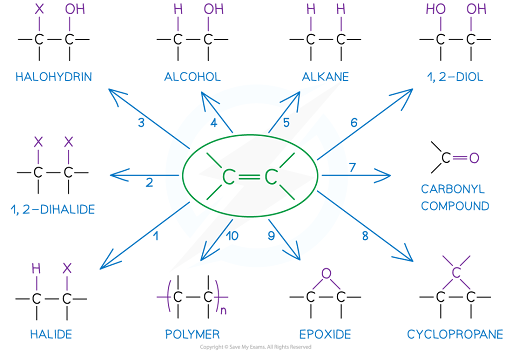
A mind map for learning alkene chemistry
3. Prioritise High-Weightage Topics First
Structuring your revision around the areas most likely to appear gives you the best return on your time.
Go through your syllabus and highlight the key topics. For example, the periodic table, chemical reactions, and electrochemistry are critical areas that often appear on exams. Make sure you have a strong grasp on these before moving on to more niche topics.
4. Master the Data Booklet
The IB Chemistry Data Booklet (opens in a new tab) is provided to use alongside every exam. It contains key equations, constants, electrochemical series, and thermodynamic data.
Most students don't open it until a few days before the exam. This is a mistake.
During revision, use the Data Booklet alongside every practice question. Get to know where to find key values instantly. Being slow with the booklet during the real exam wastes precious time.
Make sure you're using the booklet labelled for first exams 2025, as the old version does not match the new syllabus.
5. Use Active Recall
Active recall means testing yourself on content rather than re-reading it. It is one of the most evidence-backed revision strategies (opens in a new tab) in educational research.
For IB Chemistry, this means:
Blurting - Closing your notes and writing out a mechanism or equation from memory.
Using flashcards to test yourself on definitions and unit conversions.
Answering practice questions to assess your knowledge baseline before proper revision.
6. Learn to Interpret Exam Command Terms
IB Chemistry questions use specific command terms that tell you exactly what to do. Misunderstanding them costs marks. Here are some key command terms that you need to be familiar with in IB Chemistry.
Command term | What it means |
Define | Give the precise meaning |
Explain | Give reasons using chemical principles |
Deduce | Reach a conclusion from the information given |
Evaluate | Assess the implications, considering the evidence |
Construct | Represent or create something (an equation or graph) |
Spend time practising questions for each command term. Knowing the content isn't enough - you need to respond in the format the examiner expects.
7. Teach What You've Learned To Someone Else
Explaining concepts to someone else is a fantastic way to test your own understanding. If you can teach a topic clearly, it means you’ve mastered it.
Find a study buddy, or even explain concepts aloud to yourself. Try to explain complex topics, like bonding or kinetics, in simple terms. The more you simplify the topic, the better your grasp will be.
Students often find that teaching others not only reinforces their own knowledge, but also highlights areas they need to revisit.
8. Practise Timed Mock Exams
Exam technique is a skill that needs dedicated practice. Many students know the content but struggle to deploy it efficiently under time pressure.
Set aside at least two full mock exam sessions in the final month of your revision. Complete papers from start to finish under timed, exam-like conditions.
Review your performance afterwards using the mark scheme. Identify patterns in the mistakes you make.
Are you running out of time?
Are you misreading questions?
Are you dropping marks on the same topic repeatedly?
Each mock exam is a diagnostic tool to help you fine-tune your revision.
Don’t Neglect Your Wellbeing
Finally, it’s important to remember that your mental and physical health are key to your success. Burnout can be a serious obstacle to effective revision.
Make sure to take regular breaks, get enough sleep, and stay active. Taking time away from your studies allows your brain to absorb information more effectively. Exercise, sleep, and healthy eating all play an essential role in your cognitive function.
Students who prioritise their wellbeing find that they perform better in exams. Effective revision means maintaining balance and staying focused.
Frequently Asked Questions
Is IB Chemistry SL or HL harder?
HL covers all SL content plus additional higher-level topics within each theme. HL students sit longer papers and are expected to engage with more complex mathematical and conceptual material. Both require serious revision, but HL demands significantly more depth.
How important is the IB Chemistry IA?
The IA is worth 20% of your total grade. It's important, but you shouldn't sacrifice your exam revision for it. Choose a focused, manageable investigation topic, complete the IA early, and make sure the majority of your revision time is spent on written paper preparation.
What is the best way to remember IB Chemistry formulas?
Use spaced repetition with flashcards to memorise key formulas regularly over time. And practise applying formulas to calculation questions, rather than just memorising them. Active use embeds them far more effectively than passive review.
Smash Your IB Chemistry Grades with Save My Exams
Revising IB Chemistry doesn't have to feel overwhelming. With the right tactics - active recall, past paper practice, mind mapping, and a solid grip on the Data Booklet - you can go into your exams feeling confident and prepared.
The students who score 6s and 7s are the ones who revise smart, stay consistent, and use the best resources available.
That's where Save My Exams comes in. Our IB Chemistry revision notes, flashcards, and topic questions are written by experienced IB teachers and examiners, and fully aligned to the syllabus. Everything you need is in one place. No more trawling through outdated resources or wondering if what you're revising is even relevant.
Whether you're just starting your revision or your exams are just around the corner, Save My Exams has you covered. Start revising smarter today. Your grade 7 is closer than you think.
References
IBO Chemistry Subject Brief (opens in a new tab)
IB Chemistry Data Booklet (opens in a new tab)
PubMed - Active recall strategies associated with academic achievement in young adults: A systematic review (opens in a new tab)
Was this article helpful?
Sign up for articles sent directly to your inbox
Receive news, articles and guides directly from our team of experts.

Share this article


 written revision resources that improve your