Practical: Factors Affecting Starch Production (SQA National 5 Biology): Revision Note
Exam code: X807 75

Written by: Naomi Holyoak
Updated on
Investigating the factors affecting starch production
Plants make glucose during photosynthesis, but it is quickly converted into starch for storage
Testing a leaf for starch therefore shows where photosynthesis has taken place; this process can be used to demonstrate the effect of different factors on photosynthesis, including:
chlorophyll
light
carbon dioxide
Examiner Tips and Tricks
Note that these practicals are 'suggested practicals' in the specification, rather than content that all students are expected to learn. Some schools may choose to complete alternative practicals, or may miss out practical work that is not realistic, e.g. due to equipment or time constraints.
Investigating the need for chlorophyll
Chlorophyll in chloroplasts absorbs light energy for photosynthesis
Testing for starch in a variegated leaf can demonstrate that chlorophyll is needed for photosynthesis
Equipment
A plant with variegated leaves
Beaker
Tripod and gauze
Bunsen burner
Forceps
Boiling tube
Ethanol
White tile
Iodine solution
Method
Boil leaf in a beaker of water, e.g. over a Bunsen burner
Remove leaf from hot water using forceps and transfer to a boiling tube containing ethanol; heat leaf in the ethanol until the green colour is lost
This can be achieved by placing the boiling tube of ethanol inside the beaker of previously boiled water
Ensure that any nearby Bunsen burners have been extinguished before this step, as ethanol is highly flammable
Use the forceps to remove the leaf from the ethanol and dip it back into the hot water
This removes excess ethanol and further softens the leaf
Place leaf on a white tile and test with iodine solution
A colour change to blue-black indicates that starch is present
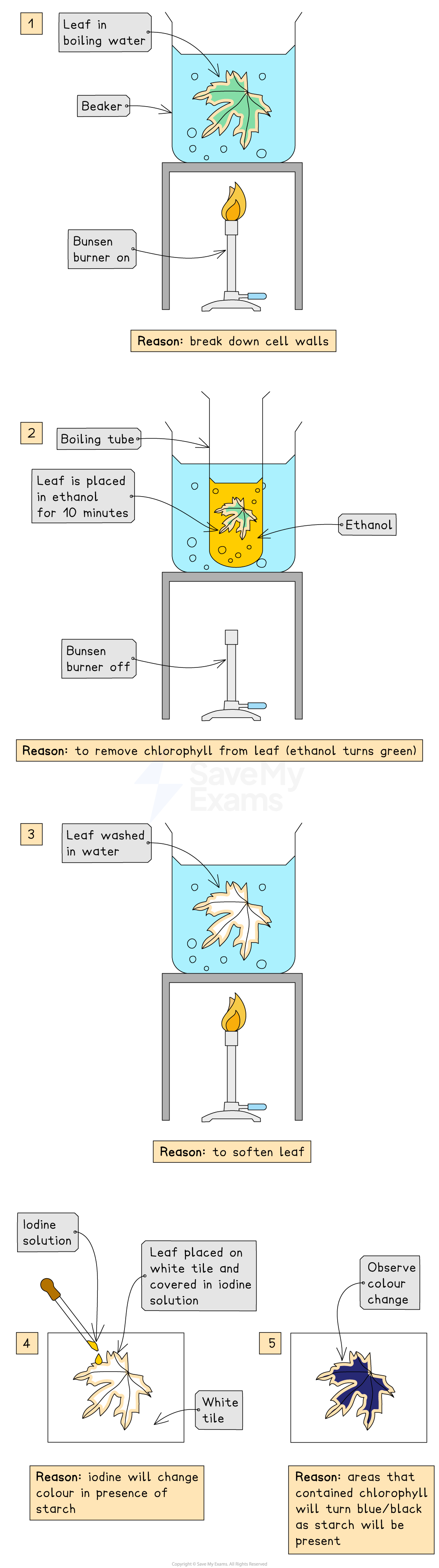
Expected results
Only the green areas of the variegated leaf should turn blue-black, showing that photosynthesis (and starch formation) occurs only where chlorophyll is present
The white areas, which contain no chlorophyll, should stay orange-brown, indicating a lack of photosynthesis in these regions
Limitations
Limitation | Possible solution |
|---|---|
Plant not fully destarched | Keep plant in full darkness for at least 24 hours before experiment |
Leaf may not be fully decolourised in the ethanol, making it more difficult to see any colour change | Keep leaf in hot ethanol until pale |
Uneven application of iodine, resulting in patchy colour change that doesn't match the pattern of variegation | Ensure that the whole leaf is covered evenly by iodine |
Investigating the need for light
Light provides the energy needed for photosynthesis
Testing for starch in leaves that have been kept in the light and in the dark can demonstrate that light is needed for photosynthesis
Equipment
Potted plant with healthy green leaves
Access to a dark room or cupboard
Aluminium foil / black paper
Paper clips / tape
Beaker
Tripod and gauze
Bunsen burner
Forceps
Boiling tube
Ethanol
White tile
Iodine
Method
Destarch the plant by placing it in darkness for 24 hours
This ensures that any starch already present in the leaves will be used up and will not affect the results of the experiment
Remove the plant from the dark location and cover one leaf with aluminium foil, keeping other leaves uncovered
Place the plant in bright light for several hours
Remove the covered leaf from the plant and test it for starch as follows:
boil leaf in a beaker of water
transfer leaf to a boiling tube containing ethanol
heat leaf in the ethanol until the green colour is lost
Ensure that any nearby Bunsen burners have been extinguished
remove the leaf from the ethanol and rinse the ethanol from the leaf
place leaf on a white tile and test with iodine solution
a colour change to blue-black indicates that starch is present
Repeat step 4 for an uncovered leaf
Expected results
Only the leaves exposed to light should turn blue-black, showing that light is needed for photosynthesis
The covered leaves will stay orange-brown, showing the absence of starch, and therefore no photosynthesis
Limitations
Limitation | Possible solution |
|---|---|
Plant not fully destarched | Keep plant in full darkness for at least 24 hours before experiment |
Foil not tightly attached | Press foil flat and attach to leaf using a paperclip or tape |
Investigating the need for carbon dioxide
Carbon dioxide is fixed during photosynthesis
Testing for starch in leaves that have been kept in the presence and absence of carbon dioxide can demonstrate that this it is needed for photosynthesis
Equipment
Two healthy, potted plants
Access to a dark room or cupboard
Two bell jars
Beaker of sodium hydroxide solution (NaOH)
Beaker of water
Petroleum jelly
Beaker
Tripod and gauze
Bunsen burner
Forceps
Boiling tube
Ethanol
White tile
Iodine
Method
Destarch both plants by keeping them in darkness for 24 hours
This ensures that any starch already present in the leaves will be used up and will not affect the results of the experiment
Remove the plants from the dark location and place one plant under a bell jar with a beaker of NaOH solution
NaOH absorbs carbon dioxide from the air under the bell jar
Place the other plant under a bell jar with a beaker of water
The beaker of water acts as a negative control, demonstrating that it is the lack of carbon dioxide that causes the change in photosynthesis and not any other factor
Seal each jar with petroleum jelly to prevent air entry
Leave both plants in bright light for several hours
Test one leaf from each plant for starch as follows:
boil leaf in a beaker of water
transfer leaf to a boiling tube containing ethanol
heat leaf in the ethanol until the green colour is lost
Ensure that any nearby Bunsen burners have been extinguished
remove the leaf from the ethanol and rinse the ethanol from the leaf
place leaf on a white tile and test with iodine solution
a colour change to blue-black indicates that starch is present

Expected results
We would expect the leaf from the plant in the jar with NaOH to remain orange-brown, showing that no starch forms in the absence of CO2
The control plant leaf will turn blue-black, showing that photosynthesis will occur in the presence of CO2
Limitations
Limitation | Possible solution |
|---|---|
Plant not fully destarched | Keep plant in full darkness for at least 24 hours before experiment |
Bell jar not sealed properly | Seal base carefully with petroleum jelly |
Light intensity not equal between the two bell jars | Place both plants side-by-side under same light source |

Unlock more, it's free!
Join the 100,000+ Students that ❤️ Save My Exams
the (exam) results speak for themselves:

Was this revision note helpful?