Factors of Production (SQA National 5 Business Management): Revision Note

Exam code: X810 75

Lisa Eades

Written by: Lisa Eades

Reviewed by: Steve Vorster

Updated on

Capital, enterprise, land and labour

  • Factors of production are the resources used to produce goods and services

    • They include land, labour, capital and enterprise

Farmer on blue tractor, with factory, crops, and thought bubble with lightbulb, labelled as enterprise, labour, capital, and land.
The four factors of production are land, capital, labour and enterprise
  • The production of any good or service requires the use of a combination of all four factors of production

    • Goods are physical objects that can be touched (tangible), e.g., a mobile phone

    • Services are actions or activities that one person performs for another (intangible), e.g., a manicure or car wash

An explanation of the four factors of production

Land

Capital

  • Non-man-made natural resources available for production

  • Some countries have a vast amount of a particular natural resource, so are able to specialise in its production

    • For example, Scotland specialises in the production of whisky which accounts for 77% of its food and drink exports

  • Capital is any man-made resource that is used to produce goods and services

  • Examples include tools, buildings, machines and computers

Labour

Enterprise

  • The human input into the production process, labour involves mental or physical effort

  • Not all labour is of the same quality

    • It can be skilled or unskilled

    • Some workers are more productive than others because of their education, training and experience

  • Enterprise involves taking risks in setting up or running a firm

  • An entrepreneur decides on the combination of the factors of production necessary to produce goods and services with the aim of generating profit

Adding value

  • Adding value is the process of taking raw materials and using them in such a way that the end product created is worth more than the cost to make it

  • It is therefore the difference between the price charged to the customer and the cost of inputs required to create the product or service

    • For example, customers are prepared to pay more for frozen oven chips than they would be willing to pay for a bag of potatoes

  • The greater the added value, the more successful the business is likely to be and the higher their profits

  • Product and marketing teams explore ways to increase added value
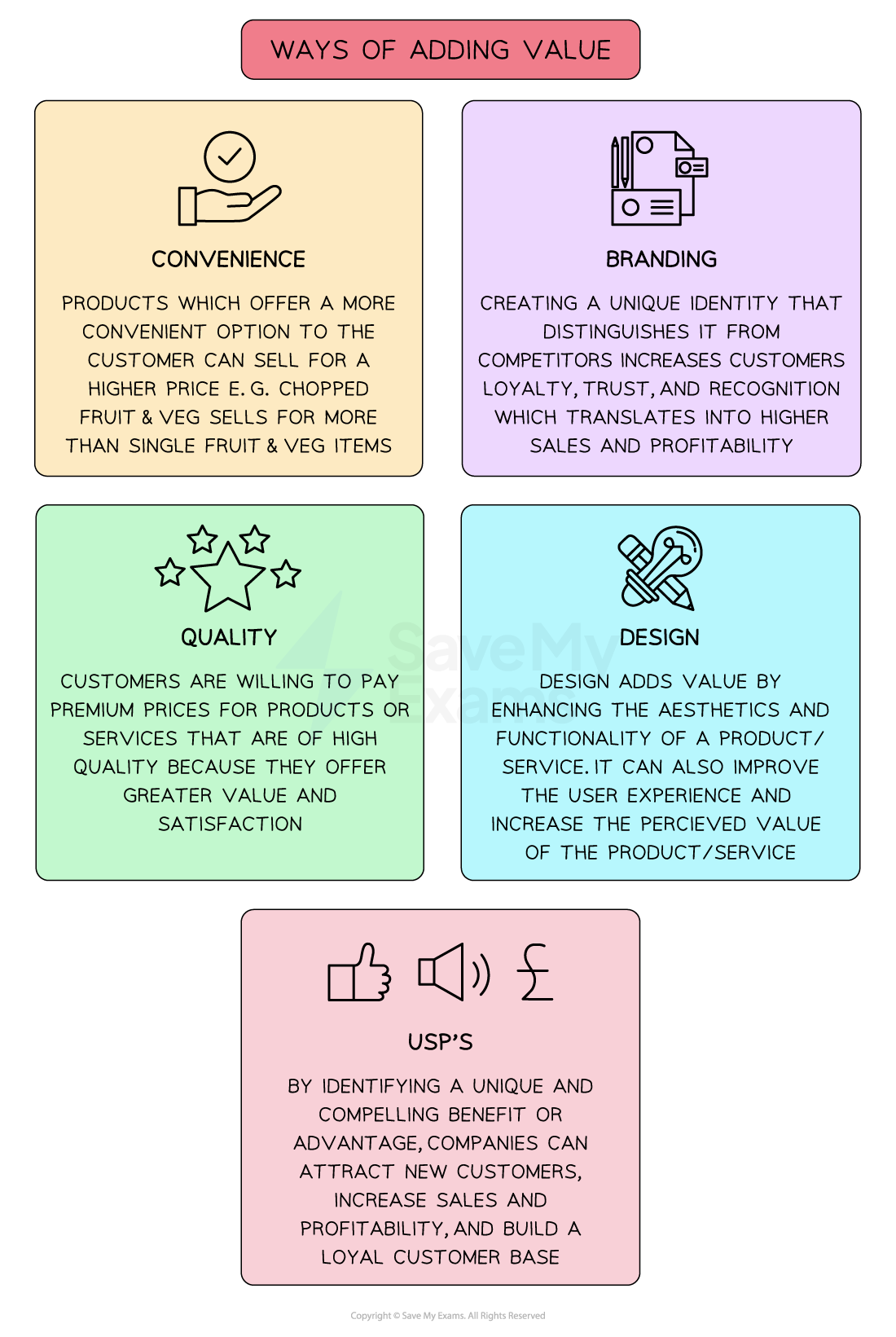
Infographic on ways to add value: convenience, branding, quality, design, and USPs, each with icons and descriptions in coloured boxes.
Some of the methods of adding value allow for product differentiation, which allows the business to charge a higher selling price

Examples of added value

Method

Example

Branding

  • Apple has built a brand that many customers believe is superior to other brands

    • They have achieved this through the use of quality materials, innovative design and good marketing

    • This branding allows the firm to charge a higher price for its products, thus increasing the added value

Convenience

  • Persil initially provided a bottle of dishwashing liquid for dishwashing machine use

    • This resulted in spillage as customers added the liquid to their machines, so Persil then created tablets

    • The tablets offered a much more convenient option and Persil was able to charge a higher selling price for them

Quality

  • Jo Malone perfume products are well known for their beautiful packaging, which creates an exciting opening experience for the customer

    • This allows the firm to charge a higher price for its products, thus increasing the added value

Unique selling points (USPs)

  • MoonPig birthday cards can be completely customised (size, colour, design etc.) and the level of customisation has helped them gain a competitive advantage

    • This customisation allows the firm to charge a higher price for its cards, thus increasing the added value

Design

  • Edinburgh's COCO Chocolatier wraps each chocolate bar in commissioned artwork by independent Scottish artists

    • Alongside product quality, this allows the firm to charge a high price for its confectionery, thus increasing added value

Examiner Tips and Tricks

Don’t confuse adding value with profit – adding value is the difference between the cost of inputs and the selling price, whereas profit is what remains after all business costs have been paid

Unlock more, it's free!

Join the 100,000+ Students that ❤️ Save My Exams

the (exam) results speak for themselves:

Lisa Eades

Author: Lisa Eades

Expertise: Business Content Creator

Lisa has taught A Level, GCSE, BTEC and IBDP Business for over 20 years and is a senior Examiner for Edexcel. Lisa has been a successful Head of Department in Kent and has offered private Business tuition to students across the UK. Lisa loves to create imaginative and accessible resources which engage learners and build their passion for the subject.

Steve Vorster

Reviewer: Steve Vorster

Expertise: Economics & Business Subject Lead

Steve has taught A Level, GCSE, IGCSE Business and Economics - as well as IBDP Economics and Business Management. He is an IBDP Examiner and IGCSE textbook author. His students regularly achieve 90-100% in their final exams. Steve has been the Assistant Head of Sixth Form for a school in Devon, and Head of Economics at the world's largest International school in Singapore. He loves to create resources which speed up student learning and are easily accessible by all.