Specific Heat Capacity (SQA National 5 Physics): Exam Questions

Exam code: X857 75

29 mins7 questions
11 mark

A student carries out an experiment to determine the specific heat capacity of copper using the apparatus shown.
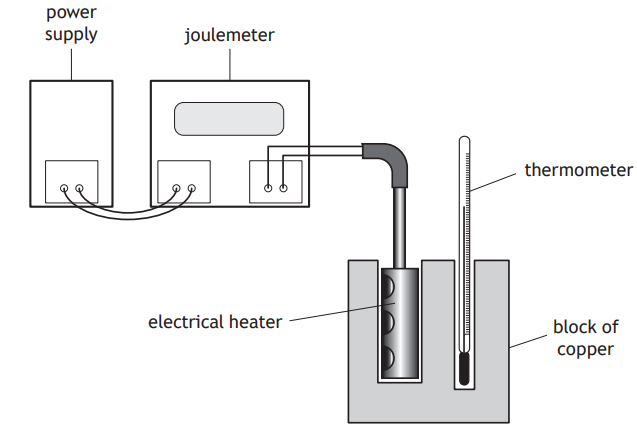
Diagram of a scientific setup showing a power supply, joulemeter, electrical heater, thermometer, and block of copper for thermal experiments.

The student switches on the power supply and the electrical heater heats the block of copper.

The joulemeter measures the energy supplied to the electrical heater.

The student suggests the following measurements should also be made:

I The mass of the block of copper.

II The initial and final readings on the thermometer.

III The power rating of the electrical heater.

Which of these measurements must be made to determine the specific heat capacity of copper?

  • I only

  • II only

  • I and II only

  • II and III only

  • I, II and III

2a
Sme Calculator
4 marks

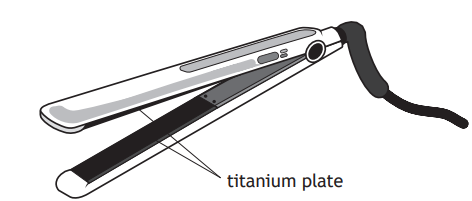
A set of hair straighteners contain a pair of titanium plates that are heated.

Illustration of a hair straightener with open titanium plates and a labelled power cord.

One of the titanium plates has a mass of 1.90 × 10⁻² kg.

The titanium plate is at an initial temperature of 25 °C. The hair straighteners are switched on and the titanium plate reaches a temperature of 235 °C.

The titanium plate has a specific heat capacity of 532 J kg−1 °C−1.

(i) Calculate the minimum energy required to raise the temperature of the titanium plate from 25 °C to 235 °C.

[3]

(ii) Explain why the energy supplied to the titanium plate is greater than the heat energy gained by the plate.

[1]

2b2 marks

The titanium plates are now replaced with ceramic plates.

Suggest two reasons why the time taken to heat the ceramic plates from 25 °C to 235 °C is different to the time taken to heat the titanium plates from 25 °C to 235 °C.

3
Sme Calculator
5 marks

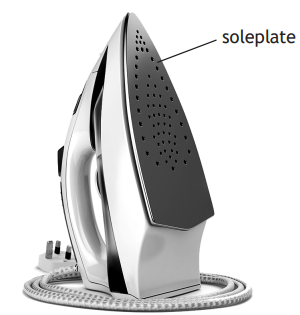
An electric iron operates at 230 V a.c.

The power rating of the iron is 1750 W.

A steam iron with a shiny silver soleplate, labelled "soleplate," resting on its side. Power cord and plug are visible in the background.

When the iron is switched on, it takes 72.0 s for the soleplate to reach the correct temperature.

During this time, 126 000 J of energy is transferred to the soleplate.

(i) The soleplate is made from aluminium.

The mass of the soleplate is 0.650 kg.

The initial temperature of the soleplate is 22 °C.

Determine the maximum temperature reached by the soleplate.

[4]

(ii) Explain why the maximum temperature reached by the soleplate will be less than that calculated in (b) (i).

[1]

4
Sme Calculator
8 marks

The hot water dispenser heats 0·250 kg of water for each cup.

(i) Calculate the minimum energy required to heat 0·250 kg of water from an initial temperature of 20·0 °C to its boiling point.

[3]

(ii) As the water is dispensed into the cup, steam is released.

Determine the maximum mass of steam that can be produced while the water for one cup is being heated.

[4]

(iii) Explain why, in practice, the mass of steam produced is less than calculated in (ii).

[1]

51 mark

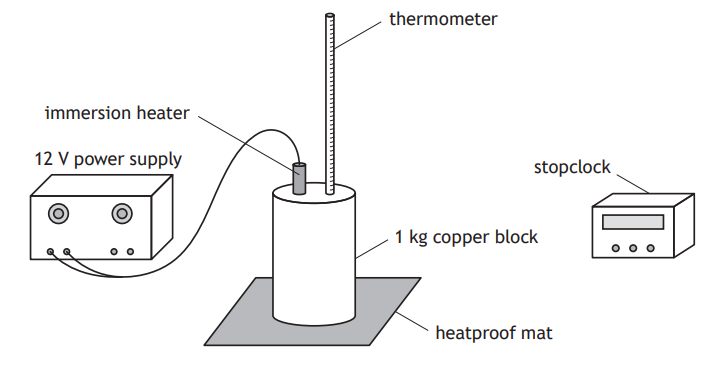
A student carries out an experiment to determine the specific heat capacity of copper.

The setup used by the student is shown.

Experimental setup diagram showing a 1 kg copper block on heatproof mat with immersion heater and thermometer, connected to 12V power supply and a stopclock.

The student heats the copper block for 5 minutes.

The temperature of the block increases by 14 °C.

The value of the specific heat capacity of copper determined by the student using this method is found to be inaccurate.

Which of the following changes would improve the accuracy of this experiment?

  • Heating the copper block for a longer time.

  • Placing insulation around the copper block.

  • Replacing the copper block with one of less mass.

  • Replacing the immersion heater with one of a higher power rating.

  • Removing the heatproof mat.

6
Sme Calculator
4 marks

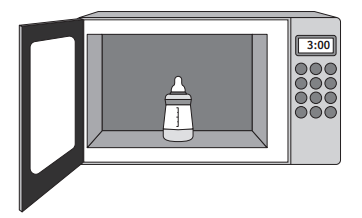
Bottles used for feeding babies require sterilising before use.

For one design of bottle, a microwave oven is used to heat water in the bottle. This produces steam, which sterilises the bottle.

Open microwave with a baby bottle inside, set to 3:00 minutes on the digital display.

To sterilise the bottle, 0.020 kg of water is placed in the base of the bottle, before being heated in the microwave oven.

The initial temperature of the water is 6.3 °C.

(i) Calculate the energy required to heat the water to its boiling point.

[3]

(ii) Determine the minimum energy required to produce 0.014 kg of steam from 0.020 kg of water at an initial temperature of 6.3 °C.

[1]

7
Sme Calculator
4 marks

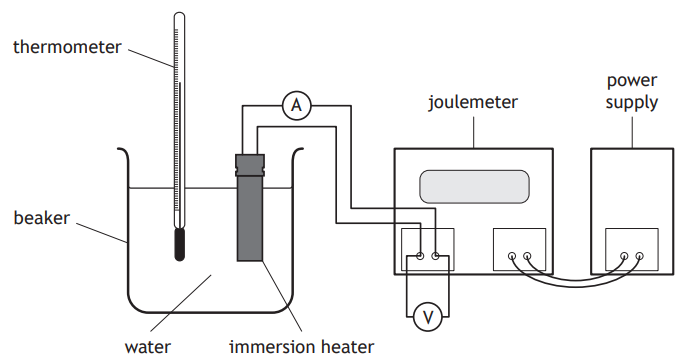
A student carries out an experiment, using the apparatus shown, to determine a value for the specific heat capacity of water.

Diagram showing a beaker with water, thermometer, and immersion heater, connected to a joulemeter, ammeter, voltmeter, and power supply.

The student switches on the power supply and the immersion heater heats the water.

The joulemeter measures the energy supplied to the immersion heater.

The student records the following measurements.

energy supplied to immersion heater = 21 600 J

mass of water = 0·50 kg

initial temperature of the water = 16 °C

final temperature of the water = 24 °C

reading on voltmeter = 12 V

reading on ammeter = 4∙0 A

(i) Determine the value of the specific heat capacity of water obtained from these measurements.

[3]

(ii) Explain why the value determined from the experiment is different from the value quoted in the data sheet.

[1]