Schedule of Non-current Assets (Cambridge (CIE) A Level Accounting): Revision Note
Exam code: 9706

Schedule of non-current assets
What is a schedule of non-current assets?
A schedule of non-current assets is a note to the statement of financial position
It is required under IAS 16
It shows the movement in cost or valuation and accumulated depreciation for each class of non-current asset
It has a column for each class of non-current asset and a column for the total
Classes include: land and buildings, plant and machinery, motor vehicles, etc
How do I prepare a schedule of non-current assets?
Cost section
Start with the balances at the start of the year
Add any additions or acquisitions
These are the non-current assets that the business has gained during the year
Subtract any disposals
Add or subtract any amounts due to revaluations
This gives you the balances at the end of the year
Accumulated depreciation section
Start with the balances at the start of the year
Add the depreciation charge for the year
Check whether assets sold or purchased during the year are charged depreciation
Subtract the accumulated depreciation for disposed assets
Subtract the accumulated depreciation for revalued assets
This gives you the balances at the end of the year
Carrying value section
State the carrying values at the start of the year
State the carrying values at the end of the year
They should equal the closing balances for the cost minus the closing balances for the accumulated depreciation
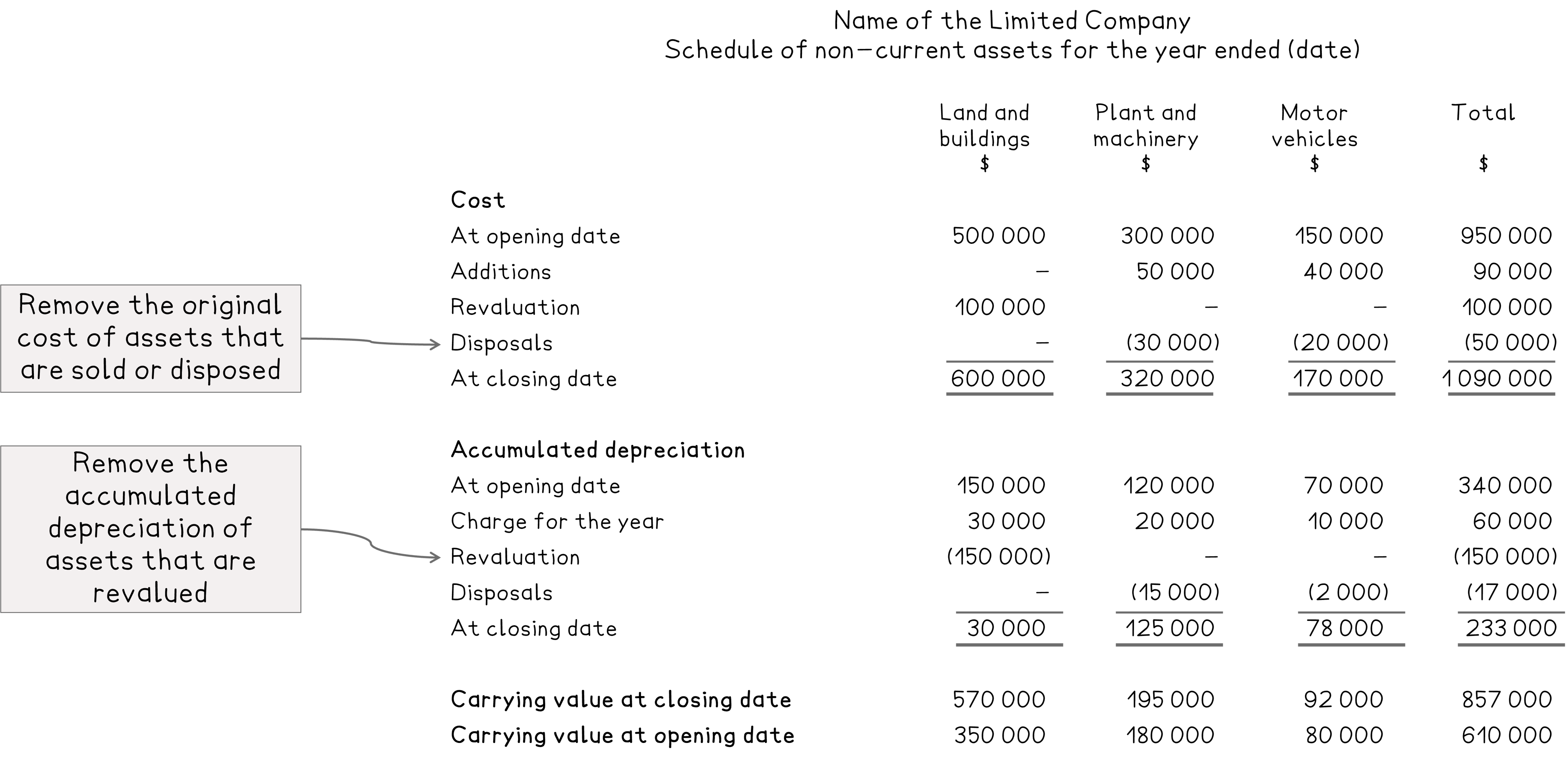
Actions for each transaction
Event | Cost section | Accumulated depreciation section |
|---|---|---|
Addition (purchase) | Add the cost | No entry |
Disposal | Deduct the original cost | Deduct the accumulated depreciation |
Revaluation (upward) | Add the increase in value | Deduct any existing accumulated depreciation |
Revaluation (downward) | Deduct the decrease in value | Deduct any existing accumulated depreciation |
Depreciation charge for the year | No entry | Add the charge for the year |
Examiner Tips and Tricks
When an asset is revalued, the existing accumulated depreciation on that asset is eliminated (deducted) from the accumulated depreciation section. After revaluation, the asset sits at its new fair value with a clean slate of zero accumulated depreciation.
Worked Example
The cost section and accumulated depreciation section of Omega plc’s schedule of non-current assets at 31 December 2024 are as follows:
Land and buildings $ | Plant and machinery $ | Motor vehicles $ | |
|---|---|---|---|
Cost | |||
At 1 January 2024 | 300 000 | 210 000 | 140 000 |
Additions | 100 000 | 40 000 | - |
At 31 December 2024 | 400 000 | 250 000 | 140 000 |
Accumulated depreciation | |||
At 1 January 2024 | 70 000 | 85 000 | 56 000 |
Charge for the year | 10 000 | 33 000 | 28 000 |
At 31 December 2024 | 80 000 | 118 000 | 84 000 |
The following information has been provided for the year ended 31 December 2025:
The 'Land and buildings' balance at 31 December 2024 consists of Land costing $200 000 and Buildings costing $200 000. On 1 January 2025, the directors decided to revalue the land upwards to $290 000.
On 1 April 2025, a new machine was purchased at a cost of $55 000.
During the year, a motor vehicle which had originally cost $30 000 was sold for $11 000. There was a $1 000 loss on disposal.
The company's depreciation policy is as follows:
Land: No depreciation is charged.
Buildings: 5% per annum using the straight-line method.
Plant and machinery: 20% per annum using the reducing balance method.
Motor vehicles: 20% per annum using the straight-line method.
A full year's depreciation is provided in the year of acquisition and none is provided in the year of disposal.
Prepare the schedule of non-current assets for Omega plc for the year ended 31 December 2025, suitable for use as a note to the financial statements.
Answer:
Calculate the carrying values at 31 December 2024
Land and buildings $ | Plant and machinery $ | Motor vehicles $ | |
|---|---|---|---|
Cost | 400 000 | 250 000 | 140 000 |
Accumulated depreciation | 80 000 | 118 000 | 84 000 |
Carry value | 320 000 | 132 000 | 56 000 |
Calculate the increase in the value of the land due to the revaluation
$290 000 - $200 000 = $90 000
Calculate the accumulated depreciation of the sold vehicle
Calculate the net book value by adding the loss to the sale proceeds
$11 000 + $1 000 = $12 000
Subtract this from the original cost
$30 000 - $12 000 = $18 000
Calculate the depreciation charge for the year
Buildings
5% × $200 000 = $10 000
Plant and machinery
Add the purchase price to the carrying value from the start of the year
20% × ($132 000 + $55 000) = $37 400
Motor vehicles
Subtract the cost of the sold vehicle
20% × ($140 000 - $30 000) = $22 000
Omega plc
Schedule of Non-Current Assets for the year ended 31 December 2025
Land and buildings $ | Plant and machinery $ | Motor vehicles $ | Total $ | |
|---|---|---|---|---|
Cost or Valuation | ||||
At 1 January 2025 | 400 000 | 250 000 | 140 000 | 790 000 |
Revaluation | 90 000 | - | - | 90 000 |
Additions | - | 55 000 | - | 55 000 |
Disposals | - | - | (30 000) | (30 000) |
At 31 December 2025 | 490 000 | 305 000 | 110 000 | 905 000 |
Accumulated Depreciation | ||||
At 1 January 2025 | 80 000 | 118 000 | 84 000 | 282 000 |
Charge for the year | 10 000 | 37 400 | 22 000 | 69 400 |
Disposals | - | - | (18 000) | (18 000) |
At 31 December 2025 | 90 000 | 155 400 | 88 000 | 333 400 |
Carrying Amount | ||||
At 31 December 2025 | 400 000 | 149 600 | 22 000 | 571 600 |
At 31 December 2024 | 320 000 | 132 000 | 56 000 | 508 000 |

Unlock more, it's free!
Join the 100,000+ Students that ❤️ Save My Exams
the (exam) results speak for themselves:

Was this revision note helpful?