Types of Costs (Cambridge (CIE) A Level Accounting): Revision Note
Exam code: 9706

Direct & indirect costs
How are material and labour costs accounted for?
Material and labour costs are accounted so they can be included in the cost of production
Accounting for material costs involves:
Recording purchases and usage of inventory
Allocating direct material costs to production costs
Allocating indirect material costs to overheads
Accounting for labour costs involves:
Recording wages
Allocating direct labour costs to production
Allocating indirect labour costs to overheads
What is a direct cost?
Direct costs are those that can be specifically associated with the manufacture of one unit of production
Examples include:
Direct materials
Direct labour
Other direct costs
E.g. royalties
How are direct costs calculated?
Direct material and labour costs are calculated by multiplying the rate per unit by the quantity used
Unit could be kg, litres, metres etc.
Other direct costs are also included in direct costs
E.g. royalties costed $200, so include $200 in direct costs
Worked Example
Product A requires 2 metres of fabric and 6 hours of labour to manufacture.
Each metre of fabric is $4 and the wage rate per hour is $8.
Royalty cost is $3 per unit.
Calculate the direct cost per unit.
Answer:
Direct materials:
2m × $4 per m = $8 per unit
Direct labour
6 hours × $8 per hour = $48 per unit
Other direct costs (royalties): $3 per unit
Direct cost = Direct materials + Direct labour + Other direct costs
8 + 48 + 3 = 59
$59 per unit
What are indirect costs?
Indirect costs are those that cannot economically be specifically associated with the manufacture of one unit of production
Indirect costs are also known as overheads and can be classified as
production overheads
Production overheads are included in production costs
administrative overheads
or sales and distribution overheads
Administrative overheads and sales and distribution overheads are included in total costs but not production costs
Examples include:
Depreciation of machinery
Electricity
Rent of factory
Maintenance costs
Examiner Tips and Tricks
Direct costs are often variable costs, while indirect costs are often fixed costs.
Remembering this can help when classifying costs.
How are indirect costs calculated?
Indirect costs are often divided into a factory portion and an administrative portion using specified allocation percentages
The factory portion is included in production cost
While the administrative portion is not included in production cost
Indirect cost included in production cost = Indirect cost × Allocation percentage
Worked Example
Rent and rates was $125 000 for the year ended 31 December 2024.
Rent and rates are to be allocated 60% to the factory and 40% to the office.
Calculate the amount of rent and rates to be included in production cost.
Answer:
125 000 × 60% = 75 000
Add $75 000 to direct costs and this will be the production cost.
Fixed, variable, semi-variable & stepped costs
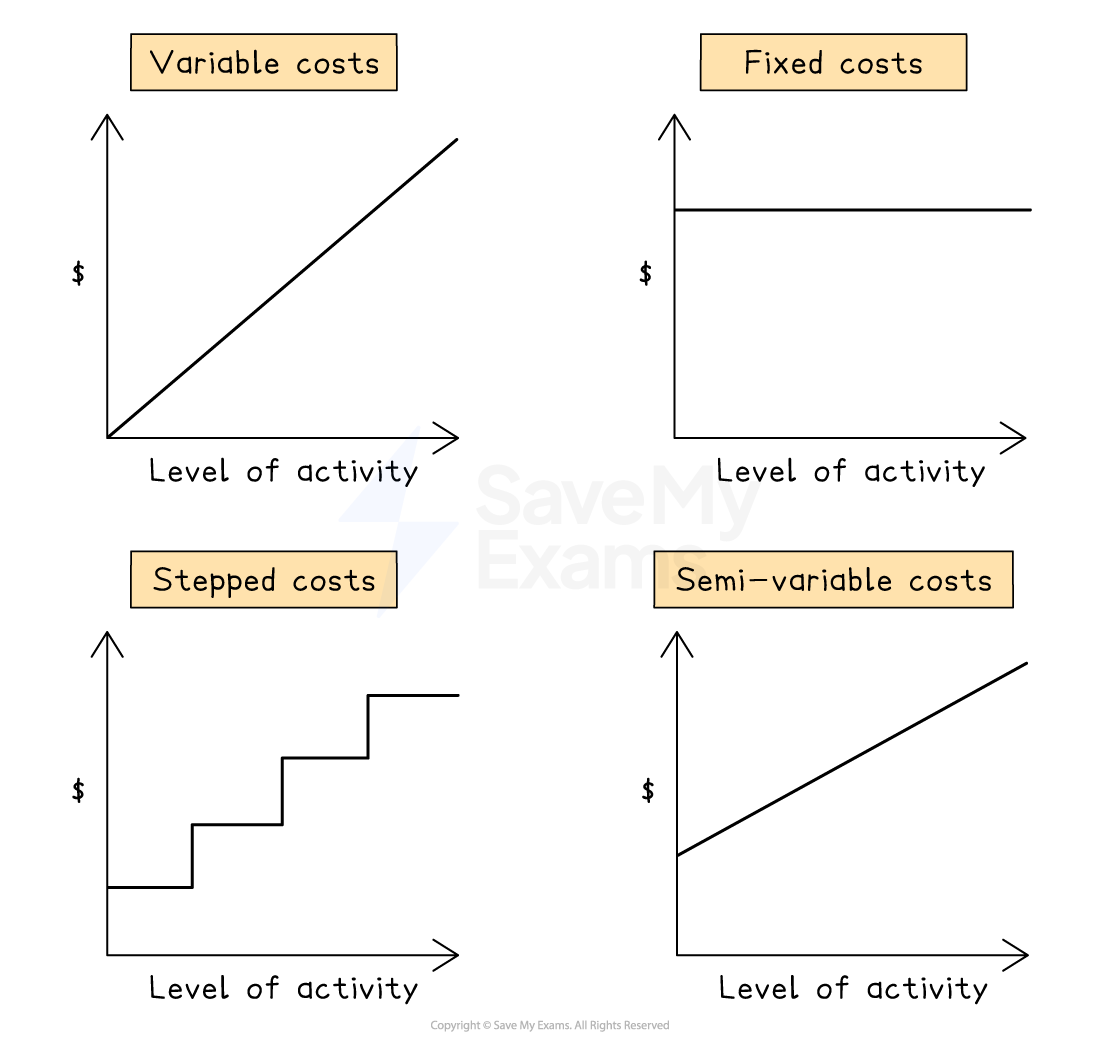
What are fixed costs?
Fixed costs are costs that remain unchanged within a certain level of activity/output
E.g. depreciation of machinery
What are variable costs?
Variable costs are costs that are constant per unit
Total variable cost increases as output increases
E.g. direct material costs
How can fixed costs and variable costs be calculated?
Use the high-low method:
STEP 1
Identify periods with higher and lower activity level
STEP 2
Calculate the variable cost per unit
STEP 3
Calculate the fixed cost
OR
Worked Example
Total cost at 1 000 units = $8 000
Total cost at 600 units = $6 400
Calculate the variable cost per unit and fixed costs.
Answer:
STEP 1
Higher activity level = 1 000 units at $8 000
Lower activity level = 600 units at $6 400
STEP 2
Variable cost per unit is
(8 000 - 6 400) ÷ (1 000 - 600) = $4 per unit
STEP 3
Fixed cost
8 000 - (4 × 1 000) = $4 000
Or fixed cost
6 400 - (4 × 600) = 4 000
Variable cost is $4 per unit
Fixed cost is $4 000
What are semi-variable costs?
Semi-variable costs are costs that are partly fixed and partly affected by production level
For example, electricity is a semi-variable cost
Fixed: Standing charge
Variable: Cost per unit of electricity used
How can semi-variable costs be calculated?
Use the high-low method:
STEP 1
Identify periods with higher and lower activity levelSTEP 2
Find the variable cost per unitSTEP 3
Find the fixed costsOr
STEP 4
Write it as a formula
What are stepped costs?
Stepped costs are fixed for a given level of activity and increases when that level is exceeded
For example, factory rent is a stepped cost
Rent is fixed for one space but increases when an additional space is rented
How can stepped costs be calculated?
From identifying ranges:
STEP 1
Identify the ranges and the relevant costs for these ranges
STEP 2
Add the relevant costs together
Worked Example
Supervisor cost:
1 supervisor is required for every 20 workers.
Each supervisor has a salary of $2 000
What is the supervisor cost for 35 workers?
Answer:
Number of steps required:
3520 = 1.75
Round up to 2 supervisors
2 × $2 000 = $4 000
Total supervisor cost is $4 000

Unlock more, it's free!
Join the 100,000+ Students that ❤️ Save My Exams
the (exam) results speak for themselves:

Was this revision note helpful?
