Budgets (Cambridge (CIE) A Level Accounting): Revision Note
Exam code: 9706

Budgets
What is a budget?
This is a future financial plan that helps businesses make decisions
There are two types of budgets:
Incremental budgeting is based on using previous budgets and adjusting it accordingly
Zero-based budgeting is starting the budgeting without any prior information
Benefits | Limitations | |
|---|---|---|
Incremental budgeting |
|
|
Zero-based budgeting |
|
|
What are the limiting factors when preparing budgets?
Depending on what the limiting factors are, will depend on what order the different budgets are made:
Shortage of material
This will limit production and purchases
Shortage of labour
This will limit production and labour
Limited demand
This will limit sales and production
Limited cash
This will impact the ability to buy materials and pay workers
Will have an impact on cash budget too
Shortage of space
A limited amount of space will limit production
What are the different budgets?
There are 8 budgets and 2 master budgets that help the business to plan and make decisions
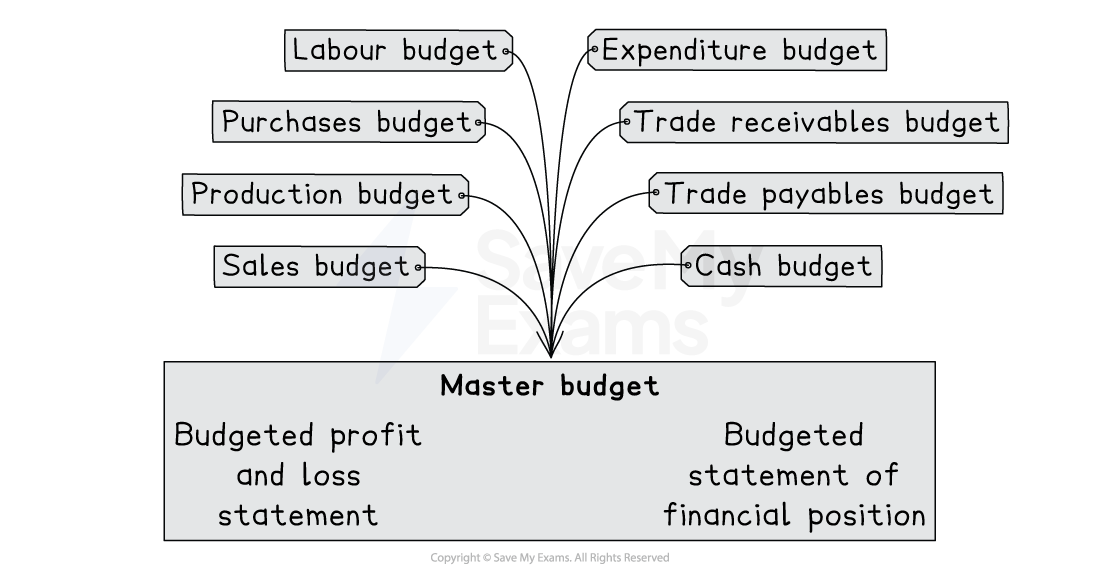
Master budgets
Budgeted statement of profit and loss
Forecasted income and expenditure
Same layout as the historical statement of profit and loss
Budgeted statement of financial position
Forecasted assets, liabilities and capital
Same layout as the historical statement of financial position
Other budgets
Sales
Shows revenue from sales and the volume of sales
Production
Shows the number of units to produce for a particular time period
Purchases
Shows the cost of purchasing inventory or raw materials and the volume needed
Labour
Shows the labour costs and hours expected for a particular time period
Expenditure
Shows other cash expenses that need forecasting which can be incorporated in the cash budget
Trade receivables
Shows the amount of money expected from credit customers and is linked to the sales budget
Trade payables
Shows the amount of money expected to pay credit suppliers and is linked to the purchase budget
Cash
Shows the money coming in and out of the business for a particular period of time
Examiner Tips and Tricks
Use the 'other' budgets to help compile the master budgets.
Advantages & disadvantages of budgetary control
What are the advantages of budgetary control?
Can be a motivating factor for staff, especially if bonuses are paid on meeting targets
Can help identify departments that need improving and help managers with decision making
Allows greater access to external sources of finance such as bank loans
Allows the business to plan for expansion and growth
What are the disadvantages of budgetary control?
Can be time-consuming to put together and take managers away from their daily tasks
External factors are often ignored when budgeting
Managers may create inefficiencies in the budget to give them some 'budgetary slack'
An expert is needed to prepare the budgets, which can be costly
What are the advantages and disadvantages of preparing budgets using spreadsheets?
Advantages | Disadvantages |
|---|---|
Allows budgets to be made quicker | Could lose data with computer-based systems |
Can use graphs and charts to present some of the data | Potential security issues as the computers may get hacked |
Worksheets help organise the files and keep historical data without using physical storage | Training staff to use spreadsheets could be costly |
With formulas, it's easy to flex the budgets and make changes easily | |
Can shape the spreadsheets so it can be tailored to meet the business needs |

Unlock more, it's free!
Join the 100,000+ Students that ❤️ Save My Exams
the (exam) results speak for themselves:

Was this revision note helpful?
