Cash Budgets (Cambridge (CIE) A Level Accounting): Revision Note
Exam code: 9706

Cash budgets
How to prepare a cash budget?
The cash budget shows all the projected money coming in and going out
The cash budget includes all transactions relating to cash, cheque and bank transactions
Here is an example of the cash budget
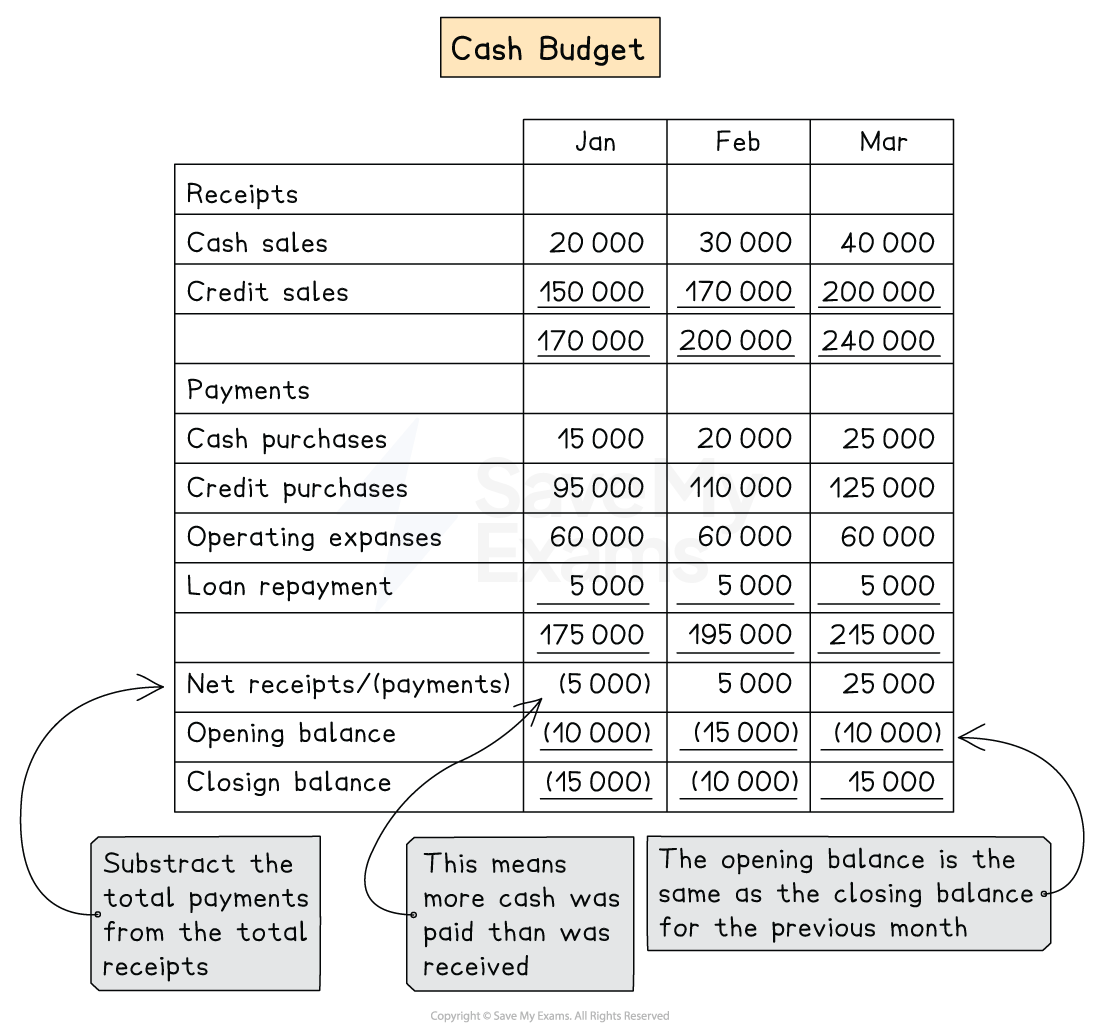
STEP 1
Calculate the receipts for each periodThis may include:
Receipts of cash sales
Receipts from credit sales
Sale of non-current assets
Capital
Loans
STEP 2
Calculate the payments for each periodThis may include:
Payment of cash purchases
Payments for credit purchases
Purchase of non-current assets
Drawings
Loan repayments
Cash expenses only
STEP 3
Calculate the net receipts or payments by using this formulaTotal receipts - total payments
STEP 4
Write down the opening balanceThis is the same as the closing balance for the previous month
Brackets indicate that the bank is overdrawn
STEP 5
Find the closing balanceAdd the net cash flow to the opening balance
Examiner Tips and Tricks
If depreciation is included in the expenses, then you need to subtract it from the total. Depreciation does not affect the cash budget.
Worked Example
Cushions manufacture a range of cushions. Here is the following information relating to a cash budget:
January | February | March | |
|---|---|---|---|
Sales $ | 60 000 | 58 000 | 66 000 |
Purchases $ | 30 000 | 28 000 | 31 000 |
Expenses (including depreciation) | 15 000 | 12 000 | 12 000 |
Additional information
40% of sales are made on cash basis. The remaining 60% of customers will pay one month later. Sales in December are expected to be $40 000.
Payments to suppliers are made one month later. The purchases expected in December is to be $20 000.
Expenses are paid in the month they are incurred.
The opening balance in January is expected to be $3 000 overdrawn.
Depreciation for existing non-current assets for the year is $12 000.
In February a new van was purchased for $17 000. The policy is that vehicles are not depreciated in the year of purchase.
Loan repayments will be $1 500 each month starting in February
Prepare the cash budget for January, February and March
Answer
Calculate the receipts for all three months
Sales:
January
Cash sales = 40% × $60 000 = $24 000
Credit sales = 60% × $40 000 = $24 000
February
Cash sales = 40% × $58 000 = $23 200
Credit sales = 60% × $60 000 = $36 000
March
Cash sales = 40% × $66 000 = $26 400
Credit sales = 60% × $58 000 = $34 800
Calculate the payments for all three months
Purchases
January = $20 000
February = $30 000
March = $28 000Expenses
Depreciation for the month = $12 000 ÷ 12 = $1 000 per month
January = $15 000 - $1 000 = $14 000
February = $12 000 - $1 000 = $11 000
March = $12 000 - $1 000 = $11 000
The answer will be presented as the following cash budget:
January $ | February $ | March $ | |
|---|---|---|---|
Receipts | |||
Cash sales | 24 000 | 23 200 | 26 400 |
Credit customer - one month | 24 000 | 36 000 | 34 800 |
Total receipts | 48 000 | 59 200 | 61 200 |
Payments | |||
Credit suppliers - one month | 20 000 | 30 000 | 28 000 |
Expenses | 14 000 | 11 000 | 11 000 |
Van | 17 000 | ||
Loan repayment |
| 1 500 | 1 500 |
Total Payments | 34 000 | 59 500 | 40 500 |
Net receipts or payments | 14 000 | (300) | 20 700 |
Opening balance | (3 000) | 11 000 | 10 700 |
Closing balance | 11 000 | 10 700 | 31 400 |

Unlock more, it's free!
Join the 100,000+ Students that ❤️ Save My Exams
the (exam) results speak for themselves:

Was this revision note helpful?
